
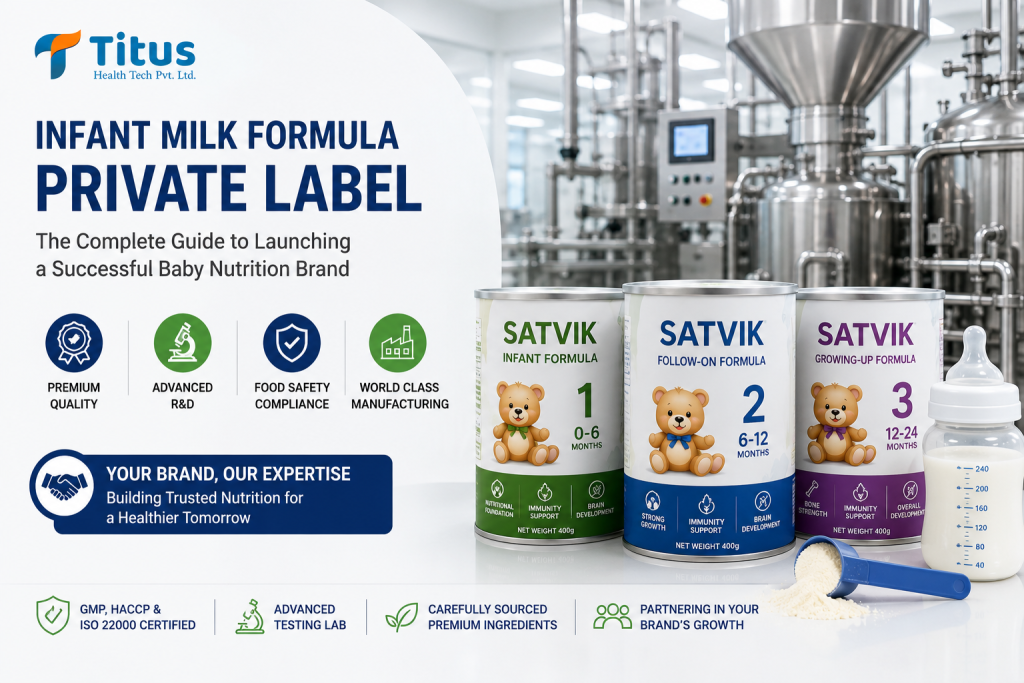
Launching a baby nutrition brand no longer requires a factory. An infant milk formula private label arrangement requires a formulation you trust, a plant that proves its quality systems, and paperwork that survives inspection.
That is the appeal of infant milk formula private label. You handle brand, distribution and pricing; a certified manufacturer handles production, testing and documentation.
The model works, but only when the partner is chosen carefully. Many entrants search for the largest private label infant formula manufacturer in India and assume scale settles the question. It rarely does.
This guide covers how infant milk formula private label works, what to evaluate, the mistakes that delay launches, and where the category is heading. For an overview of the service, this private label manufacturing page is a useful starting point.
Under an infant milk formula private label arrangement, a certified manufacturer produces formula to an established specification and packs it under your brand, artwork and licence.
You own the brand and the market relationship. In every infant milk formula private label agreement, the manufacturer owns the process, the testing and the technical file behind it.
Three models are commonly confused with infant milk formula private label, so it helps to separate them:
This is why searches for the largest private label infant formula manufacturer in India have risen with the model itself. Demand for infant milk formula private label has grown because the alternative is prohibitive. A compliant plant needs spray drying capacity, a laboratory, cleanroom discipline and a regulatory team, which is a decade of investment for most entrants.
In infant milk formula private label, the formulation already has stability data, an approved specification and a proven production route, removing the longest item from your critical path.
Brands using infant milk formula private label typically reach market in months, not years, provided artwork and licensing run in parallel.
With infant milk formula private label, capital moves from plant and equipment into stock and marketing, where a new brand competes. There is no depreciation on machinery you never bought.
That said, baby milk formula private label still ties up working capital in batch quantities, so plan inventory carefully.
Customisation is broader than a label. Depending on volumes, a baby milk formula private label programme can cover pack format, pack size, variants within regulatory limits and stage-specific products.
Growth is where partnerships break. A plant comfortable with small runs may struggle when demand triples, which is why buyers look to the largest private label infant formula manufacturer in India when planning beyond year one.
Before signing a baby milk formula private label contract, ask about capacity headroom and how raw material contracts hold when dairy prices move.
Work through these eight areas with every shortlisted plant. Scale matters, but the largest private label infant formula manufacturer in India still has to satisfy each one.
Reviewing the quality policy and walking through its manufacturing infrastructure will answer most of these faster than a call.
In infant milk formula private label, experience shows up mainly in the problems that never reach you.
A mature infant milk formula private label partner also protects you commercially. Clear specifications, rejection criteria and liability terms prevent the disputes that damage young brands.
Titus Health Tech Pvt. Ltd. manufactures nutrition powders in Gujarat, serving brands in India and export markets. It describes itself as one of India’s largest private label manufacturers of infant formula, and reports partnerships with more than 40 private label firms and 10 international partners.
Its facility holds GMP, ISO 22000:2018 and HACCP certification alongside FSSAI and BIS requirements, covering the checklist applied to any infant milk formula private label partner.
Its private label service covers concept, formulation, production, packaging and labelling, with flexible order quantities. The Triomil line indicates the range available to an infant milk formula private label client:
Review the infant formula product range or add a category through the baby cereal range without appointing another supplier. The company also publishes an explainer on how private label works in practice.
These errors delay more infant milk formula private label launches than any technical problem.
Assuming the largest private label infant formula manufacturer in India will manage compliance for you is the costliest error. Regulatory responsibility for a branded product sits with the brand owner.
Several shifts are reshaping what buyers expect from an infant milk formula private label partner.
Plants investing in laboratories and documentation will meet these comfortably. That investment, not tonnage, separates a strong infant milk formula private label partner from a weak one, and distinguishes the largest private label infant formula manufacturer in India from a mid-sized competitor.
If you are evaluating an infant milk formula private label or baby milk formula private label programme, begin with a technical discussion rather than a price list. Share your target market, formulation stages, pack format and volumes, then ask what documentation the plant can supply.
You can contact the Titus Health Tech team to discuss private label and OEM manufacturing, product development, packaging and long-term supply.
Infant milk formula private label has opened the baby nutrition category to brands that could never build a plant. It has not made it easy, because the regulatory and quality obligations are unchanged.
Choose on evidence: certificates verified, laboratories seen, references called and a contract stating who is responsible for what. Whether your partner is the largest private label infant formula manufacturer in India or a focused mid-sized plant matters far less than whether it proves those four things.
Do that before your first order, and a baby milk formula private label launch becomes a manageable project rather than a run of expensive surprises.
In infant milk formula private label, a certified manufacturer produces formula to an established specification and packs it under your brand, while you handle marketing and distribution.
Private label uses the manufacturer’s proven formulation. Contract manufacturing develops your own specification, which costs more and adds months of trials and stability work.
Minimums depend on pack size and formulation. Batches must stay large enough for blending, testing and packing to remain consistent and viable.
Plan several months. In infant milk formula private label, formulation selection, samples, artwork, regulatory review, licensing and first production each take time and cannot fully overlap.
Usually yes. Brand owners generally require their own registration as a marketer, separate from the manufacturer’s licence. Confirm this before printing any labels.
Yes, though each destination has its own registration route. The manufacturer supplies the dossier, while import approval remains the brand owner’s responsibility.
No. The largest private label infant formula manufacturer in India still needs the right certificate scope, laboratory capability and documented batch release for your specific product.
Tins, laminated pouches and sachets suit baby milk formula private label programmes, with barrier films and nitrogen flushing selected to protect fat and vitamin stability.
WhatsApp us