
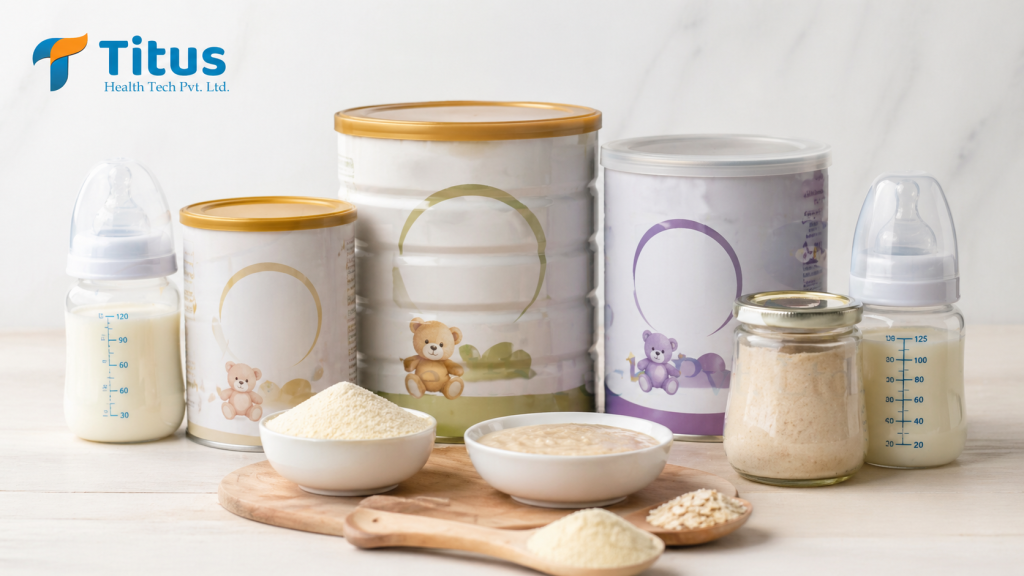
Private label has become one of the most practical ways for nutrition brands to enter a sensitive and highly regulated category without building a factory from scratch. When a brand works with an Infant nutrition products manufacturer, it gains access to technical formulation support, production systems, packaging flexibility, and a route to market that is faster than setting up an in-house operation. The model is especially relevant for companies that want to launch infant formulas, baby cereals, or related nutrition products with tighter control over branding and quality.
The idea is simple, but the execution is not. In this space, every step must support safety, consistency, and trust. For any brand comparing partners, an Infant nutrition products manufacturer should make the process clear, repeatable, and commercially workable. That is why the right manufacturing partner matters so much, particularly when the goal is to build a scalable product line under a private label arrangement. Titus Health Tech positions itself as a nutrition manufacturer in India with infant formula, baby cereal, and private label capabilities, which makes it a useful reference point for understanding how the model works in practice.
Private label manufacturing means a company sells products under its own brand name while the production happens at a specialist facility. The brand owns the market identity, the packaging, the messaging, and the customer relationship. The manufacturer handles formulation, processing, quality control, filling, and often the compliance-led production workflow.
In infant nutrition, that division of responsibility is especially valuable. Why? Because the category demands more than basic contract production. It requires careful ingredient selection, process discipline, batch consistency, and packaging that protects product integrity through storage and distribution. A capable Infant nutrition products manufacturer also helps the brand avoid technical drift as the product moves from concept to production. A good partner does more than make powder. It helps the brand maintain confidence from the first development discussion to the final pack leaving the plant.
A private label launch also reduces operational burden. Instead of investing years in plant development, equipment sourcing, and technical hiring, a brand can focus on positioning and sales while the manufacturing side is handled by a specialist. For a new entrant, this often shortens the launch cycle significantly and lowers early-stage risk.
Brands usually choose an Infant nutrition products manufacturer for three practical reasons: expertise, speed, and scale. Infant nutrition is a category where even small production errors can affect product quality, shelf stability, and customer trust. Working with an experienced partner gives the brand a stronger foundation than trying to build everything internally.
It also improves speed to market. A manufacturer that already understands infant formulas, baby cereals, and related nutrition formats can move from concept to commercialization with fewer delays. For brands in India and export-focused businesses alike, that speed can make the difference between leading a category and chasing it.
Another reason is consistency. Parents expect every pack to feel identical in taste, texture, and performance. That expectation is not cosmetic; it is the basis of trust. A strong Infant nutrition products manufacturer helps keep specification drift under control and makes repeat orders easier to manage at scale.
Does private label reduce complexity?
Yes. It shifts technical production work to a specialist while the brand stays focused on growth.
A private label project usually follows a structured path. The details may differ from one facility to another, but the overall flow is fairly consistent.
For many businesses, this is where an Infant milk formula private label project becomes truly valuable. The brand is not just buying a finished product; it is building a repeatable supply chain around a controlled specification. At each stage, an Infant nutrition products manufacturer must keep the brief, the formula, and the pack aligned.
India has become attractive for infant nutrition sourcing because brands want production capability, technical support, and cost discipline in one place. An Infant formula manufacturer in India can often support domestic and international brands that need packaging flexibility, ingredient guidance, and a more efficient path to launch.
That value is not only about manufacturing cost. It is also about coordination. When formulation, production, and packaging sit under one roof, communication becomes more efficient and fewer handoffs are needed. That often improves timeline control and reduces the risk of misalignment between what the brand wants and what the final product delivers.
Problem → Solution: Many brands struggle because they try to manage product development, manufacturing, and packaging through separate vendors. The solution is a single specialist partner that can align all three stages with one technical standard.
Titus Health Tech presents itself as a private label and nutrition manufacturing partner in India, with services spanning infant formula, infant cereal, and related nutrition categories. That kind of broad capability is useful because brands often begin with one product and later expand into adjacent lines using the same operational partner.
| Factor | In-House Setup | Private Label Model |
| Setup time | Longer | Faster |
| Initial investment | Higher | Lower |
| Technical burden | Fully internal | Shared with manufacturer |
| Scalability | Slower in the early stage | Easier if capacity already exists |
| Brand focus | Split between operations and sales | Concentrated on marketing and growth |
This comparison shows why the Infant milk formula private label model appeals to both startups and established nutrition brands. Instead of spending heavily on infrastructure, brands can direct energy toward product strategy, channel growth, and customer trust. For businesses entering the category for the first time, that can be a safer and more flexible route. That is why an Infant nutrition products manufacturer with integrated development and packing support often creates fewer bottlenecks.
A reliable manufacturing partner should offer more than production capacity. It should help the brand make practical decisions at every stage. That includes format selection, pack design guidance, batch planning, and the discipline required for repeat supply.
The best partnerships are built on clarity. A brand should know what is included, what is optional, and what needs to be approved before production begins. In that sense, the right Infant nutrition products manufacturer is not just a vendor. It becomes part of the brand’s operating model.
What makes a partner dependable?
A dependable partner keeps quality, timelines, and product specifications aligned without forcing the brand to manage every technical detail alone.
This model is especially useful for brands that want to test the market before committing to a large internal investment. It also works well for distributors who want to launch a house brand, healthcare businesses that need a controlled nutrition line, and founders who already have market access but need a production backbone.
The Infant formula manufacturer in India model is also practical for businesses that want regional or export expansion. If a company already has demand in one market, private label production can support a phased rollout instead of a risky, all-at-once launch. That is one reason the model is attractive for infant formulas, baby cereals, and related nutrition formats.
Titus Health Tech’s public positioning reflects this broader category logic. On its website, the company describes private label support, infant formula capability, and baby cereal manufacturing, which suggests a setup designed for brands that may want to build across adjacent nutrition segments later.
Before signing a contract, brands should evaluate the partner on process, not promises. A polished pitch is not enough in a category where trust is built through execution.
An Infant milk formula private label project should feel structured from the beginning. If a manufacturer cannot explain the workflow clearly, that is a warning sign. Strong partners make the process easier to understand, not harder.
How should a brand start?
Start with a clear product brief, then confirm whether the manufacturer can support the required format, packaging, and commercial volume.
Infant nutrition is not a category where marketing can compensate for weak execution. The product must perform consistently because parents and caregivers make decisions based on safety, convenience, and perceived reliability. That is why brand trust is built through quality discipline, not just design.
A disciplined manufacturer helps reduce avoidable variation. It also supports a more credible product story when the brand goes to market. Customers may not know the details of sourcing or production, but they do notice when a product feels dependable.
This is where the role of an Infant nutrition products manufacturer becomes strategic. The right partner does not simply fill packs. It helps the brand protect its reputation through every batch, every label, and every shipment.
Private label works best when the brand and the manufacturer operate as a single growth system. The brand brings market insight, positioning, and demand generation. The manufacturer provides the technical framework, production discipline, and packaging execution needed to deliver a dependable product. In that setup, an Infant nutrition products manufacturer is not just a production partner; it is a practical enabler of speed, consistency, and scale. A capable Infant formula manufacturer in India can also help the brand stay closer to local market realities.
For companies exploring infant formula or adjacent nutrition formats, Titus Health Tech’s positioning shows how a specialist partner can support private label development in India with a broader nutrition manufacturing base. Whether the priority is launch speed, packaging flexibility, or a more structured supply model, the right Infant nutrition products manufacturer can make the process simpler and more commercially sound. For many brands, Infant milk formula private label is the most practical way to launch without overbuilding operations. Learn more through Titus Health Tech’s official website and service pages to evaluate how the fit works for your brand.
A private label project usually includes product development support, manufacturing, packaging, and brand-specific label execution. The exact scope depends on the partner and the final commercial plan. This is where a capable Infant nutrition products manufacturer can save time and reduce confusion during launch.
Brands often choose this route because it combines technical production capability with a more efficient launch model. It can be especially useful for new brands and companies planning phased expansion. In many cases, an Infant formula manufacturer in India gives a better balance of cost, control, and speed.
Yes, because it allows a brand to enter the market without building a factory. That reduces early capital pressure and keeps the team focused on sales, distribution, and brand building. For many founders, private label is the cleanest route to an early launch.
The brand should review product capability, communication quality, production workflow, and packaging support. An Infant nutrition products manufacturer should make this evaluation easier, not harder. A clear process matters as much as the final product.
It helps by turning a concept into a repeatable product line. Once the production system is stable, the brand can focus on retail, online, or distributor growth with less operational stress. In that sense, the manufacturer becomes part of the brand’s growth engine.
Yes, based on its website, the company presents infant formula, baby cereals, private label nutrition, and broader nutrition manufacturing support. That makes it relevant for brands that may expand later.
The biggest advantage is speed with control. A brand can launch faster while still working within a structured manufacturing process that supports quality and consistency.
WhatsApp us