
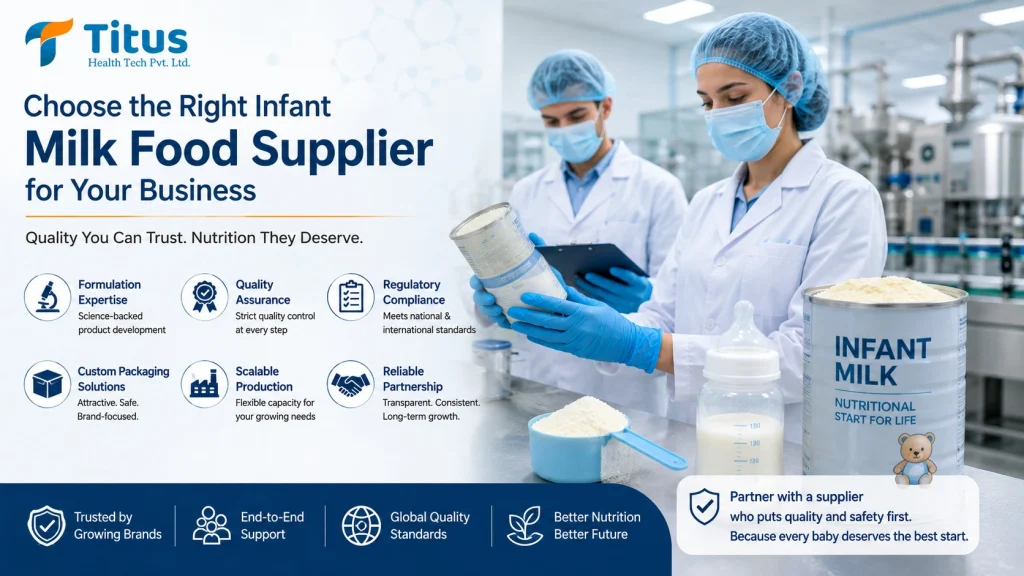
Choosing a dependable Infant milk food supplier is an important strategic decision for businesses developing, launching, or expanding products in the infant nutrition category. Infant milk products require controlled formulation, carefully selected ingredients, disciplined manufacturing, suitable packaging, batch traceability, quality assurance, and regulatory compliance. A reliable manufacturing partner should therefore provide more than production capacity. Businesses should evaluate technical expertise, product-development support, quality systems, packaging capabilities, regulatory understanding, private-label services, scalability, and supply reliability before establishing a long-term manufacturing relationship.
Why Supplier Selection Matters
Infant nutrition products are intended for a sensitive consumer group, making manufacturing consistency and process control particularly important. An Infant milk food supplier should understand that product quality begins with raw-material selection and continues through formulation, processing, testing, packaging, storage, and distribution.
Supplier selection can also influence product-development timelines, batch consistency, documentation, packaging execution, commercial scalability, and the ability to respond to changing business requirements. Selecting a manufacturing partner only because of a lower price can create challenges later if technical support, quality documentation, regulatory coordination, or production flexibility is limited.
A dependable Infant milk food supplier should have structured systems covering:
Evaluate Formulation and Product Development Expertise
Formulation Is a Technical Process
Infant formula development involves considerably more than combining powdered ingredients. Formulation must correspond with the intended product category, nutritional specification, ingredient functionality, processing method, stability requirements, packaging format, and applicable regulatory provisions.
An experienced Infant milk food supplier should be able to explain how an agreed product specification can be translated into a controlled and repeatable manufacturing process. During an initial technical discussion, businesses should provide information about the intended product, target market, formulation requirements, preferred pack size, packaging format, expected volume, and applicable regulatory market.
A capable Infant nutrition products supplier may also contribute to formulation discussions, sample development, product evaluation, and scale-up. The exact scope of technical support differs between manufacturers, so responsibilities should be confirmed before development begins.
Assess Research and Development Support
A structured product-development process can help a brand move from concept to commercial manufacturing with fewer unnecessary revisions. Depending on the project, the manufacturer may review an existing formulation, develop a product according to agreed specifications, produce samples, support technical evaluation, and coordinate the transition to commercial production.
Businesses should clarify whether formulation development, sample preparation, testing, packaging coordination, and documentation are included in the manufacturing arrangement or treated as separate services.
Review Quality Control and Batch Traceability
Quality Should Be Controlled Throughout Production
Finished-product testing is important, but it should form part of a broader quality-management system. An Infant milk food supplier should maintain appropriate controls across receiving, dispensing, formulation, processing, filling, packaging, storage, and product release.
Businesses should ask how incoming materials are approved, how production batches are identified, what in-process checks are performed, how deviations are documented, and how finished-product release is managed.
Important quality areas include:
Batch traceability connects incoming materials with production records, quality checks, packaging information, and finished products. This documentation supports quality management and provides a structured record when a manufacturing deviation requires investigation.
Titus Health Tech states that its infant formula manufacturing includes batch-level quality control and traceability as part of its manufacturing processes.
Consider Regulatory Compliance From the Beginning
Infant nutrition is a regulated food category, so compliance should be considered during formulation and product development rather than addressed only before launch. An Infant milk food supplier should understand the requirements applicable to the proposed product, market, composition, labelling, packaging, and claims.
In India, the Food Safety and Standards Authority of India maintains specific regulations for foods for infant nutrition, including the Food Safety and Standards (Foods for Infant Nutrition) Regulations, 2020. Businesses should review the current requirements relevant to their particular product and obtain appropriate professional regulatory guidance where necessary.
For the authoritative regulatory reference, businesses can review the FSSAI Foods for Infant Nutrition Regulations.
Regulatory requirements can influence:
A responsible Infant milk food supplier should communicate regulatory limitations clearly and avoid unsupported nutritional, medical, or health claims.
Assess Private-Label and Contract Manufacturing Capabilities
Private-label manufacturing can allow businesses to develop infant nutrition products without establishing their own manufacturing infrastructure. However, the value of an Infant milk food supplier depends on the depth of technical and operational support available beyond filling and packaging.
Titus Health Tech describes private-label and contract manufacturing services for B2B partners, including custom formulation, product development, packaging, labelling, and commercial production. Its infant formula operations are presented under the Dugdha and Triomil divisions.
Before selecting a partner, businesses should clarify whether the manufacturer supports:
Minimum order quantities, lead times, formulation ownership, packaging specifications, documentation, and commercial terms should be confirmed during the business enquiry.
Compare Suppliers Using Practical Criteria
Price should not be the only factor when comparing manufacturing partners. A structured evaluation can help businesses determine whether a supplier is capable of supporting the complete product lifecycle.
| Evaluation Area | Basic Supplier | Dependable Manufacturing Partner |
| Formulation | Limited support | Technical and formulation coordination |
| Manufacturing | Production-focused | Controlled production processes |
| Quality | Mainly finished-product testing | In-process and finished-product controls |
| Traceability | Basic batch identification | Documented batch-level traceability |
| Packaging | Standard packing | Private-label and packaging coordination |
| Regulatory support | Limited | Product-specific documentation support |
| Scalability | May be unclear | Defined route from samples to commercial volumes |
| Communication | Transaction-focused | Technical and commercial coordination |
This comparison allows businesses to evaluate an Infant milk food supplier according to technical and operational capability rather than price alone.
Evaluate Packaging and Supply Reliability
A dependable Infant milk food supplier should be able to discuss packaging formats, artwork coordination, batch coding, shelf-life documentation, storage requirements, and dispatch procedures.
Supply reliability should also be assessed before finalizing the manufacturing relationship. Businesses should understand production lead times, minimum order quantities, raw-material availability, production scheduling, and procedures for handling changes in demand.
Titus Health Tech states that its infant formula manufacturing supports formats including tins, pouches, sachets, and bulk B2B supply, with low-MOQ availability and timelines confirmed during enquiry.
Follow a Structured Product Development Workflow
A clearly defined workflow can reduce unnecessary revisions and improve communication between the brand and manufacturer. A typical project with an Infant milk food supplier may include:
Titus Health Tech describes a comparable contract-manufacturing workflow involving enquiry, formulation and sampling, approval and documentation, manufacturing and quality control, followed by packaging and dispatch.
This structured approach also clarifies responsibilities. The brand may manage positioning, artwork approvals, distribution, and commercial strategy, while the manufacturer manages formulation, production controls, quality processes, and manufacturing documentation.
How Titus Health Tech Supports B2B Nutrition Brands
Titus Health Tech presents itself as a nutrition products manufacturer serving B2B customers across nutrition categories. Its website identifies infant milk formula under the Dugdha division and baby cereals under Satva, while also describing private-label, contract manufacturing, custom formulation, and bulk supply solutions.
For businesses evaluating Infant milk food manufacturers, Titus Health Tech’s published information provides details about manufacturing methods, formulation support, packaging capabilities, quality processes, and facility organization.
Its current contract-manufacturing information states that infant formula production operates under FSSAI licensing with ISO 22000:2018, HACCP, and GMP-compliant processes, alongside batch-level quality control. Businesses should verify current product-specific documentation and manufacturing scope directly with Titus before placing an order.
Titus Health Tech also describes private-label manufacturing and B2B supply as part of its nutrition manufacturing services. These capabilities may be relevant for businesses that require a partner for product development and commercial production rather than manufacturing alone.
What Makes a Supplier Dependable?
Dependability involves more than delivering an order on time. A strong Infant milk food supplier should combine technical competence, disciplined manufacturing, quality management, regulatory awareness, transparent communication, and appropriate commercial support.
An Infant nutrition products supplier should also recognize that infant nutrition requires responsible product communication. Businesses should ensure that product descriptions, packaging, and promotional materials do not make unsupported health or medical claims.
When comparing Infant milk food manufacturers, businesses should consider verified manufacturing capability, product fit, quality systems, documentation, packaging support, scalability, and long-term commercial suitability.
Finding the right infant milk food supplier is an important step in developing a reliable and market-ready nutrition product. Titus Health Tech provides infant formula manufacturing and private-label solutions, supporting businesses with formulation, production, packaging, and quality-focused manufacturing processes.
Looking for a dependable infant milk food supplier for your business? Connect with Titus Health Tech to discuss your product requirements and explore a suitable manufacturing solution for your brand.
Explore Infant Formula Manufacturing Solutions
Frequently Asked Questions
1. What should I look for in an Infant milk food supplier?
Look for relevant infant nutrition manufacturing experience, formulation support, controlled production, quality systems, batch traceability, regulatory understanding, packaging capabilities, and transparent commercial terms.
2. Can an Infant milk food supplier provide private-label manufacturing?
Yes. Some manufacturers provide private-label services covering formulation, sampling, production, packaging, and labelling support. The exact scope should be confirmed for the proposed product and target market.
3. Why is regulatory compliance important for infant milk products?
Infant nutrition products are subject to specific food-safety, composition, labelling, and marketing requirements. Compliance should therefore be considered throughout product development rather than only before launch.
4. What manufacturing methods are used for infant formula?
Depending on the formulation and specification, manufacturers may use processes such as spray drying or dry blending. The appropriate process should be determined according to the technical requirements of the product.
5. What is batch traceability?
Batch traceability connects raw materials, manufacturing records, quality checks, packaging information, and finished products. It supports quality management and helps investigate potential manufacturing deviations.
6. How should businesses compare Infant milk food manufacturers?
Businesses should compare formulation capabilities, manufacturing technology, quality systems, regulatory documentation, packaging options, scalability, minimum order requirements, lead times, and communication practices.
7. Can an Infant milk food supplier support bulk B2B requirements?
Some manufacturers provide bulk supply alongside private-label manufacturing. Titus Health Tech states that it offers bulk B2B supply, with specific quantities and timelines confirmed according to project requirements.
Conclusion
Selecting an Infant milk food supplier is a technical and strategic business decision rather than a simple purchasing exercise. The right partner should demonstrate formulation expertise, controlled manufacturing, quality assurance, traceability, packaging capabilities, regulatory awareness, and dependable communication.
Businesses developing or expanding an infant nutrition portfolio should evaluate each potential partner according to the specific product, target market, formulation, packaging, expected volume, and compliance requirements. Titus Health Tech provides infant formula manufacturing, custom formulation, private-label, contract manufacturing, and B2B supply capabilities described on its official website.
Start Your Manufacturing Discussion If you are evaluating an Infant milk food supplier for a new or existing nutrition brand, prepare your product specification, expected volume, target market, formulation requirements, and preferred packaging format before contacting the manufacturer. Titus Health Tech can discuss suitable manufacturing, private-label, and product-development options based on the specific requirements of your project.
WhatsApp us