
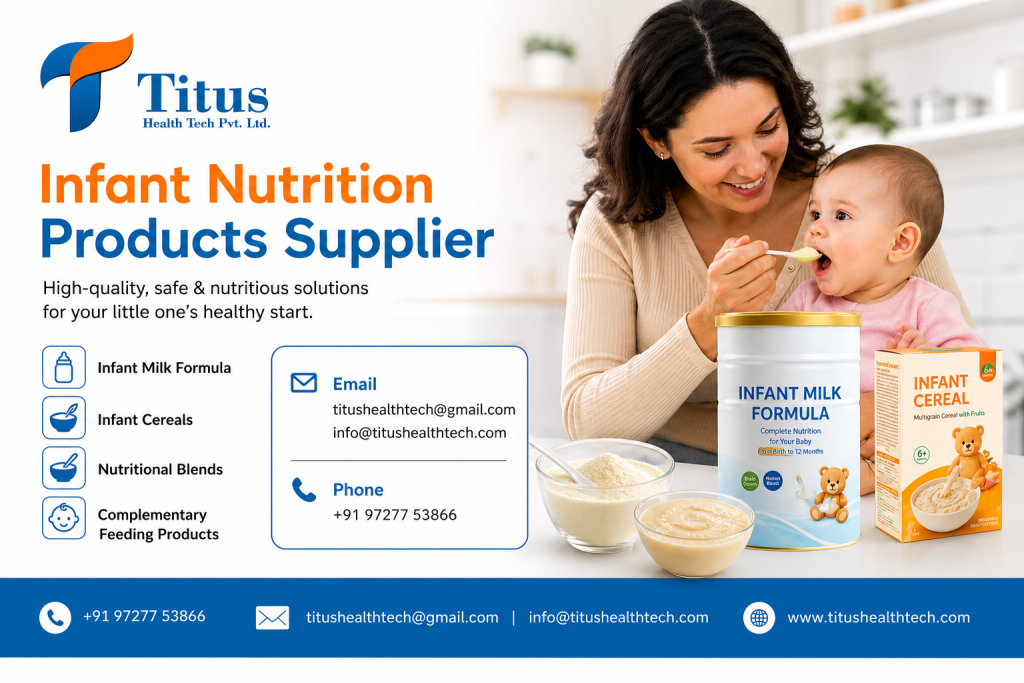
Launching or scaling a baby nutrition brand is not just about demand. It is about safety, compliance, quality control, and long-term trust. One wrong manufacturing decision can delay approvals, damage reputation, or increase product recalls. That is why selecting the right Infant nutrition products supplier is one of the most critical decisions for B2B buyers in India and global export markets.
Whether you are a startup entering baby care, a distributor expanding SKUs, or a healthcare-focused brand building premium offerings, your supplier determines your product quality and brand credibility.
If you are serious about building a safe and competitive infant nutrition line, this guide will help you make an informed decision.
An Infant nutrition products supplier is a specialized manufacturer and development partner that produces baby food products such as:
Unlike generic food manufacturers, these suppliers operate under strict food safety and pediatric nutrition regulations. They often provide:
For example, if you are planning an Infant milk formula private label, your supplier should not only manufacture the product but also help ensure FSSAI compliance, nutrient accuracy, and export documentation.
Similarly, if you are working with an Infant cereal manufacturer in India, you need assurance that ingredient sourcing, micronutrient fortification, and allergen controls meet both domestic and international standards.
In short, your supplier is not just a factory -it is a strategic growth partner.
Understanding the process helps you evaluate transparency and capability.
The journey begins with:
For brands exploring Infant milk formula private label, this stage includes selecting formulation base, protein type, DHA levels, and micronutrient ratios.
Here, nutrition experts and food technologists:
An experienced Infant nutrition products supplier will have in-house R&D and pediatric nutrition expertise.
Quality begins at the source. Look for:
For an Infant cereal manufacturer in India , grain quality, pesticide residue testing, and contamination control are especially critical.
Manufacturing involves:
Hygiene protocols, temperature monitoring, and batch coding are mandatory.
Testing typically includes:
A reliable Infant nutrition products supplier will provide Certificates of Analysis (COA) for every batch.
For reference on Indian regulatory standards, businesses can review guidelines from the Food Safety and Standards Authority of India FSSAI
This includes:
Private label clients must ensure labeling matches regulatory requirements in their destination country.
The supplier should provide:
A professional Infant milk formula private label partner can significantly reduce development time compared to building your own manufacturing unit.
Similarly, working with an established Infant cereal manufacturer in India ensures stable supply during seasonal grain fluctuations.
This service is ideal for:
If you want to explore broader manufacturing capabilities, review the company’s expertise in nutritional product development to assess scalability and diversification potential.
In infant nutrition, trust is non-negotiable.
Look for:
Years of operation in regulated nutrition manufacturing.
Qualified food technologists and nutrition scientists.
Willingness to share audits, testing data, and process documentation.
A dependable Infant nutrition products supplier openly discusses its process rather than hiding behind marketing claims.
Companies offering integrated health manufacturing solutions, such as TitusHealth Tech, often support multiple nutrition-driven verticals.
Solution: Work with a supplier experienced in documentation and labeling compliance.
Solution: Choose a facility with batch testing and traceability.
Solution: Negotiate scalable production stages.
Solution: Ensure the Infant nutrition products supplier provides a dedicated account manager.
Solution: Confirm export experience before contract signing.
Before signing, assess:
Can they scale if demand doubles?
Modern equipment ensures consistent blending and drying.
Do they offer both formula and cereal capabilities?
Client testimonials, case studies, and export history.
If you are considering Infant milk formula private label, ask for previous case references.
Verify fortification expertise if selecting an Infant cereal manufacturer in India.
A thorough audit visit is highly recommended.
Costs vary based on formulation complexity, packaging type, certifications, and order volume. Private label projects typically reduce setup investment compared to in-house manufacturing.
Standard formulations may take 4–8 weeks. Custom formulations may require additional testing and validation time.
Many suppliers offer phased production models. Confirm minimum order quantities early.
FSSAI licensing is essential. ISO, GMP, and HACCP certifications add credibility and export readiness.
Yes, if manufactured in certified facilities with documented quality testing and regulatory compliance.
Experienced manufacturers provide documentation support for customs clearance and regulatory submissions.
Selecting the right Infant nutrition products supplier in India is not just a procurement decision -it is a strategic partnership that shapes your brand’s safety, credibility, and scalability.
From formulation and compliance to packaging and export readiness, every stage demands precision. Businesses that invest time in evaluating certifications, transparency, and production capacity reduce long-term risk and accelerate growth.
If you are planning to launch or scale your infant nutrition line, explore the manufacturing capabilities and compliance expertise offered by TitusHealth Tech to build a safe, scalable, and trusted product portfolio. Looking for a reliable and compliant Infant nutrition products supplier in India?
Partner with TitusHealth Tech to develop safe, scalable, and export-ready infant nutrition products. Contact our team today to discuss your B2B requirements
WhatsApp us