
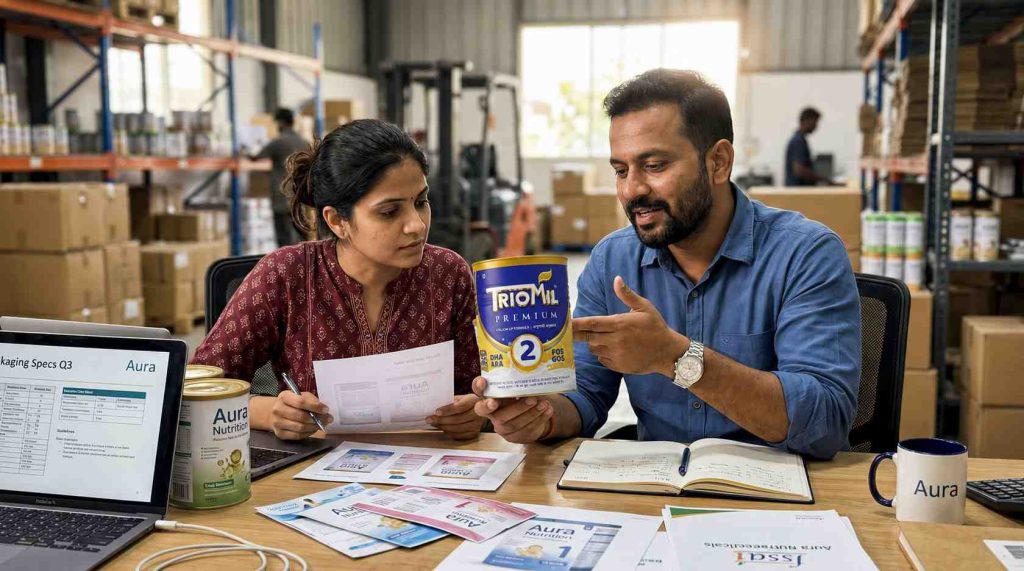
If you want to sell infant formula under your own brand without building a factory, baby milk formula private label is the route most Indian brands take. You own the name, the pack, and the customer. A licensed manufacturer handles the formulation, testing, and production behind the scenes. It sounds simple, and the model is proven. But this is a tightly regulated category, so the details around process, cost, and compliance decide whether your launch is smooth or stuck. This guide walks through all three in plain terms.
Quick answer
What is baby milk formula private label? It is an arrangement where a certified manufacturer produces infant formula to agreed specifications, and you sell it under your own brand. You control branding, pricing, and distribution, while the maker handles R&D, sourcing, food-safety testing, and regulatory-ready production.
Let us clear up the basics first. In a private label deal, you are the brand owner, not the producer. The manufacturer already runs a licensed plant, holds the recipes, and knows the compliance rules. You bring the brand, the market access, and the order. Then the factory makes the product to spec and ships it ready for your label.
This differs from building your own unit, which would cost crores and take years of approvals. With baby milk formula private label, you skip that burden and reach the shelf far faster. That is why the model is so popular with new-age D2C brands, regional distributors, and clinics that want a trusted product under their own name.
The appeal is practical, not just financial. Here is what draws most brand owners in.
For a closer look at how the model works on the ground, this walkthrough on how private label works with an infant nutrition products manufacturer in India adds useful context to what follows here.
Infant nutrition is not one product; it is a family of them. So decide early which stage fits your market before you commit to an infant milk formula private label plan.
Many brands begin with one or two stages, prove demand, then widen the range. An experienced partner can produce a full ladder, so your infant milk formula private label line can grow with your customers instead of forcing a fresh search each time.
Private label is not only for big players. It fits a surprising range of businesses. Regional distributors use it to add a house brand. Pharmacy chains and clinics use it to offer a trusted product they control. New D2C founders use it to enter the market without heavy capital. Even established food brands use it to extend into infant nutrition quickly. If you have a route to customers, the model can work for you.
Every serious project moves through the same broad stages. Timelines vary, but the order rarely does.
Most first launches take a few months from first call to first pallet. The formulation and compliance steps usually eat the most time, so start those early rather than late.
There is no single sticker price, because a baby milk formula private label project is built from moving parts. Still, a few factors drive most of the cost.
A smart approach is to model your landed cost per unit, not just the factory quote. Add packaging, testing, freight, and margin, then check it against your target retail price. That single exercise saves many brands from a painful surprise later.
Want a realistic quote for your idea?
Share your product concept and target volumes with our team through our private labeling service, and we will map the process, costs, and timelines for you.
This is where the category gets serious. Infant nutrition is treated as high-risk, and for good reason. So before you sell a single tin, you must satisfy several overlapping rules.
Every product falls under the Food Safety and Standards Authority of India (FSSAI). The Foods for Infant Nutrition Regulations set out what an infant formula must contain, how it is labelled, and how it is packed. Because infant nutrition is a high-risk category, FSSAI has moved to require State or Central licences rather than basic registration. So confirm your manufacturer holds the right licence class.
The Infant Milk Substitutes, Feeding Bottles and Infant Foods Act (the IMS Act) governs how these products are promoted. In short, it restricts advertising, free samples to mothers, and any marketing that discourages breastfeeding. This matters a lot for brand owners, because the usual promotion playbook does not apply. Plan your marketing around the law from day one, not after your labels are printed.
Infant food increasingly requires the BIS mark, alongside strict batch testing for contaminants and nutrient accuracy. Reliable private label nutrition manufacturers already test every batch and keep the paperwork ready, which protects both your customers and your brand if a query ever arises.
Many Indian brands do not stop at the home market. If exports are even a possibility, flag it at the start. Different countries ask for different documents, labels, and nutrient profiles, so a maker with export experience saves you months of rework later.
A typical export-ready file includes:
When your partner already handles this paperwork for other clients, your own launch moves faster and hits fewer walls at customs.
Your manufacturer is not a vendor; they are the foundation of your brand. So choose carefully. The best private label nutrition manufacturers share a few clear traits.
You can gauge a maker quickly by touring the plant or reviewing its manufacturing infrastructure. A capable facility shows you clean-room production, quality labs, and controlled storage, which are non-negotiable for infant products. Strong private label nutrition manufacturers will welcome the scrutiny.
A few missteps show up again and again. Dodge these, and your launch gets much easier.
No model is perfect, so weigh both sides. On the plus side, you save enormous capital, launch quickly, and lean on an expert for safety and compliance. On the other side, you share margin with the maker, you depend on their capacity, and you must respect strict marketing limits. For most brands the maths still favours private label, because building and licensing an infant-formula plant from scratch is slow, costly, and risky. Knowing the trade-offs upfront simply helps you negotiate a fairer, clearer deal.
Done right, baby milk formula private label lets you launch a trusted infant nutrition brand without the cost and delay of building a plant. The winning formula is straightforward: pick an experienced, certified partner, respect India’s compliance rules from the start, and model your true landed cost before you commit. Get those three right, and the rest is execution.
If you are ready to explore your own line, our infant formula range and private label programme give you a compliant, tested starting point. Get in touch with Titus Health Tech to discuss your product, volumes, and timeline.
Most first launches take a few months from concept to finished stock. Formulation and regulatory steps take the longest, so begin them early to avoid delays later.
MOQs vary by manufacturer, format, and formulation. Larger runs lower your per-unit cost, while smaller pilot batches let you test the market before scaling up.
Yes, brand owners typically need the correct FSSAI licence and product approvals to sell, alongside the manufacturer’s own licences. A good partner will guide you through the paperwork.
You can adjust within what the regulations permit, from recipe tweaks to pack sizes and branding. The manufacturer keeps every change compliant with FSSAI standards.
Because the end user is a vulnerable infant. India treats this as a high-risk category, so testing, labelling, and marketing rules are tighter than for ordinary food.
Yes, provided you meet each destination’s rules. Work with an export-experienced maker who can supply the specifications, certificates, and country-specific labels that overseas markets demand.
Check certifications, tour the facility, confirm infant-specific experience, and insist on batch testing and clear documentation. Reliable private label nutrition manufacturers welcome that scrutiny rather than avoiding it.
WhatsApp us