
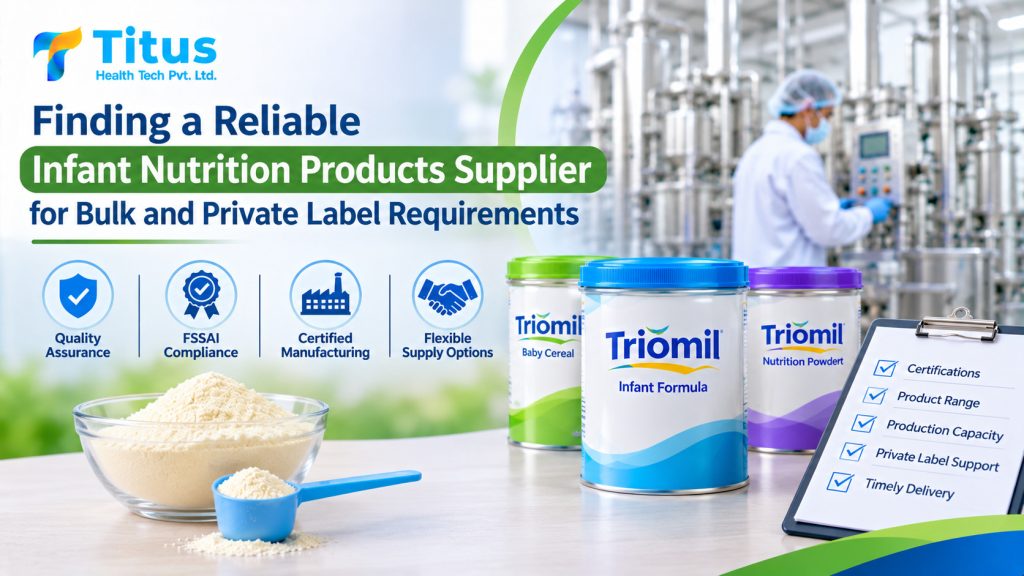
Quick answer: A reliable infant nutrition products supplier can show valid FSSAI licensing, hygienic and documented production, batch traceability and clear terms for bulk or private label orders. Confirm whether the business manufactures or only trades, request documents and samples, and agree quantities, packaging and responsibilities in writing before ordering.
Retailers, distributors, healthcare procurement teams and new brands all reach the same question when they need infant formula, baby cereals or related products at volume: who can be trusted to supply them? Choosing an infant nutrition products supplier is a decision about safety and accountability as much as price, because these products are consumed by one of the most vulnerable groups and are regulated accordingly.
This guide explains how to tell manufacturers from intermediaries, what to verify for bulk and private label requirements, and how Titus Health Tech works with business buyers. It is general educational information for businesses and not medical advice.
The phrase covers several kinds of business, and buyers should understand the differences before placing an order.
A manufacturer operates the production facility, controls processing and testing, and releases batches. A supplier may be the manufacturer itself or a trader who sources products from others. A distributor holds stock and moves it through retail or institutional channels. Each role carries different responsibilities for storage, documentation and complaint handling, so an infant nutrition products supplier should be able to state clearly which role it plays.
When something goes wrong with an infant product, traceability decides how quickly the cause can be found. Buying directly from a producer, or from an intermediary that can name the producing facility and share batch records, shortens that chain. An infant nutrition products supplier that cannot say where its products are made gives the buyer little protection if a quality question arises.
India has a wide range of businesses offering infant nutrition products, from manufacturers with their own plants to traders and regional distributors. Buyers searching for an infant nutrition products supplier in India will find large differences in documentation, storage practices and willingness to answer questions. Comparing each infant nutrition products supplier in India on the same checklist, rather than on price alone, makes the choice more objective. Direct contact with the production facility is generally the most transparent route, especially for private label projects.
Requirements differ by channel and customer. Business buyers typically look for one or more of the following:
Each category has its own regulatory and handling requirements, so an infant nutrition products supplier suited to one may not suit another.
Buyers who need volume should ask a bulk infant formula supplier a defined set of questions before any commitment. Confirm the minimum order quantity, available pack sizes, production lead time and the shelf life remaining at dispatch, since slow-moving stock can approach expiry before it is sold. It should also explain storage and transport conditions, how batches are coded and what happens if a quality concern is reported. Quotations should state what is included, such as testing documentation and packaging, so that offers from different bulk infant formula supplier candidates can be compared like for like.
An infant milk formula supplier should be able to produce documentation on request, because infant products are subject to specific rules. According to the Food Safety and Standards Authority of India (FSSAI), foods intended for infant nutrition must comply with standards notified under the Food Safety and Standards Act, 2006, covering composition, labeling and safety. Buyers should therefore ask an infant milk formula supplier for current license details, product specifications, label copies and batch records. Where a supplier is a trader, the buyer should also ask for the manufacturer’s identity and the documents that connect each batch to its source.
Brands that want to sell under their own name work with a private label infant nutrition manufacturer, and several models exist.
| Model | How It Works | Formulation | Typical Fit |
| Private label | Brand sells a manufacturer’s existing product under its own name | Manufacturer’s base | New brands seeking a faster launch |
| Contract manufacturing | Manufacturer produces to the brand’s specification | Brand-defined | Brands with an established recipe |
| Bulk supply | Large volumes of finished product for distribution | Agreed specification | Distributors and institutional buyers |
A private label infant nutrition manufacturer usually starts from an existing base formula, which reduces development time and risk. Brands should ask which formulations are available, what packaging customization is included, what minimum quantities apply and who is responsible for labeling review. Responsibilities for testing, release and complaint handling should be agreed in writing.
Powders are sensitive to moisture and require careful blending, filling and packaging. A baby nutrition powder manufacturer should be able to describe how it controls blend uniformity, humidity and cross-contact between products. Buyers should ask the baby nutrition powder manufacturer how finished batches are tested, how packaging protects shelf life and how traceability is maintained. A baby nutrition powder manufacturer with several product lines should also explain which products share equipment and how cleaning is verified between runs, because allergen and contamination control depend on it.
Wholesale buyers often serve pharmacies, retail chains and institutions. An infant food wholesale supplier should be able to explain stock availability, delivery schedules and how products are protected during transport. Because infant foods are sensitive to heat and humidity, buyers should ask an infant food wholesale supplier about warehouse conditions and rotation of stock by expiry date. They should also confirm return and recall procedures before the first order, so that responsibilities are clear if a batch must be withdrawn.
An infant nutrition product distributor plays an important role in keeping products safe after they leave the factory. Good practice includes:
An infant nutrition product distributor that follows these steps protects consumers and its own reputation, and it makes quality discussions with the manufacturer much simpler.
Whether buying directly or through an intermediary, it helps to understand how to judge the producer. An infant formula manufacturing company should be assessed on evidence rather than assurances. Useful checks include:
Visiting the facility, or reviewing a structured walkthrough, remains the most dependable way to assess an infant formula manufacturing company.
Several errors recur in infant product sourcing. Buyers sometimes accept a low price without asking where the product is made, or order large volumes before checking remaining shelf life. Others assume that an intermediary shares the manufacturer’s documents without asking to see them, or fail to agree who handles complaints and recalls. Another frequent mistake is skipping a sample and label review, which can lead to relabeling costs later. Choosing an infant nutrition products supplier that welcomes these checks, and recording the answers in writing, avoids most of these problems and builds a more dependable relationship.
Pricing depends on product type, formulation, pack size, packaging and order volume, and private label projects add development and artwork costs. Buyers should ask for an itemized quotation that states what is included, such as testing documentation, packaging and delivery. Payment terms, validity of the quotation and arrangements for repeat orders should be confirmed in writing. Comparing offers from each infant food wholesale supplier or manufacturer on the same basis makes differences visible and prevents a low headline price from hiding extra charges.
Businesses that supply infant products operate within legal and ethical limits. According to the ICMR-National Institute of Nutrition’s Dietary Guidelines for Indians, exclusive breastfeeding is recommended for the first six months, with complementary foods introduced after that while breastfeeding continues. National legislation also restricts the promotion of infant milk substitutes, so any infant nutrition products supplier should understand what marketing and communication are permitted and should advise customers accordingly. Buyers should take specialist advice on these rules.
A well-prepared enquiry saves time for both sides. State the product category, expected monthly volume, preferred pack sizes, whether the product is private label or branded, and the markets or channels to be served. Ask for license details, product specifications, sample availability, lead times and minimum order quantities. A good infant nutrition products supplier will respond with clear, written answers and will explain anything that is not available, instead of avoiding the question.
Titus Health Tech Pvt. Ltd. is a nutrition products manufacturer based in Gandhinagar, Gujarat, with divisions covering infant nutrition, baby cereals, speciality nutrition and sports nutrition. The facility operates under GMP, ISO 22000:2018 and HACCP-aligned practices. Business buyers can review the infant formula range and the manufacturing infrastructure to understand how production is organized, and brands can explore private labeling options across the company’s divisions.
Retailers, distributors and brands looking for an infant nutrition products supplier with specific volume, packaging or private label requirements are encouraged to contact Titus Health Tech to discuss their needs, sampling and timelines.
Selecting an infant nutrition products supplier is a decision that should rest on documentation, traceability and transparency rather than price alone. Buyers who understand the difference between manufacturers, suppliers and distributors, who ask suppliers and private label partners the right questions, and who verify the credentials of the producer, are better placed to build dependable supply relationships. Titus Health Tech supports business buyers and brands across infant and baby nutrition and welcomes enquiries about requirements and next steps.
It is a business that supplies infant formula, baby cereals or related products, and it may be a manufacturer, a trader or a distributor.
Check licensing, whether it manufactures or trades, batch traceability, documentation, storage practices and willingness to answer questions in writing.
Ask about minimum order quantity, pack sizes, lead time, remaining shelf life at dispatch, storage conditions and the process for quality concerns.
It should provide license details, specifications, label copies and batch records, and name the manufacturer if it is a trader.
It produces products under your brand name, usually from an existing base formula, with agreed packaging, testing and release responsibilities.
It stores and moves products through retail or institutional channels, and must handle stock, records and returns responsibly.
Review licensing, hygiene design, ingredient control, regulatory knowledge and transparency, and visit the facility where possible.
Contact the team through the website with your product category, volumes, packaging preferences and timelines.
WhatsApp us