
Infant cereal brands are built on trust, and that trust starts at the factory. Choosing a multigrain baby cereal manufacturer decides how your product is formulated, how safely it is processed, and whether it can legally reach shelves. For businesses that want to sell under their own name without building a regulated plant, private label nutrition manufacturing has become the practical route into infant nutrition.
This guide explains what a multigrain baby cereal manufacturer actually does, which regulations apply in 2026, how private label and bulk production work, and how to judge a partner before you sign. It is written for brand owners, distributors, pharmacy chains and importers who need clear answers rather than sales talk.
A multigrain baby cereal manufacturer develops, processes, tests and packs cereal-based complementary foods made from two or more grains, often combined with pulses, milk solids, fruit powders, vitamins and minerals. The finished product is a fine, instant powder that parents reconstitute with water or milk for babies who have started solid foods.
The role goes well beyond blending flour. A capable partner manages:
The World Health Organization guideline on complementary feeding, published in 2023, recommends introducing complementary foods at 6 months (180 days) while breastfeeding continues, and it covers children from 6 to 23 months. That window defines the market a multigrain baby cereal manufacturer serves, and it shapes texture, nutrient density and serving guidance on every pack.
Single-grain rice cereal is usually the first food parents try because it is mild and easy to digest. As babies grow, many families look for variety, and multigrain baby food answers that need with a broader mix of cereals, pulses and flavours.
From a commercial point of view, a mixed grain baby cereal gives a brand three advantages:
Fruit-based variants are especially popular. A multi grain fruite blend, for example, pairs mixed cereals with fruit and milk to create a familiar, mildly sweet taste that suits babies moving beyond plain rice.
An experienced multigrain baby cereal manufacturer will help you plan a sensible range, typically a single-grain starter, one or two multigrain baby cereal options and a fruit variant, rather than launching too many SKUs at once.
Infant food is one of the most tightly regulated categories in India, which is why the choice of multigrain baby cereal manufacturer matters so much. Any multigrain weaning food sold in the country must comply with the Food Safety and Standards (Foods for Infant Nutrition) Regulations, 2020, notified by FSSAI in December 2020.
The regulations define two cereal-based categories for infants from 6 months up to 24 months:
The category determines the compositional limits, permitted additives and label declarations. A reliable multigrain baby cereal manufacturer will confirm the correct category before formulation begins, because changing it later means reworking the recipe and the artwork.
Under Indian food law, infant milk food, milk cereal based complementary food and processed cereal based complementary food must be manufactured under Bureau of Indian Standards certification. This is a hard requirement, so verify the manufacturer’s valid BIS licence for the specific product category before anything else.
Infant food labels carry mandatory declarations, age guidance, preparation instructions and restrictions on promotional claims. Errors here can stop a launch, so ask your multigrain baby cereal manufacturer to review artwork against current FSSAI rules before printing.
Private label lets you own the brand, pricing and distribution while the multigrain baby cereal manufacturer owns production and compliance. Most partnerships cover the following areas.
You can launch with an existing, proven formula or develop a custom recipe. Custom work covers grain selection, pulse ratios, fruit inclusion, fortification levels and sensory testing. Proven formulas shorten time to market, while custom recipes take longer but give you a unique product. A multigrain baby cereal manufacturer with in-house R&D can also adapt a base recipe, for example turning a plain mixed grain baby cereal into a ragi or millet variant. Fruit recipes such as a multi grain fruite blend need extra care, because fruit powders absorb moisture and can affect flowability and shelf life.
Common formats include bag-in-box cartons, tins and pouches. Pack size, oxygen and moisture barrier and shelf-life targets all influence the choice, and your multigrain baby cereal manufacturer should run shelf-life trials on the exact pack you select. Bag-in-box packs, for example, are widely used for infant cereals because the inner bag protects the powder while the outer carton carries branding.
Expect a certificate of analysis for every batch, nutritional data for labels and support with product registration. For exporters, a multigrain baby cereal manufacturer that has shipped overseas before will already know which documents importing countries ask for.
Bulk buyers, including distributors, institutional suppliers and government nutrition programmes, need consistency across large volumes. Institutional buyers sourcing multigrain baby food in bulk usually specify a fixed formula, a mixed grain baby cereal base and tight nutrient tolerances for every lot. A multigrain baby cereal manufacturer serving this segment should offer planned production slots, batch-to-batch uniformity and export-ready documentation.
For importers comparing options, our guide to baby cereals exporters and bulk supply options covers shipping formats, shelf-life planning and distribution models in more detail.
Demand for multigrain infant food India produces is also growing in Asian, African and Middle Eastern markets, where Indian manufacturers are valued for competitive pricing and familiarity with cereals and pulses that local consumers trust.
While each facility differs, the typical process a multigrain baby cereal manufacturer follows looks like this:
The infant formula manufacturing process shares many of the same hygiene and quality principles, particularly zoning, environmental monitoring and release testing.
Shortlisting a partner is easier with a structured checklist. Before you commit to a multigrain baby cereal manufacturer, confirm the following:
Our step-by-step article on how to choose a top baby food manufacturer expands on audits and commercial terms. A site visit to the multigrain baby cereal manufacturer is still the most reliable test, because the cleanliness of the packing hall usually tells you more than any brochure.
Even experienced food companies make avoidable errors when they first approach a multigrain baby cereal manufacturer:
Avoiding these mistakes saves months. A good multigrain baby cereal manufacturer will flag these risks during onboarding rather than after the first batch.
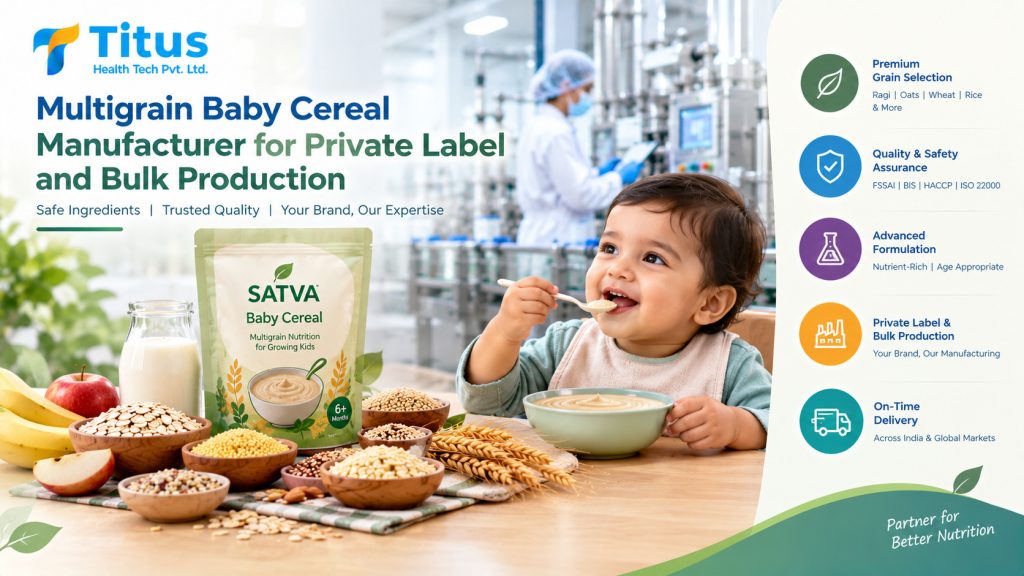
Titus Health Tech is a Gandhinagar, Gujarat based nutrition manufacturer whose Satva division focuses on baby cereals. The company manufactures for more than 40 private label companies in India and 10 international partners, and its facility is certified for GMP, ISO 22000:2018 and HACCP. Overseas importers looking for multigrain infant food India can supply reliably often start with exactly these credentials.
Its own Triolac range shows the kind of products it builds. Triolac Multigrain & Fruits, listed on the site as multi grain fruite, is a milk cereal based complementary food for babies from 6 to 24 months. It is packed in a 300 g bag-in-box and provides 35% of a baby’s daily iron need in two serves. Brands evaluating a multigrain baby cereal manufacturer for the first time can review this range alongside the wider multigrain baby food portfolio. You can explore the full baby cereals range to see the formats available for private label.
As a multigrain baby cereal manufacturer, Titus supports brands from formula selection and packaging design to regulatory documentation and export paperwork. If you are planning a new infant cereal line or need dependable bulk supply, contact the Titus Health Tech team to discuss your formulation, volumes and target markets.
MOQ depends on formula, pack type and printed packaging. Existing formulas usually allow smaller first runs than custom recipes. Share your pack size and target volume with the manufacturer to get an accurate MOQ before you plan a launch.
Yes. You can choose grains, pulses, fruit inclusions and fortification levels within FSSAI limits. Custom recipes need extra development and stability testing, so allow more time than you would for an existing, proven formula from the same plant.
At minimum, a valid FSSAI licence and BIS certification for the relevant infant food category. Food safety systems such as GMP, HACCP and ISO 22000 add confidence. Always request copies and check that the scope covers your product type.
Using an existing formula, timelines are driven mainly by artwork approval, packaging procurement and batch testing. Custom formulas add development and shelf-life trials. Ask your partner for a written timeline that covers every stage before launch.
Under FSSAI rules, milk cereal based complementary food contains milk, while processed cereal based complementary food is made without milk. Both serve infants from 6 to 24 months but follow different composition, additive and labelling requirements.
Yes. Titus Health Tech supplies private label and bulk infant nutrition products to partners in India and overseas, and supports the documentation importers need. Share your target country and volumes so the team can confirm formats and lead times.
Request a certificate of analysis, test results for microbiological safety and nutrient content, and shelf-life data. Then sample the product yourself, checking texture, reconstitution, taste and packaging integrity before you approve a commercial batch.
WhatsApp us