
Table of Contents
How Infant Formula Is Made: Inside a Modern Spray Drying Facility………………………………………… 1
Why the Infant Formula Manufacturing Process Is So Tightly Controlled………………………….. 3
Step-by-Step: How Infant Formula Is Made………………………………………………………………………………………. 3
Spray Drying Infant Formula: The Heart of the Process…………………………………………………………….. 3
Infant Formula Production Process: From Powder to Pack………………………………………………………. 4
Baby Formula Manufacturing Steps That Support Consistency………………………………………………. 4
Infant Formula Spray Dryer Technology and Facility Design…………………………………………………… 4
Milk Powder Spray Drying and Nutrient Retention………………………………………………………………………. 5
Formula Powder Production and Final Quality Release……………………………………………………………… 5
Why Manufacturing Experience Matters in This Process…………………………………………………………… 5
Conclusion………………………………………………………………………………………………………………………………………………………. 5
Frequently Asked Questions……………………………………………………………………………………………………………………. 6
1. What is the first stage of the infant formula manufacturing process?………………………… 6
2. How is infant formula turned into powder?…………………………………………………………………………… 6
3. Why is spray drying preferred over other drying methods for infant formula?……. 6
4. Are all nutrients added before spray drying?……………………………………………………………………….. 6
5. What quality checks happen during the production process?……………………………………….. 6
6. Can private label brands use a manufacturer’s existing production line?………………… 6
7. How is contamination prevented between different product batches?……………………… 6
8. What happens if a batch fails quality testing?……………………………………………………………………….. 6
Understanding the infant formula manufacturing process helps brands, private label partners and even informed caregivers appreciate why infant nutrition production is treated so differently from ordinary food manufacturing. Every stage of the infant formula manufacturing process, from raw material selection to final packing, is designed around nutritional accuracy, microbiological safety and batch consistency. Titus Health Tech, which manufactures infant milk formula under its Dugdha division at its Gandhinagar facility, follows this kind of structured infant formula manufacturing across its Triomil range and its private label production lines.
This article walks through how infant formula is made, explains the role of spray drying, and outlines the quality checkpoints built into a modern infant formula manufacturing process.
Because infant formula may serve as a sole source of nutrition for babies who are not breastfed, the infant formula manufacturing process cannot tolerate the variability acceptable in many other food categories. Nutrient levels, moisture content, particle size and microbiological limits must stay within narrow, regulator-defined ranges in every batch. This is why facilities dedicated to infant nutrition invest heavily in controlled environments, validated equipment and continuous testing rather than relying on standard food-processing setups.
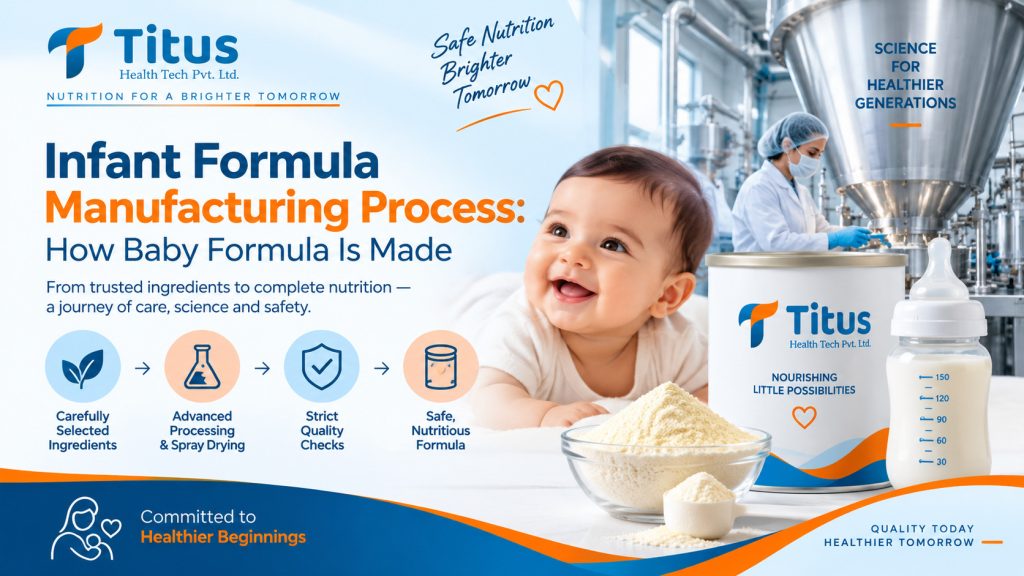
Explaining how infant formula is made is easiest when the infant formula manufacturing is broken into its core stages:
Spray drying infant formula is the stage most people associate with powdered baby milk, and for good reason: it defines the texture, solubility and shelf stability of the finished product. In this step, the homogenised liquid formula is atomised into fine droplets and sprayed into a large drying chamber where hot air rapidly removes moisture, leaving behind dry powder particles. Because heat-sensitive nutrients such as certain vitamins can degrade under excessive temperature, spray drying infant formula requires carefully calibrated inlet and outlet temperatures, airflow rates and residence times, all governed by strict controls within the infant formula manufacturing process.
The table below summarises how the key stages of the infant formula manufacturing process connect to their primary quality objectives.
| Production Stage | Primary Purpose | Key Quality Check |
| Ingredient Standardisation | Accurate nutrient formulation | Raw material testing, supplier verification |
| Mixing & Homogenisation | Uniform liquid blend | Viscosity, fat stability checks |
| Spray Drying | Moisture removal, powder formation | Temperature control, moisture content |
| Sifting & Cooling | Particle size uniformity | Sieve analysis, powder flowability |
| Packing | Contamination prevention, shelf life | Seal integrity, nitrogen flushing |
Once drying is complete, the infant formula production process moves into secondary handling, where the powder is sifted to remove clumps, cooled to a stable temperature, and, where required, blended with heat-sensitive nutrients that are added after drying to preserve their potency. This stage of the infant formula production process is followed by packing under controlled humidity, often with nitrogen flushing to limit oxidation and extend shelf life. Manufacturers running a private label infant formula production process for multiple brands must maintain strict changeover protocols between formulations to avoid cross-contamination, keeping the wider infant formula manufacturing process free of residue from a previous batch.
Consistency across batches is one of the hardest parts of scaling production, which is why documented baby formula manufacturing steps matter as much as the equipment itself. Facilities typically follow these baby formula manufacturing steps in sequence:
Skipping or shortcutting any of these baby formula manufacturing steps increases the risk of batch rejection or, more seriously, a product that fails to meet its declared nutritional profile, undermining the wider infant formula manufacturing process.
The infant formula spray dryer itself is only part of a wider system. Modern facilities pair the dryer with automated cleaning-in-place lines, air filtration systems, and segregated zones to prevent cross-contact between allergens or different product formulations. An infant formula spray dryer operating within a GMP and HACCP-certified environment, such as the one used at Titus Health Tech’s facility, is supported by continuous monitoring of temperature, humidity and airflow to keep the surrounding infant formula manufacturing process within validated limits at every shift.
Milk powder spray drying is not unique to infant formula, but the nutrient-retention requirements for infant nutrition are considerably stricter than for general dairy powders. Because breast milk substitutes must deliver specific vitamin and mineral levels reliably, milk powder spray drying for infant formula is validated against nutritional targets rather than general moisture specifications alone. This is one reason nutrition science bodies such as the ICMR-National Institute of Nutrition, in its Dietary Guidelines for Indians, continue to study infant feeding requirements in depth, providing the broader scientific backdrop against which formulation targets for the infant formula manufacturing process are set, even though FSSAI’s compositional standards remain the binding regulatory reference for manufacturers.
The final phase of formula powder production involves laboratory testing of the finished powder for protein, fat, carbohydrate, vitamin and mineral content, along with microbiological screening before a batch is cleared for dispatch. No batch from a properly controlled formula powder production line should reach the market without this release testing, since it is the last checkpoint before the product reaches caregivers. Titus Health Tech applies this release discipline across its infant formula manufacturing process for both its own brand and private label partners.
The quality and consistency of infant nutrition products depend on a well-managed facility, reliable equipment, and a strong quality control team. Titus Health Tech Pvt. Ltd., based in Gandhinagar, Gujarat, operates its production facilities in accordance with GMP, ISO 22000:2018, and HACCP standards.
The company supports brands through private label and contract manufacturing services, helping businesses develop and produce infant nutrition products according to their specific requirements. Its capabilities cover key stages of the infant formula manufacturing process, from formulation and ingredient handling to controlled production and quality checks.
For businesses looking to launch or expand an infant nutrition product line, Titus Health Tech offers support with formulation, production capacity, packaging requirements, and manufacturing timelines. Its structured approach helps brands maintain consistency, safety, and quality throughout production.
Businesses interested in private label or contract manufacturing can contact Titus Health Tech to discuss their product requirements and explore suitable manufacturing solutions.
The infant formula manufacturing process combines precise formulation science, carefully controlled spray drying, and disciplined quality testing at every stage. From ingredient standardisation to final release testing, each step exists to protect the nutritional integrity and safety of a product intended for the most sensitive consumer group of all. Titus Health Tech continues to apply this rigour across its infant formula manufacturing process, giving private label partners a manufacturing base built around consistency and compliance.
The first stage is ingredient standardisation, where milk solids, oils, vitamins and minerals are tested and blended according to the target formulation before liquid processing begins.
Liquid formula is atomised and passed through a spray dryer, where hot air rapidly removes moisture, leaving behind fine, dry powder particles.
Spray drying allows precise temperature control and rapid moisture removal, which helps protect heat-sensitive nutrients while achieving the powder texture required for reconstitution.
No. Some heat-sensitive vitamins and nutrients are added after drying to preserve their potency, since prolonged heat exposure can degrade certain compounds.
In-process sampling at mixing, drying and packing stages, along with final finished-product testing for nutrition and microbiology, are standard checkpoints before batch release.
Yes, many infant nutrition brands rely on contract or private label manufacturers with established facilities rather than building their own production infrastructure.
Facilities use validated cleaning-in-place systems, segregated production zones, and documented changeover protocols between different formulations or allergen profiles.
A batch that does not meet nutritional or microbiological specifications is rejected or reprocessed where possible, and is never released for dispatch to the market.
WhatsApp us