
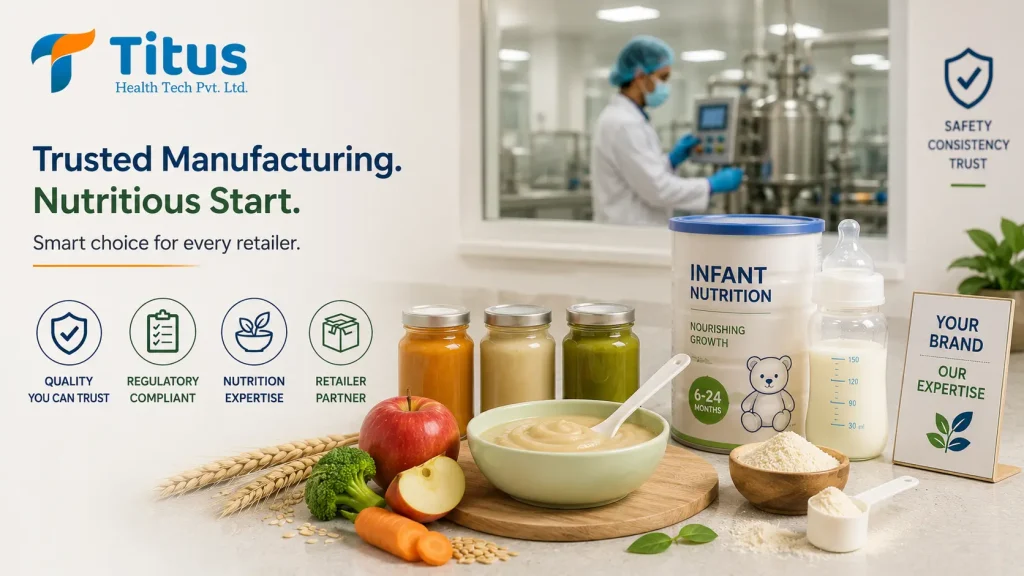
Selecting the right baby food manufacturer is one of the most consequential decisions a retailer or emerging nutrition brand will make. Infant and toddler nutrition products sit at the intersection of strict regulatory compliance, delicate formulation science, and consumer trust, which means the manufacturing partner behind the label carries as much weight as the brand itself. A dependable baby food manufacturer brings together food safety systems, formulation expertise, and consistent quality control so that retailers can bring products to market with confidence. This article walks through the factors that matter most when evaluating a baby food manufacturer, so retailers, distributors, and private-label brands can make an informed, low-risk choice.
Why the Choice of Baby Food Manufacturer Matters
Baby food is not an ordinary FMCG category. Infants have narrower nutritional tolerances and underdeveloped digestive systems, with no ability to communicate discomfort from a poorly formulated product. A single lapse in hygiene, sourcing, or nutrient balancing can cause serious consequences for the child and lasting reputational damage for the retailer’s brand. This is why the manufacturing partner functions almost like a silent co-founder of the business — every claim on the packaging and every safety assurance ultimately depends on how the product was made behind the scenes.
Retailers entering this category, whether through private-label lines or by stocking third-party brands, need a baby food manufacturer that treats infant nutrition as a specialized discipline rather than a scaled-down version of general food manufacturing. This distinction shapes everything from raw material sourcing to batch testing protocols.
The Retailer’s Responsibility Beyond the Manufacturer
Even when production is outsourced, the retailer retains responsibility toward the end consumer. Regulators and consumers alike expect retailers to have done adequate due diligence on their supply chain, which makes manufacturer evaluation a risk-management exercise, not just a procurement one.
Key Factors to Evaluate Before Choosing a Baby Food Manufacturer
Retailers should approach this decision methodically, since the right baby food manufacturer directly influences product quality, compliance, and brand reputation. Below are the core areas that deserve scrutiny before signing any manufacturing agreement.
1. Regulatory Compliance and Food Safety Systems
Infant nutrition products in India fall under specific regulatory frameworks, including the Food Safety and Standards (Foods for Infant Nutrition) Regulations, which prescribe composition, labeling, and safety requirements for this category. According to the ICMR-National Institute of Nutrition’s Dietary Guidelines for Indians, infant nutrition foods must comply with defined standards covering composition, permitted additives, and labeling disclosures before they can be manufactured or sold in the market. A credible baby food manufacturer should be able to clearly demonstrate how its facility and processes align with these regulatory expectations, rather than offering vague assurances.
Retailers should ask potential manufacturing partners about:
2. Formulation and Product Development Expertise
Formulating nutrition products for infants and toddlers requires a different level of technical rigor compared to general packaged foods. Nutrient density, ingredient interactions, allergen management, and age-appropriate texture all need careful balancing. A capable infant food manufacturer should be able to walk a retailer through its product development approach — ingredient selection, micronutrient balancing, and validation before scale-up.
This is also where the distinction between a manufacturer and a true product development partner becomes visible. A top baby food manufacturer typically participates in refining formulations based on nutritional science and manufacturing feasibility, rather than simply producing to a fixed recipe. Retailers building a private-label line benefit from a partner of this kind, since it reduces the burden of in-house R&D.
3. Manufacturing Capabilities and Quality Control
The physical manufacturing setup of a baby food manufacturer — equipment, processing lines, and quality control laboratories — directly influences product consistency. Retailers should understand what quality checkpoints exist at each stage of production, from raw material inspection to finished-product testing. Titus Health Tech, as a nutrition products manufacturing company, works with structured quality processes across its production stages, reflecting the industry expectation that a baby food manufacturer must apply tighter controls than standard food categories.
Retailers should specifically inquire about:
4. Private-Label and Custom Manufacturing Support
Many retailers and emerging brands enter the infant and toddler nutrition space through private-label arrangements rather than building manufacturing infrastructure themselves. In such cases, the manufacturer’s flexibility around private-label manufacturing becomes a decisive factor. A manufacturer experienced in private-label work can support retailers with formulation guidance, packaging coordination, and batch-size flexibility suited to a growing brand, rather than rigid, high-minimum-order arrangements.
5. Packaging, Labeling, and Shelf Stability
Packaging is a factor many retailers underestimate when comparing a baby food manufacturer. It is not purely aesthetic — it directly affects shelf life, contamination risk, and regulatory compliance. Labels must accurately reflect nutrient composition, age suitability, and any allergen declarations, since these are the primary trust signals a parent relies on at the point of purchase. A reliable top baby food manufacturer will factor in barrier packaging requirements, tamper-evidence, and label accuracy as part of its standard process rather than treating them as afterthoughts.
Comparing Manufacturing Models: In-House vs. Outsourced vs. Private-Label
Retailers evaluating how to enter or expand within the baby food category typically weigh three broad manufacturing models, each involving a different level of dependence on a baby food manufacturer. The comparison below outlines how these approaches differ across key operational dimensions.
| Factor | In-House Manufacturing | Fully Outsourced Manufacturing | Private-Label Manufacturing |
| Capital investment | High (facility, equipment, compliance setup) | Low to moderate | Low |
| Time to market | Longer (facility setup and licensing) | Moderate | Fastest |
| Formulation control | Complete control | Limited, depends on manufacturer | Shared, manufacturer-guided |
| Regulatory burden | Fully borne by retailer | Shared with manufacturer | Largely managed by manufacturer |
| Suitability | Large, established brands | Mid-sized brands scaling production | New entrants and growing retailers |
For most retailers entering the infant and toddler nutrition space, partnering with an experienced baby food manufacturer through a private-label or outsourced model offers a practical balance between speed to market and quality assurance, without the capital burden of building dedicated infrastructure.
Questions Retailers Should Ask Before Finalizing a Manufacturing Partner
Before entering any manufacturing agreement, retailers should treat evaluation as a structured due-diligence exercise, not a one-time conversation. A few areas deserve particular attention:
These questions help retailers separate manufacturers who treat compliance as a checkbox exercise from those who have built it into their operational culture.
Understanding Nutritional Requirements for Infant and Toddler Products
Beyond manufacturing and compliance, retailers benefit from understanding the nutritional science behind infant and toddler food categories, since this helps in evaluating whether a manufacturer’s formulations are genuinely appropriate for the target age group. Nutrient requirements for infants and young children differ substantially from those of adults, particularly around calorie density, protein quality, and micronutrient adequacy during the critical early years of growth. A reputable best infant food manufacturer in India typically aligns its formulation approach with recognized nutritional guidelines rather than relying solely on generic industry benchmarks, since infant nutrition science is a continuously evolving, evidence-based field. Retailers evaluating a best infant food manufacturer in India should ask specifically how age-wise nutrient variations are addressed across the product range.
This general nutrition education is meant to inform sourcing and formulation decisions, not to serve as medical guidance for individual infants or toddlers — parents and caregivers should always consult a pediatrician for specific dietary recommendations for their child.
Building Long-Term Trust with a Manufacturing Partner
A retailer’s relationship with its baby food manufacturer should extend beyond a single production run. Consistency across batches, responsiveness to formulation adjustments, and transparency around process changes all contribute to a partnership that scales as the retailer’s brand grows. Manufacturers who document their processes clearly and communicate proactively about quality parameters tend to reduce operational friction over time, particularly as order volumes increase or new product variants are introduced.
This is also where working with a nutrition-focused manufacturing company, rather than a general food contract manufacturer, offers a meaningful advantage. Infant nutrition formulation, quality assurance, and regulatory documentation are specialized enough that manufacturers focused on this category are better positioned to support a retailer’s long-term growth.
If your business is evaluating manufacturing partners for infant or toddler nutrition products, reach out to Titus Health Tech to discuss your private-label or custom manufacturing requirements and understand how the process can be structured around your specific product goals.
Conclusion
Choosing the right baby food manufacturer is a decision that shapes a retailer’s product quality, regulatory standing, and long-term brand trust. From compliance and formulation expertise to packaging and private-label flexibility, each factor discussed here determines whether a manufacturing partnership supports sustainable growth or introduces unnecessary risk. Retailers who evaluate these dimensions carefully are better positioned to bring safe, well-formulated infant and toddler nutrition products to market. Titus Health Tech works with retailers and emerging brands on nutrition product manufacturing, offering a structured, compliance-oriented approach to help partners navigate this specialized category with clarity and confidence.
Frequently Asked Questions
1. What should a retailer look for first when evaluating a baby food manufacturer? Retailers should first verify that the manufacturer meets applicable food safety and infant nutrition regulations, since compliance forms the foundation for every other quality consideration.
2. Is private-label manufacturing a good option for new baby food brands? Yes, private-label manufacturing allows new brands to enter the category with lower capital investment and faster time to market, while shifting much of the formulation and compliance burden onto an experienced partner.
3. How can a retailer verify a manufacturer’s quality control standards? Retailers can request documentation on raw material sourcing, in-process quality checks, and finished-product testing protocols. Facility visits and sample batch reviews also help confirm consistency.
4. What regulatory standards apply to infant nutrition products in India? Infant nutrition foods in India are governed by FSSAI regulations that define composition, labeling, and safety requirements specific to this category.
5. Does outsourcing manufacturing mean the retailer has no compliance responsibility? No, retailers retain responsibility for products they sell even when manufacturing is outsourced. This makes manufacturer due diligence an essential part of a retailer’s own risk management.
6. How important is packaging in baby food manufacturing? Packaging directly affects shelf stability, contamination prevention, and label accuracy, all of which influence consumer trust. A dependable manufacturer builds packaging requirements into product development rather than treating it as an afterthought.
7. Can a baby food manufacturer help with formulation, or only production? This varies by manufacturer. Some offer only production against a fixed recipe, while nutrition-focused manufacturing companies often support formulation and product development based on nutritional and manufacturing feasibility.
8. How can retailers start a conversation with a baby food manufacturer about private-label products? Retailers typically begin by sharing their product concept, target age group, and expected volumes with the manufacturer’s team, who can then guide formulation, compliance, and production planning from there.
WhatsApp us