
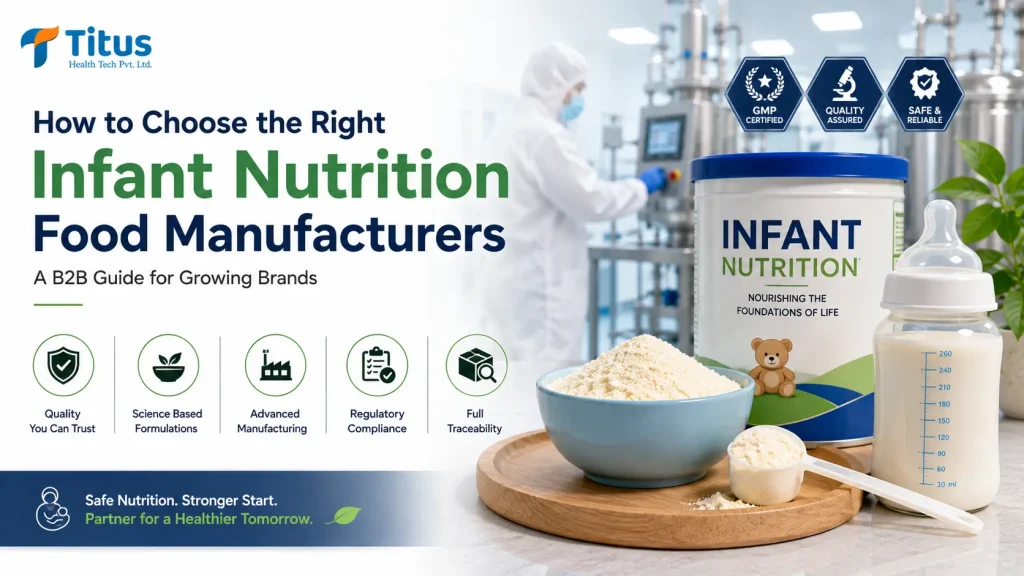
Infant nutrition food manufacturers play a critical role in translating nutrition science, food safety requirements, formulation expertise, and controlled manufacturing into products intended for one of the most sensitive stages of life. Their responsibility extends beyond producing a powder or cereal: it includes ingredient selection, formulation accuracy, process control, packaging, traceability, regulatory compliance, and consistent quality. For businesses developing infant nutrition brands, understanding this role helps explain why the choice of manufacturing partner can influence product reliability and consumer trust.
Infancy is a period of rapid physical development, and nutrition must be considered with particular care. Products intended for infants are formulated according to defined nutritional and safety requirements rather than general food manufacturing practices. Infant nutrition food manufacturers must translate those requirements into repeatable production controls.
A suitable manufacturing system must also reduce risks from contamination, formulation errors, moisture, and packaging failures.
A formulation must be designed around the product category, intended stage, nutritional specification, ingredient functionality, and applicable regulatory requirements. Proteins, carbohydrates, fats, vitamins, minerals, and other permitted components need controlled incorporation.
The formulation process may also consider solubility, dispersibility, stability, sensory characteristics, and ingredient compatibility. These factors matter because a formula must remain consistent during processing, filling, storage, and distribution.
The quality of an infant product depends partly on the quality and suitability of its raw materials. Infant nutrition food manufacturers therefore need disciplined material controls from receipt through production. Manufacturers therefore need defined specifications and supplier controls for ingredients and packaging materials.
Important controls may include:
These controls create traceability from incoming materials to the finished product.
Infant nutrition food manufacturers use multiple control points because quality cannot be established only by testing the finished product. Preventive controls during receiving, dispensing, processing, blending, drying, filling, and packaging help reduce variation and identify potential problems earlier.
Depending on the formulation and manufacturing method, production can involve processes such as spray drying or dry blending. Each process has its own control requirements. Moisture management, temperature, mixing uniformity, equipment hygiene, and handling practices can affect the final product.
Facility design also matters. Segregated areas for raw materials, processing, packaging, and finished goods can support controlled material movement. Cleaning, personnel hygiene, equipment maintenance, and documented procedures are also important.
Quality assurance generally combines process monitoring with analytical and microbiological controls appropriate to the product. Records should make it possible to trace a finished batch back to its relevant raw materials and manufacturing information.
A robust quality system can include:
These systems help maintain consistency rather than relying on end-product inspection alone.
Infant nutrition is a highly regulated category. Infant nutrition food manufacturers must integrate compliance into formulation, processing, packaging, and release activities. In India, the Food Safety and Standards Authority of India provides specific regulations for foods for infant nutrition, alongside requirements covering areas such as labelling, packaging, and food safety. Businesses should review the applicable requirements for their specific product and market.
For authoritative reference, the official FSSAI regulations page includes the Food Safety and Standards (Foods for Infant Nutrition) Regulations, 2020 and related regulatory resources: FSSAI Food Regulations
Regulatory compliance affects formulation specifications, permitted ingredients, claims, labelling, documentation, and release procedures.
An infant nutrition products manufacturer can contribute at several stages, from technical discussions to scale-up and commercial production. The depth of support depends on the manufacturer’s capabilities and the project requirements.
A structured development pathway may include:
This approach reduces avoidable changes and clarifies technical and regulatory considerations.
For companies entering the infant nutrition category, private-label manufacturing can provide access to formulation, production, packaging, and technical capabilities without requiring the brand owner to build a complete manufacturing facility.
Infant nutrition food manufacturers supporting private-label projects need to understand that commercial requirements and technical requirements are closely connected. Product positioning, pack size, target market, forecast volumes, packaging format, shelf-life expectations, and regulatory obligations should be considered together.
When assessing a manufacturing partner, businesses should look beyond price alone. Useful evaluation areas include:
A transparent technical discussion can help a brand determine whether a potential partner is suitable for its product and market. This is especially important when evaluating infant nutrition food manufacturers for a new or expanding range.
Titus Health Tech Pvt. Ltd. is a nutrition products manufacturer based in Gujarat, India, with product categories that include infant milk formulas and baby cereals. This is relevant for businesses assessing infant milk food manufacturers for private-label projects. Its website describes dedicated manufacturing operations, research and product-development capabilities, and private-label, contract manufacturing, and bulk supply solutions.
For infant formula projects, Titus states that its Rakanpur facility supports spray-dried and dry-blended formula, custom formulation, private-label production, and batch-level quality control. Its current manufacturing information also identifies FSSAI licensing and ISO 22000:2018, HACCP, and GMP-compliant processes. These claims should be considered in the context of the specific product and current documentation supplied during a business enquiry.
Titus also describes segregated manufacturing areas covering raw-material storage, dispensing, processing, packaging, and finished-product storage. A separate facility is described for its Satva infant cereal range.
For businesses comparing infant nutrition food manufacturers, these capabilities illustrate why facility design, process control, documentation, and product-development support should be assessed together rather than as isolated features.
Consistency is an important manufacturing objective. Infant nutrition food manufacturers therefore monitor the factors that can introduce batch-to-batch variation. Variations in raw materials, weighing, blending, processing conditions, moisture, packaging, or storage can affect finished-product characteristics.
Infant nutrition food manufacturers therefore need systems that control variability across batches. This includes calibrated equipment, defined process parameters, trained personnel, appropriate testing, documented procedures, and traceability.
Consistency should not be confused with a guarantee of a specific health outcome. Product quality and nutritional suitability depend on the formulation, regulatory requirements, manufacturing controls, storage, preparation, and intended use.
A business selecting a manufacturing partner should conduct appropriate technical and commercial due diligence. This is a key step when comparing infant nutrition food manufacturers. Questions should cover the manufacturer’s relevant product experience, quality systems, formulation support, manufacturing processes, documentation, packaging capabilities, minimum order requirements, lead times, and market-specific compliance.
Infant milk food manufacturers should also be evaluated on how clearly they communicate limitations and requirements. Responsible infant milk food manufacturers should not encourage unsupported health claims or treat infant nutrition as an ordinary consumer-food category.
For companies developing a new product, it is useful to request current regulatory and quality documentation relevant to the proposed project and to confirm which services are included in the manufacturing scope. This helps distinguish capable infant nutrition food manufacturers from suppliers with limited technical support.
They can manufacture products such as infant milk formulas and other specialised infant nutrition products, depending on their approved capabilities, formulations, facilities, and regulatory scope. Infant nutrition food manufacturers should clearly define the product categories within their manufacturing scope.
Infant products are intended for a sensitive population and are subject to specific nutritional, food-safety, labelling, and regulatory requirements. Controlled processes help maintain product quality and consistency.
Businesses should assess relevant manufacturing experience, quality systems, regulatory documentation, formulation capabilities, production methods, packaging options, traceability, and commercial terms. These are core evaluation points for infant nutrition food manufacturers.
Yes, some manufacturers provide private-label services covering formulation, sampling, production, packaging, and labelling support. The exact scope varies by manufacturer and product.
Traceability connects raw materials, processing records, quality checks, packaging, and finished batches. It supports investigation, quality management, and controlled product release.
No. Manufacturing controls support product quality, but individual infant feeding decisions should be discussed with an appropriate paediatrician or qualified healthcare professional.
Packaging helps protect the product during storage and distribution. Material suitability, sealing, moisture protection, labelling accuracy, and handling controls can all affect product integrity.
Titus Health Tech states that it provides infant formula manufacturing, custom formulation, private-label production, bulk supply, and related manufacturing support for B2B partners. Specific services depend on the product and project requirements.
Infant nutrition food manufacturers are an important part of the child-nutrition supply chain because they connect nutrition science with controlled production, quality assurance, food safety, packaging, and regulatory compliance. A responsible manufacturer does more than produce a finished product; it maintains systems that support consistency, traceability, and documented quality.
For businesses entering or expanding in infant nutrition, choosing a partner should be based on technical capability, regulatory understanding, manufacturing controls, documentation, and transparent communication. Titus Health Tech can support businesses exploring infant formula and baby cereal manufacturing through its nutrition manufacturing and private-label capabilities. For product-specific requirements, brands should discuss their formulation, market, packaging, and volume needs directly with the Titus team.
Explore Titus Health Tech’s infant nutrition manufacturing solutions to discuss a suitable manufacturing approach for your product requirements.
WhatsApp us