
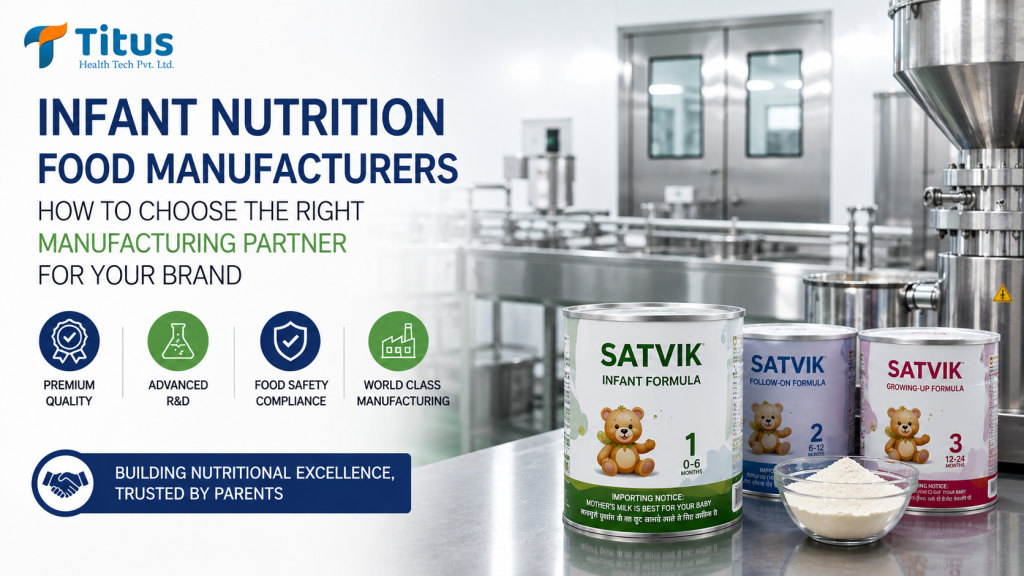
Few categories punish a bad supplier choice as quickly as baby food. A cosmetics brand can survive a mediocre batch. A nutrition brand selling to parents cannot.
That is why the search for infant nutrition food manufacturers deserves more scrutiny than any other decision in your launch plan. Your manufacturer controls formulation, ingredient sourcing, testing and the paperwork that lets your product legally reach a shelf.
Most new entrants underestimate this. They shortlist infant nutrition food manufacturers on price, pick the lowest, then discover that the plant cannot supply stability data or that the label breaches Indian regulations. Rework costs far more than the margin saved.
This guide explains how experienced buyers evaluate infant nutrition food manufacturers, what separates a genuine infant nutrition products manufacturer from a trader, and which questions to ask before signing. If you want to see what a working portfolio looks like, review this range of infant formula products as a reference point.
Infant nutrition food manufacturers produce formulated foods for babies and young children, usually as spray-dried powders. The category covers infant formula, follow-on formula, specialised formula and processed cereal-based complementary foods.
Their work is not simply blending. A competent infant nutrition products manufacturer runs product development, sources dairy and micronutrient inputs, controls a hygienic processing environment, tests each batch and compiles the technical file a regulator expects. Weaker infant nutrition food manufacturers stop at blending and packing.
Most infant nutrition food manufacturers operate on three commercial models:
Understanding which model you need shapes the shortlist, because not all infant milk food manufacturers offer all three.
Your manufacturer becomes a permanent part of your product. When buyers compare infant nutrition food manufacturers, four areas decide whether the partnership holds.
Infant products allow almost no tolerance for variation. Protein content, fat blends, vitamin levels and microbiological limits must sit within tight ranges in every batch, not just the sample you approved. This is where capable infant nutrition food manufacturers separate themselves.
Ask how each lot is released and who signs it off. Serious infant nutrition food manufacturers operate documented quality systems, and you can usually judge the culture from a published quality policy and the discipline of their records.
In India, infant nutrition sits under FSSAI regulation, with BIS specifications applying to infant milk substitutes and cereal-based complementary foods.
The Infant Milk Substitutes Act of 1992 also restricts how these products may be advertised and promoted. A reputable infant nutrition products manufacturer will raise this early, because it constrains your labelling and marketing long before your first shipment.
Formulation is technical work. Adjusting a protein ratio changes solubility, taste and shelf life at the same time, so trial batches and stability studies are unavoidable. The better infant milk food manufacturers budget for this from the start.
Manufacturers with in-house scientists move faster here. Check whether the infant nutrition products manufacturer you are considering employs food technologists and nutrition specialists, or outsources development to a consultant.
Capacity failures usually appear after success, not before it. Some infant nutrition food manufacturers comfortable at 2 tonnes a month struggle at 20, and shortages during a growth phase cost distribution you rarely win back.
Visit the plant if you can. Reviewing manufacturing infrastructure in person tells you more about real capacity than any capability deck.
Work through this checklist with every shortlisted partner. Applied consistently across infant nutrition food manufacturers, it surfaces most problems before a contract exists.
Among established infant nutrition food manufacturers, a supplier who answers all nine without hesitation is already unusual.
Titus Health Tech Pvt. Ltd. is a Gujarat-based infant nutrition products manufacturer working with brands across India and several export markets. Among Indian infant milk food manufacturers, the company reports partnerships with more than 40 private label firms and 10 international partners.
Its facility is certified under GMP, ISO 22000:2018 and HACCP, alongside FSSAI and BIS requirements, which covers the checklist most buyers apply to infant nutrition food manufacturers at the first screening stage.
Unlike infant nutrition food manufacturers that run a single line, production is organised into four divisions:
For brands comparing infant nutrition products manufacturer options, the private label manufacturing service covers formulation, production and packing, while the baby cereal range offers a second product line without a second supplier.
The company was founded by professionals with research backgrounds, and its leadership team reflects that scientific emphasis. Among Indian infant milk food manufacturers, that combination of technical depth and export experience is what most private label buyers are actually shopping for.
The same errors appear repeatedly when brands select infant nutrition food manufacturers.
Each mistake is avoidable, and each is expensive once production has started.
Several shifts are changing what buyers expect from infant nutrition food manufacturers.
Manufacturers investing in laboratories and documentation systems are the ones positioned for this.
If you are evaluating infant nutrition food manufacturers for a new range, or moving production from an existing infant nutrition products manufacturer, the practical first step is a technical conversation rather than a quotation request. Discuss your target market, formulation and volume, then ask what documentation the plant can provide.
You can contact the Titus Health Tech team to discuss private labelling, contract manufacturing or bulk supply, and request certification copies before you commit to anything.
Selecting among infant nutrition food manufacturers comes down to evidence rather than persuasion. Certifications you have verified, laboratories you have seen, references you have called and contracts that state who is responsible for what.
Brands that invest time at this stage spend far less time firefighting later. The right infant nutrition products manufacturer protects your registration, your shelf life and ultimately your reputation with parents, which is why the strongest infant nutrition food manufacturers win business on documentation rather than discounts.
Take the checklist above into your next supplier meeting. The answers will tell you quickly which infant milk food manufacturers are equipped for the category and which are simply willing to take the order.
Infant nutrition food manufacturers handle formulation, sourcing, blending, testing, packing and regulatory documentation, letting brands sell without building a plant.
Request current FSSAI, GMP, HACCP and ISO 22000 certificates, then check issue dates and scope. Genuine infant milk food manufacturers share these without hesitation.
MOQ varies with product and pack size. Most infant nutrition products manufacturer partners set batch minimums so blending, testing and packing remain commercially viable.
Yes. A capable infant nutrition products manufacturer can adjust protein, fat blends, vitamins and minerals within the limits set by FSSAI and the applicable BIS specification.
Usually several months. Formulation, trials, stability data, label approval and licensing all take time, and infant nutrition food manufacturers cannot compress the regulatory steps.
Many infant milk food manufacturers supply export documentation and registration dossiers, though import approval in the destination country remains the brand owner’s responsibility.
Yes. India’s IMS Act restricts advertising and promotion of infant milk substitutes and feeding bottles, so plan label and marketing compliance before launch.
India combines scientific expertise, competitive costs and export-ready plants. Established infant nutrition food manufacturers here also understand multi-country regulatory requirements.
WhatsApp us