
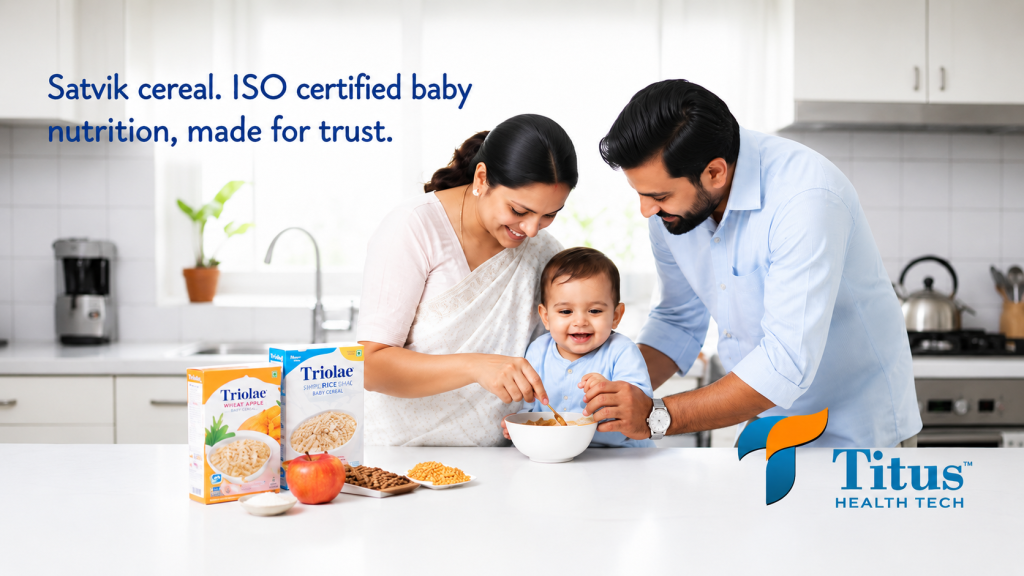
Launching a baby nutrition product is not the same as launching an ordinary food line. Parents expect clean ingredients, reliable taste, and safe processing. Retailers expect consistency. And brands need a manufacturing partner that can handle quality, compliance, and scale without creating risk.That is exactly where Satvik cereal matters.
In India, the category is shaped by real regulatory expectations, not just marketing language. Under FSSAI’s infant nutrition framework, processed cereal-based complementary food is meant for infants after 6 months up to 24 months, which makes formulation, hygiene, and documentation especially important. Titus Health Tech presents its baby cereal range under SATVA and publicly positions its facilities as GMP, HACCP, and ISO 22000:2018 certified, alongside private label and contract manufacturing support.
In this article, you will see what Satvik cereal means, how it is made, why quality systems matter, what common problems brands face, and how to choose the right partner. You will also see how Titus Health Tech’s baby cereal range and manufacturing approach fit the needs of Indian brands looking for dependable infant nutrition support.
In simple terms, Satvik cereal is baby cereal positioned around clean, gentle, and thoughtfully made nutrition. In practice, it usually refers to complementary cereal foods designed for young children, with an emphasis on simplicity, digestibility, and trustworthy ingredient choices.
For Indian buyers, the definition matters because the product is not just “baby food.” It falls into a regulated nutrition category. FSSAI defines processed cereal-based complementary food for infants after 6 months up to 24 months, which means the formula, labeling, and production process must be designed with care. That is why a serious Infant cereal manufacturer in India must think beyond taste and focus on safety, traceability, and consistent output.
Titus Health Tech’s own site places its baby cereal products under the SATVA division and lists variants such as Triolac Rice, Triolac Rice & Moong Dal, Triolac Wheat Apple, and Triolac Multigrain & Fruits. That range shows how Satvik-style cereal can be expressed through simple grains, fruit blends, and complementary formulations that fit different feeding needs.
The process starts with selecting raw materials that are suitable for infant nutrition. That includes cereals, pulses, milk ingredients where relevant, and other approved components that support the intended age group and nutrition profile. The goal is not to create a long ingredient list. The goal is to keep the formulation controlled, understandable, and stable.
A strong Satvik cereal formula is built around texture, digestibility, nutrient balance, and shelf stability. This is where working with an experienced Best infant food manufacturer in India becomes important, because the formulation has to satisfy both the product promise and the regulatory framework. Titus Health Tech’s private label offering includes infant formulas, baby cereals, health supplements, sport nutrition powders, and specialized nutrition products, which suggests a broader formulation capability than a single-product factory.
The production stage is where quality either becomes visible or falls apart. Clean handling, controlled processing, and line discipline are essential. Titus Health Tech says its facilities operate in accordance with FSSAI and Indian FDA requirements and are certified to GMP, HACCP, and ISO 22000 . ISO 22000 is an international food safety management standard that helps organizations control food safety hazards across the food chain.
Before product release, a reliable manufacturer checks whether the batch meets specifications for safety, consistency, and packaging integrity. In infant nutrition, testing is not a formality. It is part of brand trust. Documentation, batch records, and review systems make it easier to manage quality over time.
Packaging protects the product from moisture, contamination, and handling damage. It also carries the trust story: age suitability, ingredient clarity, preparation guidance, and regulatory details. For infant cereal, packaging is part of the safety system, not just a design exercise.
A well-managed Satvik cereal line can create value for both parents and brands.
For brands, the biggest benefit is predictability. When batch quality stays stable, customer complaints fall, repeat purchase improves, and operations become easier to scale. That is why many growing labels prefer working with a manufacturer that already understands both infant cereal and broader nutrition production.
Satvik cereal is a strong fit for brands and businesses that want to enter or expand in baby nutrition without building a plant from scratch.
Titus Health Tech publicly offers contract manufacturing and private label services, which makes this model practical for businesses that want speed, support, and technical depth. The brand also shows a dedicated baby cereal category on its site, which is helpful for buyers who want to see actual product formats before starting a discussion.
In infant nutrition, the difference between “good enough” and “trusted” is usually found in process, not promises. That is why ISO-style systems matter. ISO 22000 is built around food safety management, risk control, and a structured approach to producing safe food consistently. For baby cereal brands, that structure supports quality assurance at enterprise level.
Titus Health Tech’s public quality policy says the company follows rigorous quality assurance across R&D, sourcing, manufacturing, testing, and distribution, with regular reviews and audits. That is the kind of operational discipline brands should look for when they want a long-term manufacturing partner instead of a one-time supplier.
This matters even more in India because infant nutrition is a regulated category. The current FSSAI framework for infant nutrition products includes specific rules for complementary foods, and those rules shape how a brand must think about composition, age suitability, and labeling. A mature Infant cereal manufacturer in India understands that compliance is not a box to tick; it is part of the product itself.
One common problem is inconsistent product quality across batches. The solution is controlled sourcing, written specifications, and routine in-process checks. Another common problem is weak documentation, which can create issues during audits, launches, or distributor reviews. The best solution is a manufacturer with strong records, review systems, and quality governance.
A third issue is poor coordination between formulation and packaging. A cereal can be technically sound but still fail if the pack does not protect it properly or explain it clearly. This is where an experienced partner helps. A company like Titus Health Tech, which publicly combines private label support, product range depth, and certified quality systems, gives brands a more organized starting point.
Another problem is choosing on price alone. In baby food, the lowest quote is rarely the best business decision. Quality failures cost more than a sensible manufacturing price ever saves. That is especially true when the product is aimed at infants and young children.
When selecting a Satvik cereal partner, focus on what actually protects your brand.
A good partner should not only show you a product list. They should show you a process. Titus Health Tech’s site highlights certifications, private label services, infrastructure, and a visible baby cereal category, which are useful signals when evaluating a manufacturing partner for infant nutrition.
For brands that want to compete seriously in baby nutrition, the right question is not “Who can make this cheapest?” The better question is “Who can make this safely, consistently, and at scale?”
Satvik cereal is a baby cereal positioned around clean, gentle, and trustworthy complementary nutrition for young children. In India, it should align with infant food regulations.
It can be suitable when it is formulated as a complementary food for the correct age group and follows the right regulatory and safety standards. Always check age guidance on the pack.
ISO 22000 is a food safety management standard that helps manufacturers control hazards and maintain consistent safety across the production chain.
Yes. Titus Health Tech publicly lists baby cereals, private label manufacturing, and contract manufacturing support on its site.
Its site shows products such as Triolac Rice, Triolac Wheat Apple, Triolac Rice & Moong Dal, and Triolac Multigrain & Fruits.
Check certifications, hygiene systems, testing, regulatory alignment, packaging quality, and the manufacturer’s ability to support scale and documentation.
Private label helps brands launch faster, reduce setup complexity, and work with a partner that already understands formulation and manufacturing discipline.
A strong Satvik cereal program is not just about a gentle-sounding product name. It is about making baby nutrition that is safe, consistent, compliant, and easy for parents to trust. In India, that means working within FSSAI rules, using structured food safety systems, and choosing a manufacturing partner that can support quality at every stage.
Titus Health Tech publicly presents itself as a nutrition manufacturer with baby cereal products under SATVA, private label and contract manufacturing support, and certified quality systems. For brands looking for a serious Best infant food manufacturer in India or a dependable Infant cereal manufacturer in India, those are the kinds of signals that deserve attention.
For brands ready to build a cleaner, more trusted baby nutrition line, the next step is simple: review the prconoduct range, check the quality pages, and start a manufacturer conversation with clear specifications.
Explore Titus Health Tech’s baby cereal range, quality standards, and private label support if you are building a trustworthy infant nutrition brand in India.
WhatsApp us