
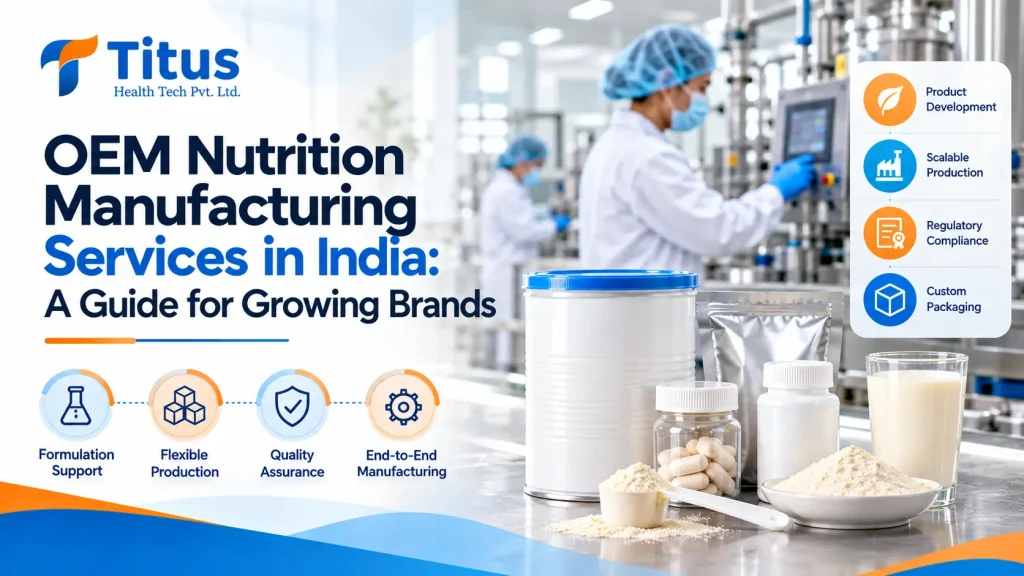
As nutrition and wellness brands scale, many reach a point where in-house production no longer makes commercial sense, and OEM nutrition manufacturing services become the practical route to consistent supply. Under an OEM arrangement, a specialist facility produces nutrition products to a brand’s requirements while the brand retains ownership of its name, positioning and distribution.
This article is general educational information for brands. It is not medical or regulatory advice.
OEM nutrition manufacturing services cover the sourcing, formulation support, production, testing and packaging of nutrition products that are sold under another company’s brand. An OEM nutrition manufacturer in India typically operates the equipment, quality systems and technical team needed to make powders, supplements and related products, so that the brand can focus on marketing, sales and customer relationships. The scope varies by facility, so brands should confirm in writing which stages are included.
Building a compliant nutrition factory requires capital, specialist staff and time. For a growing brand, OEM nutrition manufacturing services offer a way to scale production without taking on that burden. Common reasons include:
Terminology varies across the industry, and the differences affect formulation ownership, flexibility and timelines.
| Model | How It Works | Formulation | Typical Fit |
| Private label | Brand sells a manufacturer-developed product under its own name | Manufacturer’s base | New brands seeking a faster launch |
| Contract manufacturing | Manufacturer produces to the brand’s specification | Brand-defined | Brands with an established recipe |
| Custom development | Product developed around the brand’s brief | Developed for the brand | Differentiated products |
| Bulk supply | Large volumes for repacking or distribution | Agreed specification | Distributors and larger brands |
A private label nutrition products manufacturer usually starts from an existing base formula, which reduces development time. A nutrition supplement contract manufacturer produces to the brand’s own specification, so recipe confidentiality and change control should be agreed in writing. Third party nutrition manufacturing in India is the broader term for outsourcing the full production cycle, and brands using it should clarify who is responsible for sourcing, testing and batch release.
Brands seeking a differentiated product often turn to custom nutrition product manufacturing, where the formulation is built around a defined brief covering target consumer, nutrient profile, taste, texture and price point. Custom nutrition product manufacturing involves bench trials, stability evaluation and scale-up, so timelines are longer than with an existing base formula. Brands should agree who owns the final recipe before development begins, and should ask how trial results and revisions are documented.
Infant products demand stricter hygiene, ingredient control and documentation than most food categories. Infant nutrition contract manufacturing therefore requires a facility with segregated processing, validated cleaning and detailed batch records. Brands assessing infant nutrition contract manufacturing should ask how composition, labeling and safety requirements are managed, and how traceability is maintained from raw material to finished pack. Titus Health Tech’s infant formula range illustrates the type of products produced in this category.
Many nutrition products are powders, including protein blends, health drinks, cereals and formulas. A nutrition powder manufacturing company needs dry blending equipment, controlled humidity and reliable filling and sealing. Blending uniformity matters most for micro-ingredients such as vitamins and minerals, where small errors change the nutrient content of each serving. Brands should ask a nutrition powder manufacturing company how it verifies blend uniformity and how it prevents cross-contact between products.
Distributors and established brands sometimes prefer to source in volume and repack under their own systems. A bulk nutrition product manufacturer in India should confirm minimum order quantities, batch sizes, lead times and packaging formats before an order is placed. Bulk supply also raises questions about storage conditions and transport, because powders absorb moisture and need protective packaging. When comparing a bulk nutrition product manufacturer in India with a private label partner, brands should consider whether they have the packaging and labeling capability to manage the finished product themselves.
Selecting a partner calls for evidence rather than assurances. When reviewing OEM nutrition manufacturing services, or comparing a private label nutrition products manufacturer against a contract partner, brands should look at the following:
Quality control is where OEM nutrition manufacturing services are most visibly tested. Raw materials should be verified on receipt, critical points monitored during blending and filling, and finished batches checked against specification before release. Brands should ask how out-of-specification results are investigated and communicated, and how long batch records are retained. A nutrition powder manufacturing company that documents these steps clearly is better placed to support audits, customer queries and regulatory inspections. Third party nutrition manufacturing in India works best when responsibilities for testing and release are written into the agreement rather than assumed.
The cost of OEM nutrition manufacturing services depends on ingredient grade, formulation complexity, pack format, order volume and testing scope. Smaller runs usually cost more per unit because fixed activities such as changeovers and documentation are spread over fewer units. Brands should request an itemized quotation and compare it across partners like for like, since a low headline figure may exclude testing, packaging or documentation that becomes necessary later.
Nutrition products sold in India must comply with food safety rules covering composition, labeling and permitted claims. According to the Food Safety and Standards Authority of India (FSSAI), health supplements, nutraceuticals and foods for special dietary use are regulated under standards notified under the Food Safety and Standards Act, 2006. A responsible OEM nutrition manufacturer in India will explain how these requirements apply to a brand’s product and will advise against unsupported health claims. Brands should request current licensing and quality documentation and confirm its scope before committing to production.
Titus Health Tech Pvt. Ltd. is a nutrition products manufacturer based in Gandhinagar, Gujarat, with divisions covering infant nutrition, baby cereals, speciality nutrition and sports nutrition. The facility operates under GMP, ISO 22000:2018 and HACCP-aligned practices. Brands exploring a private label nutrition products manufacturer can review how private labeling is organized across these divisions, and can examine the manufacturing infrastructure to understand how production is set up.
Brands planning to scale with OEM nutrition manufacturing services are encouraged to contact Titus Health Tech to discuss formulation, packaging and volume requirements for their OEM nutrition manufacturing services project.
OEM nutrition manufacturing services give growing brands a way to scale production while keeping control of their brand, provided the partner is chosen on evidence of quality systems, formulation capability and transparent documentation. Whether a brand needs a nutrition supplement contract manufacturer for a defined recipe or custom nutrition product manufacturing for a new concept, the decision should rest on process discipline rather than price alone. Titus Health Tech supports nutrition brands across multiple categories, and its team welcomes enquiries about requirements and next steps for OEM nutrition manufacturing services of any scale.
OEM nutrition manufacturing services involve a specialist facility producing nutrition products under another company’s brand, covering sourcing, production, testing and packaging.
An OEM partner typically produces to the brand’s requirements, while private label often starts from the manufacturer’s existing base formula. Many facilities offer both.
It means outsourcing the full production cycle to a specialist, so the brand can focus on marketing and distribution.
It produces supplements to the brand’s own specification and manages sourcing, blending, filling and batch testing under agreed quality terms.
When it wants a differentiated formula built around its own brief, accepting a longer development timeline than with an existing base formula.
Check hygiene design, ingredient control, batch traceability and regulatory knowledge, and ask for supporting documentation.
It should confirm minimum order quantities, batch sizes, lead times, packaging formats and dispatch arrangements.
No. It is general information for brands. Brands should confirm current requirements with the relevant authority.
WhatsApp us