
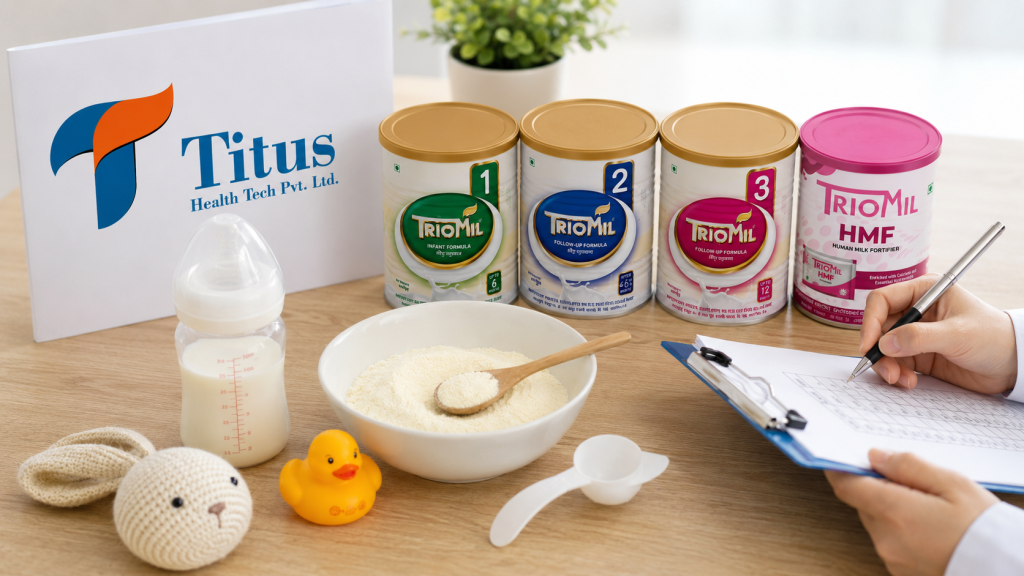
Building a baby nutrition brand is never just about filling a package and printing a label. Parents compare every detail. Health-conscious families notice the language on the box. Pregnant women often ask one question before anything else: can this brand be trusted? That is where this model becomes so powerful. It gives a brand a faster path to market without losing the discipline, quality focus, or product consistency that this category demands. For Titus Health Tech, that matters because the company positions itself around private label infant formula, contract manufacturing, baby cereals, and custom formulation from India. For many founders, infant milk formula private label is less about speed alone and more about keeping the launch controlled.
Infant milk formula private label is a manufacturing model where a brand sells infant nutrition under its own label while a specialized production partner handles formulation support, quality systems, packaging, and supply. It is often chosen by new and growing nutrition brands because it can reduce launch friction, improve speed to market, and keep product development more focused.
In India, the infant nutrition category is becoming more structured and more competitive. Titus Health Tech presents itself as one of India’s leading private label manufacturers of infant formula and nutrition powders, with contract manufacturing, bulk supply, and custom formulation support. Its public product range also includes infant formula, baby cereals, and specialized nutrition categories. That combination is exactly why brands look at this approach as a practical growth model.
A good reason to consider this approach is simple: it lets a brand focus on market trust while the manufacturing partner focuses on production discipline. That separation is useful in a category where accuracy, consistency, and communication matter as much as taste or packaging. In fact, infant milk formula private label fits especially well when the brand wants a cleaner way to enter the market without building a factory from day one.
Most serious buyers are not only asking for a formula. They want a dependable process. They want a partner who understands infant formula production, private label nutrition manufacturing, and custom formulation. also want reassurance that the product can be supported by quality control, regulatory compliance, and scalable production.
That is where the phrase Infant formula manufacturer in India becomes important in search and in decision-making. It signals technical capability, India-based production, and a local support structure that can help with timelines, documentation, and market alignment. For growing brands, Infant formula manufacturer in India also suggests easier coordination across launch stages.
Building in-house can feel attractive at first, but it usually brings higher cost, slower launch speed, and more internal complexity. The private label route is different because the brand can move with more flexibility while still maintaining a strong commercial identity.
A private label model is often better when a company wants to test demand, expand into a new region, or launch a specialized line such as follow-up formula, lactose-free formula, or low birth weight formula. Titus Health Tech’s public product pages show several of these specialized formats, including HMF, LBW, and LF offerings. For many founders, infant milk formula private label is the cleaner path because it keeps the launch focused and the execution simpler.
First, the brand defines the product goal. Is it for standard infant nutrition, a specialty need, or a broader family nutrition line? Next comes formulation and specification alignment. Then comes packaging, branding, quality review, and supply planning. Finally, the product moves into launch and replenishment.
This is why infant milk formula private label is not just a manufacturing decision. It is a brand-building decision. When the process is structured well, the brand can move faster without appearing rushed. A strong infant milk formula private label partner keeps specifications, samples, and packaging aligned from the start.
Strong buyers rarely start with design. They start with proof. They ask about quality systems, process consistency, and whether the partner can support product expansion later. In the Indian market, public trust signals often include GMP, HACCP, ISO 22000, BIS, and FSSAI references. Competitor sites such as Nutribray highlight those standards prominently, along with infant formula, follow-up formula, LF, LBW, hypoallergenic formulas, and infant cereals.
That means this approach is strongest when the manufacturer can support both the commercial side and the technical side of the brand story. If the promise is premium nutrition, the manufacturing story has to feel equally premium. A serious Largest private label infant formula manufacturer position usually helps here because it signals scale, breadth, and readiness for larger brand programs.
A company that only makes one product can be useful. A company that supports multiple infant nutrition formats is usually more valuable. Titus Health Tech publicly shows infant formula, baby cereals, HMF, LBW, LF, and premium formula ranges on its site. That broader footprint matters because brands often expand after the first launch.
When a partner can move from infant formula to adjacent nutrition categories, growth becomes easier. That is one reason the phrase Largest private label infant formula manufacturer in India is so attractive to enterprise buyers. It reflects scale, depth, and market confidence.
The first mistake is choosing a partner only because the price looks low. In infant nutrition, low friction is usually more valuable than low cost. The second mistake is ignoring whether the partner can support future product extensions. The third mistake is treating packaging as the whole brand instead of part of the trust signal.
Another common issue is not planning for supply continuity. A launch that looks strong on day one can fall apart if the manufacturing chain is weak. That is why this model works best when quality and logistics are both treated as strategic assets.
Myth: private label always means generic.
Fact: a strong private label program can be highly customized.
Myth: branded nutrition must be built in-house.
Fact: many serious brands use external manufacturing to move faster and stay focused.
Myth: the label does all the work.
Fact: trust comes from the product experience, documentation, and supply consistency.
Myth: the biggest partner is always the best one.
Fact: the best fit depends on product fit, category depth, and communication quality.
A regional nutrition brand may want to enter a new city or state with a line that feels modern, safe, and familiar. Instead of spending heavily on infrastructure, the brand can use this model to launch a focused range, test demand, and then expand into related lines such as baby cereals or specialty formulas.
This is especially useful when the brand wants to serve parents who compare products carefully and care about quality signals more than flashy marketing. In that kind of launch, infant milk formula private label works best because it gives the brand speed without losing control.
If the brand is unsure about formulation, product positioning, regulatory language, or how to scale beyond a first SKU, that is the right time to seek a specialist partner. The same is true when internal teams can manage marketing but not production complexity.
That is where an Infant formula manufacturer becomes valuable. It helps reduce uncertainty, especially when the product has to perform well in both retail and trust-driven channels. In practice, Infant formula manufacturer is often the safer first call when the product roadmap is still evolving.
The private label route is best understood as a trust-building system, not just a production shortcut. A good partner helps the brand stay organized, stay compliant, and stay ready for growth. That is why the strongest manufacturers do more than fill an order. They help shape the product story itself.
For growing nutrition companies, the appeal is not only speed. It is the ability to launch with more confidence and less chaos. And in baby nutrition, that difference matters. For brands comparing options, the Largest private label infant formula manufacturer in India can be the more strategic choice when scale is part of the plan.
1) What is infant milk formula private label?
It is a business model where a brand sells infant formula under its own name, while a manufacturing partner handles production, packaging, and supply. It is a practical option for brands that want speed and control without building a factory.
2) Why do brands choose infant milk formula private label?
Brands choose this model because it reduces launch complexity and saves time. It also lets them focus more on marketing, distribution, and customer trust while the technical work is handled by the manufacturer.
3) How do I choose the right infant formula manufacturer in India?
Look at product depth, quality systems, communication, and whether the partner can support future growth. The best manufacturer should feel reliable, clear, and easy to work with from the start.
4) Why is quality control so important in infant formula?
Because parents trust this product for daily baby nutrition, so even a small mistake can matter. A strong manufacturer should have good quality checks, compliance support, and consistent batch control.
5) Is infant milk formula private label good for first-time brands?
Yes, it is often a smart choice for new brands. It helps them test the market first, without spending too much on factory setup and heavy operations.
6) What products can grow beyond infant formula?
Many brands later expand into baby cereals, specialty formulas, and related nutrition products. This makes the manufacturing partnership more useful for long-term business growth.
7) Why do brands search for the largest private label infant formula manufacturer in India?
They usually want scale, broader product support, and stronger confidence in long-term supply. A larger partner can often support bigger brand plans and future expansion better.
For brands that want to move quickly without sacrificing trust, infant milk formula private label offers a smart and practical path. It combines brand ownership with production support, which is exactly what many modern nutrition businesses need. For growing brands, infant milk formula private label is often the difference between a rushed launch and a confident launch.
Titus Health Tech positions itself around infant formula, baby cereals, private label manufacturing, and custom formulation in India, making it a relevant option for brands exploring this model. It is based in Ahmedabad, India, and publicly presents a broad nutrition manufacturing footprint that includes infant formula products, specialty formats, and private label support. To learn more, visit Titus Health Tech and review the full product and private label offering before you launch your next step. When the fit is right, infant milk formula private label can support scale with less chaos and more trust.
WhatsApp us