
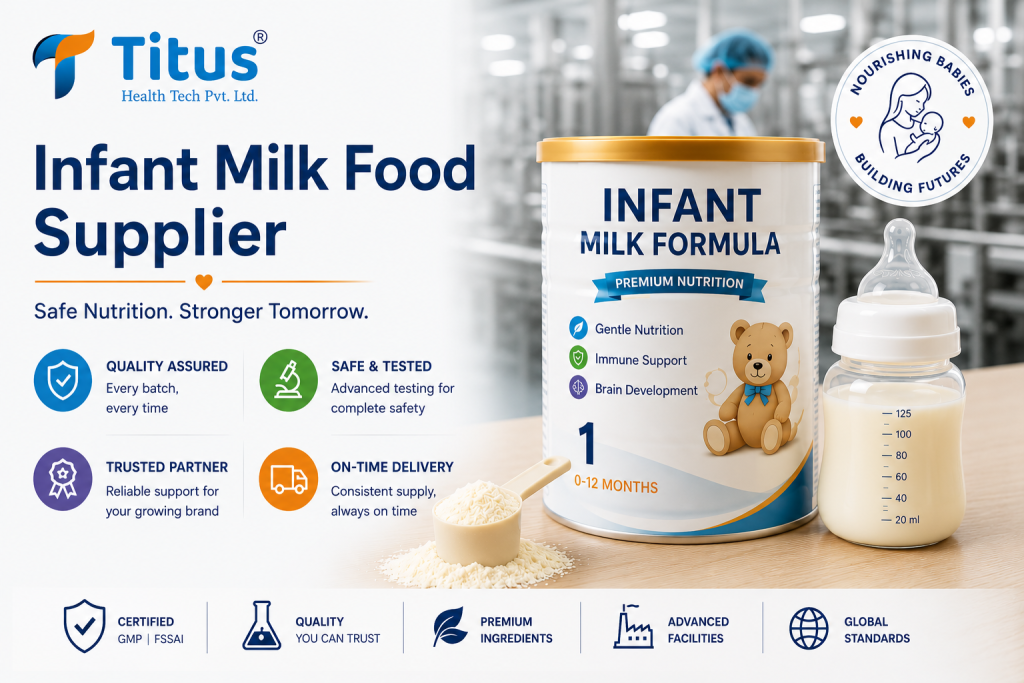
Infant milk food is bought on trust and sold on proof. A parent trusts the tin; a regulator wants the paperwork behind it. Only the plant delivers both.
That makes selecting an infant milk food supplier a technical decision, not a purchasing one. Ingredient origin, batch testing, packaging barrier and traceability records all sit with the plant.
Brands treating the choice of infant milk food supplier as a price negotiation learn this late, when a distributor asks for a certificate of analysis nobody can produce.
This guide explains how to evaluate an infant milk food supplier: what to verify, what to ask, and where brands lose time and money. For a sense of a developed line, this infant formula product range gives a practical reference.
Infants take a single product as their entire nutrition for months. No varied diet offsets a shortfall, which is why the standard applied to an infant milk food supplier differs from ordinary food supply.
A capable infant milk food supplier therefore carries responsibility well past your purchase order:
The right infant milk food supplier protects your registration, shelf life and standing with every retailer downstream.
Four areas separate a genuine infant milk food supplier from a food processor willing to take the order.
Start with certificate scope, not count. A licence held by an infant milk food supplier for nutritional powders may not extend to infant milk substitutes, and that matters at customs.
Look for a current FSSAI licence, GMP, HACCP and ISO 22000, each naming your category. Reviewing a supplier’s quality policy shows how seriously those systems are treated day to day.
Two hazards dominate every control plan: Cronobacter sakazakii and Salmonella. Both are managed through hygienic zoning, environmental monitoring and validated cleaning, not end-product testing alone.
Established infant milk food manufacturers describe their environmental monitoring programme without prompting, because it defines how the site runs.
Formulation work is unavoidable. Adjusting a whey-to-casein ratio changes solubility, taste and stability at once, so a competent infant milk food supplier runs trials and shelf-life studies before any commercial run.
An infant nutrition products supplier with in-house technologists resolves these faster. Ask whether development is internal or outsourced, since the answer predicts how quickly problems get fixed.
Capacity problems surface after success. Confirm the infant nutrition products supplier can serve your third-year volume, and ask how raw material contracts hold when dairy prices move.
Inspect the site if you can. An hour in manufacturing infrastructure tells you more than any capability presentation.
Take this list into every meeting. Applied consistently to each infant milk food supplier on your shortlist, it sorts the field quickly.
An experienced infant nutrition products supplier answers all nine without hesitation. Vagueness on any one is worth noticing.
Understanding the production discipline helps you ask better questions. Reputable infant milk food manufacturers work across five control points.
Skimmed milk powder, demineralised whey, oil blends, lactose and premixes are bought against specification. A disciplined infant nutrition products supplier verifies certificates on arrival rather than filing them unread.
Testing runs from incoming goods to finished batch: protein, fat, moisture, vitamin assays, heavy metals, aflatoxin and a microbiological panel. A serious infant milk food supplier releases stock only against those results.
Fat oxidation and vitamin loss are packaging problems as much as formulation ones. Experienced infant milk food manufacturers use barrier laminates, tins and nitrogen flushing to protect shelf life, so pack specification belongs in your technical agreement.
Every batch should trace to its ingredient lots within hours. Ask when the infant milk food supplier last ran a mock recall, and how long reconciliation took.
In India, FSSAI regulates the category and BIS specifications apply to infant milk substitutes, so infant milk food manufacturers work to both. The Infant Milk Substitutes Act of 1992 also restricts advertising and promotion, shaping your labelling long before launch. For exports, Codex standards usually govern the dossier.
Titus Health Tech Pvt. Ltd. manufactures nutrition powders in Gandhinagar, Gujarat, serving brands in India and several export markets.
The site holds GMP, ISO 22000:2018 and HACCP certification alongside FSSAI and BIS requirements. The company reports working with more than 40 private label firms and 10 international partners, a useful indicator when comparing any infant milk food supplier on experience rather than claims.
Unlike suppliers running a single line, this infant milk food supplier organises production into four divisions:
For brands entering the category, its private label manufacturing service covers formulation, production and packing under your own brand, while the baby cereal range allows a second line from the same infant nutrition products supplier.
The company was founded by professionals with research backgrounds, and the company overview sets out that scientific focus. Among Indian infant milk food manufacturers, technical depth plus export documentation experience is what private label buyers actually want.
These errors repeat whenever brands appoint an infant milk food supplier, and each has a straightforward remedy.
Buyer expectations are moving, changing what you should demand from an infant milk food supplier.
Suppliers investing in laboratories and documentation will meet these comfortably. Those competing only on price will not.
If you are appointing an infant milk food supplier for a new range, or replacing one that has stopped keeping pace, open with a technical discussion rather than a quotation.
Share your target market, formulation brief and volumes with the infant nutrition products supplier, then ask what documentation the plant can provide. You can contact the Titus Health Tech team to discuss infant milk food manufacturing, private label and OEM production, product development or long-term supply.
Selecting an infant milk food supplier comes down to evidence you checked yourself: certificates verified, laboratories seen, references called, responsibilities written down. No infant milk food supplier should resist that scrutiny.
Brands that do this early spend far less time managing problems later. The right infant nutrition products supplier protects your registration, your shelf life and your standing with the parents who buy the product.
Use the checklist at your next meeting. The answers show which infant milk food manufacturers are equipped for this category, and which are simply willing to quote.
Certification scope. Confirm the FSSAI licence, GMP, HACCP and ISO 22000 certificates specifically name infant milk substitutes, then verify the dates before anything else.
Private label uses the supplier’s existing formulation under your brand. Contract manufacturing produces your own specification, so time and cost are higher.
MOQ depends on pack size and product. Most infant milk food manufacturers set batch minimums that keep blending, testing and packing consistent and commercially viable.
Usually several months. Formulation, trials, stability studies, label review and licensing each take time, and no supplier can shorten the regulatory steps.
Many prepare dossiers and export documentation. Import approval in the destination country still rests with the brand owner, not the infant nutrition products supplier.
Barrier packs and nitrogen flushing limit fat oxidation and vitamin loss. Pack specification affects shelf life as directly as the formulation does.
Yes. India’s IMS Act restricts advertising and promotion of infant milk substitutes and feeding bottles, so labelling and marketing compliance must be planned before launch.
India offers scientific expertise, competitive costs and export-ready plants. An established infant milk food supplier there also understands multi-country regulatory requirements.
WhatsApp us