
Table of Contents
Infant Formula Stages Explained: Stage 1, 2 and 3 Formulations…………………………………………………. 1
Why Infant Formula Stages Exist………………………………………………………………………………………………………….. 3
Triomil Stage 1: Standard Formula for the First Six Months…………………………………………………….. 3
Triomil Stage 2: Follow-On Formula for Growing Infants………………………………………………………….. 3
Triomil Stage 3: Growing-Up Milk for Toddlers……………………………………………………………………………… 4
Comparing the Infant Formula Stages at a Glance…………………………………………………………………………. 4
Follow-On Formula and Growing-Up Milk: Key Differences………………………………………………………. 4
How Manufacturers Approach Stage 1 2 3 Baby Formula Development…………………………….. 4
Infant Formula Stage 1: A Closer Look at Early Nutrition………………………………………………………….. 5
Why Manufacturing Experience Across Stages Matters………………………………………………………………. 5
Conclusion………………………………………………………………………………………………………………………………………………………. 5
Frequently Asked Questions……………………………………………………………………………………………………………………. 5
1. What is the main difference between infant formula stage 1 and stage 2?………………. 5
2. Is growing-up milk the same as infant formula?…………………………………………………………………… 5
3. Can a baby switch directly from Stage 1 to Stage 3 formula?…………………………………………. 5
4. Why do infant formula stages have different nutrient levels?……………………………………….. 6
5. Is follow on formula necessary for every infant?………………………………………………………………… 6
6. How is formula milk by age regulated in India?……………………………………………………………………. 6
7. Do private label brands need separate approval for each formula stage?……………….. 6
8. What quality checks are most important for Stage 1 products?……………………………………. 6
Caregivers and private label brands alike often need clarity on infant formula stages before choosing or developing a product suited to a growing child’s age. Titus Health Tech manufactures across these infant formula stages under its Triomil range, offering Stage 1, Stage 2 and Stage 3 formulations for different phases of a child’s early development.
This article explains what distinguishes each of the infant formula stages, how follow-on and growing-up milk fit into the picture, and what manufacturers consider when formulating for each age band.
A newborn’s digestive system, nutrient requirements and growth rate are very different from those of a toddler approaching two years of age, which is exactly why the infant formula stages framework was developed. Regulators require formulations to reflect age-appropriate energy density, protein levels and micronutrient composition, so a single generic formula is not considered suitable across all these infant formula stages. The Food Safety and Standards (Foods for Infant Nutrition) Regulations, 2020, notified by the Food Safety and Standards Authority of India, sets out separate compositional standards for infant formula and follow-up formula precisely because nutrient needs shift as a child moves through these stages.
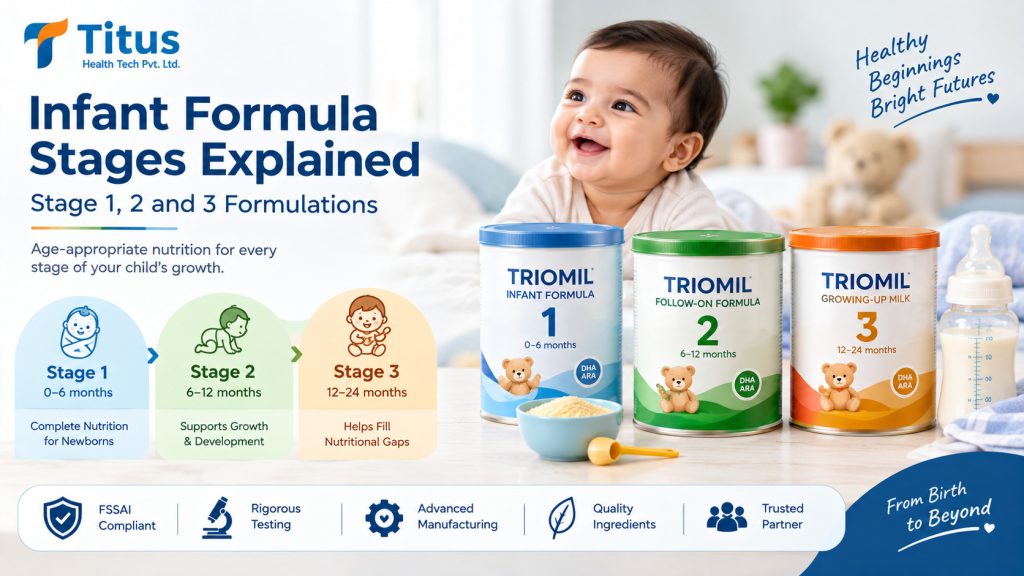
Triomil stage 1 is formulated for infants from birth, aligning with the nutrient density and composition expected of a standard infant formula during the exclusive feeding period. Formulations at this stage typically emphasise:
Triomil stage 1 is positioned as a standard formula option within Titus Health Tech’s Dugdha division, alongside a premium variant for families seeking an enhanced nutrient profile, and it forms the entry point into the wider infant formula stages range.
Once an infant moves past six months and begins receiving complementary foods, triomil stage 2 becomes relevant as part of the wider follow on formula category. Follow on formula is designed to work alongside solid or semi-solid complementary foods rather than as the sole source of nutrition, which changes its compositional targets compared to Stage 1. Triomil stage 2 formulations generally adjust protein and mineral levels to complement, rather than replace, the broader diet an infant is beginning to receive at this age, marking the second step across the infant formula stages continuum.
Triomil stage 3 falls into what is commonly described as growing up milk, intended for toddlers who are consuming a more varied family diet but may still benefit from a fortified milk-based product. At this stage, formulations often focus on filling common nutritional gaps, such as iron, vitamin D and certain B vitamins, rather than replicating the near-complete nutrition profile required at birth. Triomil stage 3 sits alongside Titus Health Tech’s premium formula line for families seeking additional nutrient support during the toddler years, completing the company’s infant formula stages portfolio.
The table below summarises how the three infant formula stages typically differ in purpose and composition.
| Stage | Typical Age Range | Primary Role | Formulation Focus |
| Stage 1 | Birth onwards | Sole or primary source of nutrition | High energy density, DHA/ARA, complete micronutrients |
| Stage 2 (Follow-on) | After 6 months | Complements complementary foods | Adjusted protein and mineral levels |
| Stage 3 (Growing-up milk) | Toddler years | Supplements a varied family diet | Fortification for common nutrient gaps |
It is easy to confuse follow on formula with growing up milk since both are marketed for infants past the initial newborn stage. This Stage 2 category generally covers infants between six and twelve months, while growing up milk usually refers to Stage 3 products intended for toddlers past the first year. Both categories fall under the broader formula milk by age classification system that helps caregivers and manufacturers align a product with a child’s developmental stage, reinforcing why the infant formula stages framework matters rather than treating all formula as interchangeable.
Developing a full stage 1 2 3 baby formula range requires separate formulation, testing and labelling work for each stage, since nutrient targets, permitted ingredients and claims differ across age bands. Manufacturers building a stage 1 2 3 baby formula portfolio typically:
Infant formula stage 1 deserves particular attention because it is formulated for the most nutritionally vulnerable period of an infant’s life. At this stage, formulations must approximate the nutrient profile of breast milk as closely as current food science allows, covering macronutrients, essential fatty acids, vitamins and minerals in carefully balanced ratios. Because this first stage product may serve as a baby’s only source of nutrition, quality control here is typically the most rigorous across the entire product range, with tighter tolerances than those applied to later-stage or growing-up formulations.
Producing consistent quality across infant formula stages requires a manufacturer with formulation expertise spanning newborn to toddler nutrition. Titus Health Tech Pvt. Ltd., based in Gandhinagar, Gujarat, manufactures across Triomil Stage 1, Stage 2 and Stage 3 formulations, along with premium variants, under GMP, ISO 22000:2018 and HACCP-certified production. This range of infant formula stages allows the company to support private label partners who need a manufacturing base capable of covering a child’s nutritional needs from birth through the toddler years.
Brands looking to develop or private-label a formula milk by age portfolio are welcome to connect with Titus Health Tech to discuss formulation options across Stage 1, Stage 2 and Stage 3 products.
Understanding infant formula stages helps caregivers choose age-appropriate products and helps brands build a coherent, compliant formula portfolio. From Stage 1’s near-complete newborn nutrition to Stage 3’s toddler-focused fortification, each of these infant formula stages serves a distinct developmental purpose. Titus Health Tech continues to manufacture across these infant formula stages, giving private label partners a dependable base for building their own age-specific product ranges under the Triomil name and beyond.
Stage 1 is formulated as a primary or sole source of nutrition from birth, while Stage 2, or follow on formula, is designed to complement complementary foods introduced after six months.
Growing-up milk, typically Stage 3, is a fortified milk product for toddlers and is not formulated to replace a complete infant diet the way Stage 1 formula is for newborns.
Formula stages are generally designed to be introduced sequentially as a child grows, since each stage’s nutrient profile is matched to a specific developmental age range.
Nutrient needs change as infants grow and begin receiving complementary foods, so each stage adjusts protein, energy and micronutrient levels to match the child’s evolving diet.
It is one option for infants past six months who are not exclusively breastfed; suitability should be discussed with a qualified health worker based on the child’s needs.
Each stage of formula milk by age falls under FSSAI’s compositional standards for infant and follow-up foods, which specify permitted ingredients and nutrient ranges for that age category.
Yes, each stage in a stage 1 2 3 baby formula range typically requires its own formulation validation, labelling review and compliance documentation before market launch.
Because Stage 1 may be an infant’s sole nutrition source, manufacturers apply the tightest tolerances for nutrient composition, microbiological safety and batch consistency at this stage.
WhatsApp us