
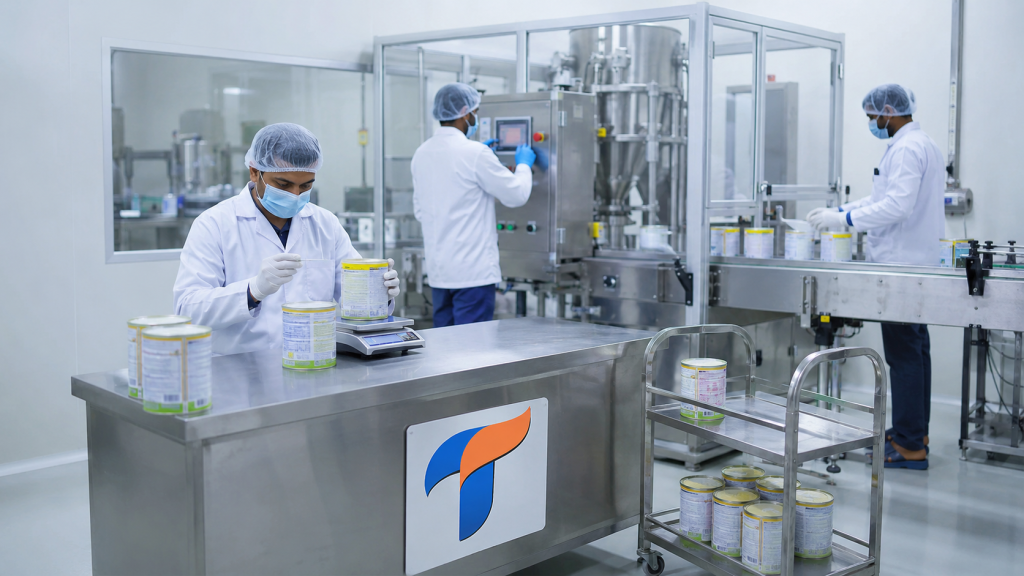
The infant nutrition market in India is growing fast. More brands, distributors, and healthcare companies are looking to source from infant milk food manufacturers who can deliver consistent quality, regulatory compliance, and scalable production. But with so many options available, how do you know which manufacturer is truly the right fit for your business? This guide will walk you through every key factor -from certifications and formulation expertise to export readiness and production capacity -so you make a confident, informed choice. At Titus Health Tech, we have spent years building a manufacturing operation that meets the demands of private label infant formula brands across India and internationally. Here is what you need to know before you sign any agreement.
Infant formula is a regulated food product. It is consumed exclusively by some of the most vulnerable individuals -newborns and infants who cannot advocate for themselves. This means the quality of the infant milk food manufacturers you partner with directly determines the safety of your product and the legal standing of your brand.
Unlike adult supplements, there is no margin for error in infant nutrition. A poorly manufactured formula with incorrect nutrient levels, contamination, or labelling errors does not just hurt your brand -it can harm a child’s development.
The decision of which manufacturer to work with is not a procurement decision. It is a health and safety decision. Treat it accordingly.
The first thing to check when evaluating infant milk food manufacturers is their certification stack. In India, all infant formula manufacturing falls under the purview of FSSAI and the IMS Act. Globally, manufacturers should align with Codex Alimentarius standards.
A manufacturer that holds all five of these certifications has demonstrated a serious commitment to safety and compliance. If any of these are missing, proceed with extreme caution -or look elsewhere.
Not all infant milk food manufacturers are equal when it comes to formulation. Some produce generic formulas with minimal variation. Others have in-house research and development teams that can design age-appropriate, condition-specific, or market-customised products.
Custom formulation capability is particularly important if your brand wants to differentiate in a competitive market. A manufacturer with strong R&D can help you develop a product that stands out -not just a relabelled version of something generic.
Production capacity is often overlooked in initial supplier evaluations. But your manufacturing partner must be able to grow with your brand -not slow it down.
When speaking with infant milk food manufacturers, ask the following:
A manufacturer that is already running at full capacity with minimal flexibility will struggle to support your growth. Choose a partner who has room to scale and has done it before for other brands.
No amount of documentation replaces an actual visit to the manufacturing plant. When evaluating how to choose the best infant nutrition manufacturer, a facility visit is one of the most valuable steps you can take.
Titus Health Tech welcomes facility visits from prospective partners. Our infrastructure is built to GMP standards, and we are transparent about our processes because we have nothing to hide.
Quality control is not a single checkpoint at the end of production -it is a continuous process that runs from raw material receipt to finished goods dispatch. The best infant milk food manufacturers maintain quality protocols at every stage.
Ask potential manufacturers to share recent batch reports and quality test certificates. Reluctance to share this information is a red flag. Transparency in quality data is a basic expectation from any serious partner.
Want to See Our Quality Certifications and Batch Reports? Titus Health Tech shares full quality documentation with verified partners. Reach out at TitusHealth Tech
If you plan to distribute infant formula in international markets, your manufacturing partner must understand the regulatory landscape of those markets. This is where many brands face unexpected problems -the product is manufactured well, but the documentation for international registration is incomplete.
A capable private label infant formula manufacturer in India will have experience handling export documentation for markets in Africa, the Middle East, Southeast Asia, and beyond. This includes:
Titus Health Tech currently serves clients in multiple countries. We have helped brands navigate regulatory registrations across continents. If you are planning international distribution, speak with our team about country-specific documentation. Contact us through the Join With Us page.
This step is frequently underestimated. The relationship between a brand and its infant milk food manufacturers partner is a long-term one. How the manufacturer communicates during the sales process is a strong indicator of how they will behave once the contract is signed.
If a manufacturer is vague about their certifications, avoids direct questions about quality processes, or is reluctant to arrange a facility visit -these are warning signs. Your brand is betting its reputation on this partnership. Choose accordingly.
A comprehensive infant milk food manufacturers partner should offer a wide enough product range to support your growth. At minimum, look for:
Titus Health Tech manufactures all of these under our DUGDHA range. You can explore the full infant formula product catalogue to understand the formulations available for private labelling.
After evaluating dozens of brands that have come to us with bad experiences from previous manufacturers, these are the most common warning signs:
Before signing any agreement, run a proper due diligence process. Check registrations, verify certifications with issuing bodies, and speak with at least two or three existing clients of the manufacturer. Reading our overview page gives you a clear picture of Titus Health Tech’s history, team, and manufacturing philosophy.
Titus Health Tech was founded by nutrition scientists with deep expertise in pediatric food safety. Over the years, we have built a manufacturing operation that is trusted by more than 40 private label companies in India and 10 international partners.
Our facility is GMP-certified, ISO 22000:2018 certified, HACCP compliant, and holds FSSAI and BIS registration. We produce across multiple formula types -standard, premium, lactose-free, and specialty variants including Human Milk Fortifier.
As one of the most recognised infant milk food manufacturers in India, we bring together scientific expertise, regulatory knowledge, export experience, and a genuine commitment to infant health. Every batch we produce represents the trust parents place in the brands we partner with -and we never take that lightly.
Selecting the right infant milk food manufacturers is a process that deserves time, research, and careful evaluation. You are not just buying production capacity -you are choosing a partner who will influence the health outcomes of the infants who consume your product.
Use the seven steps in this guide as your evaluation framework. Check certifications. Assess R&D capability. Visit the facility. Test their transparency. And always ask for references.
When you are ready to speak with a manufacturer who checks every box, Titus Health Tech is here. Explore our private labeling services, review our quality policy, and contact us to start the conversation.
Private label means you use the manufacturer’s existing formula under your own brand. Contract manufacturing means you develop a custom formula that belongs to you. Both are available at Titus Health Tech depending on your business stage.
You can verify FSSAI registration directly on the FSSAI website using the manufacturer’s license number. Always ask the manufacturer to share a copy of their current, valid FSSAI license before signing any agreement.
MOQs vary by manufacturer and formula type. They typically range from a few hundred kilograms to several metric tonnes per batch. Contact Titus Health Tech directly for current MOQs based on your required formulation.
Yes. Indian manufacturers who hold export-grade certifications and can provide required documentation -such as COA, Free Sale Certificate, and GMP compliance -can supply international markets. Titus Health Tech currently serves clients in Africa, Asia, and the Middle East.
The timeline depends on whether you use an existing formulation or require a custom one. Standard private label products can typically be launched in 8 to 12 weeks, including formulation confirmation, packaging design, and production. Custom formulations take longer.
Most established manufacturers offer Stage 1, Stage 2, and Stage 3 formulas, lactose-free variants, and specialty products like Human Milk Fortifier. Some manufacturers, including Titus Health Tech, also offer hypoallergenic and premium DHA-enriched formulas.
Ask whether they have previously exported to your target market, what documentation they provide for export registration, and whether they have a dedicated export compliance team. A truly export-ready manufacturer will have clear answers and prior experience with international clients.
WhatsApp us