
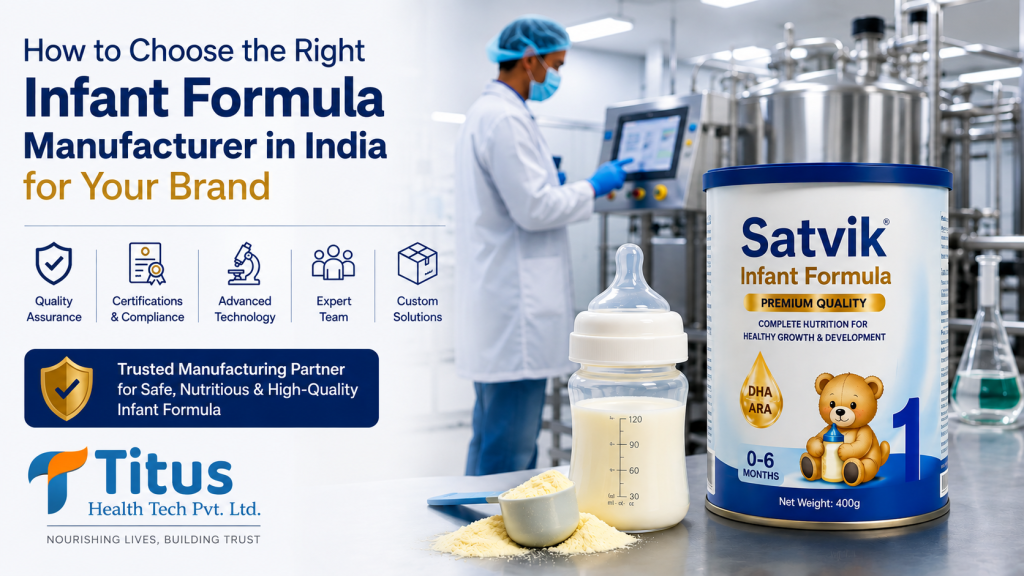
Every baby nutrition brand eventually reaches the same crossroads. The formulation looks promising, the branding is ready, distributors are interested and then the question that decides everything arrives: who will actually manufacture the product? Learning how to choose the right infant formula manufacturer in India for your brand is not a procurement exercise. It is a risk decision. Infant formula is one of the most tightly regulated food categories in the world, and a single compliance gap can stall a launch for months. India has become a serious global hub for infant nutrition manufacturing, with strong dairy sourcing, scientific talent and cost advantages, but capability varies widely from one plant to the next. Working with an experienced private label infant formula partner shortens the learning curve considerably. This guide walks through what genuinely matters when you evaluate a manufacturing partner.
Infant formula is fed to a consumer who cannot tell you something is wrong. That reality shapes everything micronutrient overages, moisture control, microbiological limits, packaging integrity and label claims.
Your manufacturer decides four things marketing cannot fix later:
Brands that treat this as a price comparison usually pay twice once for the first supplier and again for the corrective partner. Understanding how to choose the right infant formula manufacturer in India for your brand protects both your capital and your reputation.
Use the following areas as a structured evaluation framework. A serious infant formula manufacturer in India will welcome each question.
Certifications are your first filter. Any credible infant formula manufacturer in India should share them on request, and they reveal whether a plant is built for infant nutrition or merely adapted to it.
Reviewing a manufacturer’s published quality policy is a quick way to understand how seriously these systems are taken.
Infrastructure decides consistency. Wet-mix or dry-blend capability, spray drying, controlled humidity rooms, metal detection and automated filling all shape what you can produce and at what quality.
Ask every infant formula manufacturer in India on your shortlist to walk you through the line layout. Segregated infant nutrition lines, in-house laboratories and controlled raw material storage matter far more than headline capacity figures, so review the manufacturing infrastructure in person.
Quality assurance should be measurable, not aspirational.
Formulation science separates a strong partner from an average one. Ask whether the R&D team can adapt a base formula to your market stage-wise nutrient profiles, lactose-free variants, human milk fortifiers or added prebiotics. A capable infant formula range that already spans standard, premium and speciality products signals real development depth rather than a single copied recipe.
Private label and OEM manufacturing is a discipline of its own. Check whether the partner supports custom formulation, artwork development, regulatory labelling review and modest launch quantities. Brands searching for the best infant milk formula manufacturer in India usually discover that flexibility at low volumes matters more in year one than headline capacity.
Packaging protects nutrition and drives shelf appeal.
Confirm export capability early. Ask about existing shipments to your target regions, documentation support for registration, and familiarity with importing-country nutrition rules. A top infant formula manufacturer in India will have handled registrations in several countries and can give realistic timelines.
Consistency of supply matters as much as quality. Assess sourcing relationships, buffer stock policy and dependency on single-source premixes. A dependable infant formula manufacturer in India quotes honest lead times and tells you what happened the last time a shipment slipped.
Most launch failures trace back to a small number of avoidable errors.
Even a top infant formula manufacturer in India cannot rescue a launch built on rushed decisions, so knowing how to choose the right infant formula manufacturer in India for your brand is largely about avoiding predictable mistakes.
Titus Health Tech Pvt. Ltd. manufactures infant formula, baby cereals, speciality nutrition and sports nutrition from Gandhinagar, Gujarat. The plant is certified for GMP, ISO 22000:2018 and HACCP, and the company works with more than 40 private label partners in India alongside international clients.
What consistently matters to brand owners:
If you are evaluating how to choose the right infant formula manufacturer in India for your brand, a practical next step is a technical discussion rather than a quotation request. Share your target market, intended stages, pack formats and volumes, and contact the Titus Health Tech team to review feasibility, formulation options and realistic timelines for your launch.
The right manufacturing partner does more than fill tins. They protect your compliance position, stabilise costs and make growth predictable. Review certifications, walk the plant, test the R&D conversation and check references before you commit. Approached methodically, how to choose the right infant formula manufacturer in India for your brand becomes a straightforward decision built on evidence rather than promises and that evidence is what parents ultimately trust when they pick your product off the shelf.
Look for FSSAI licensing with infant food scope, GMP, ISO 22000:2018, HACCP and BIS conformity. Together these confirm hygiene control, hazard management and legal compliance for infant nutrition production.
MOQs vary by pack size, formulation and packaging format. Standard formulas in common tin or pouch sizes usually allow smaller trial runs than custom formulations requiring dedicated premix development.
Plan for formulation finalisation, artwork approval, trial production, stability checks and regulatory clearance. Most launches take a few months, with export registration adding further time depending on the market.
Yes. An experienced infant formula manufacturer in India can adjust nutrient profiles, add prebiotics or DHA, and create stage-wise or lactose-free variants within applicable regulatory limits for your market.
Many Indian manufacturers export regularly. Acceptance depends on plant certification, product registration and compliance with importing-country nutrition rules, so confirm your partner’s export documentation experience early.
Common formats include tins, mono cartons with inner pouches, sachets and refill packs. Barrier protection and nitrogen flushing preserve vitamin stability and shelf life across distribution.
Visit the plant, review certificates and audit reports, examine batch records, ask about in-process controls, and request retained samples or stability data from previous production runs.
Certification scope, laboratory strength, R&D depth, packaging flexibility, export documentation and supply reliability matter most. Price should be assessed only after these fundamentals are confirmed.
WhatsApp us