
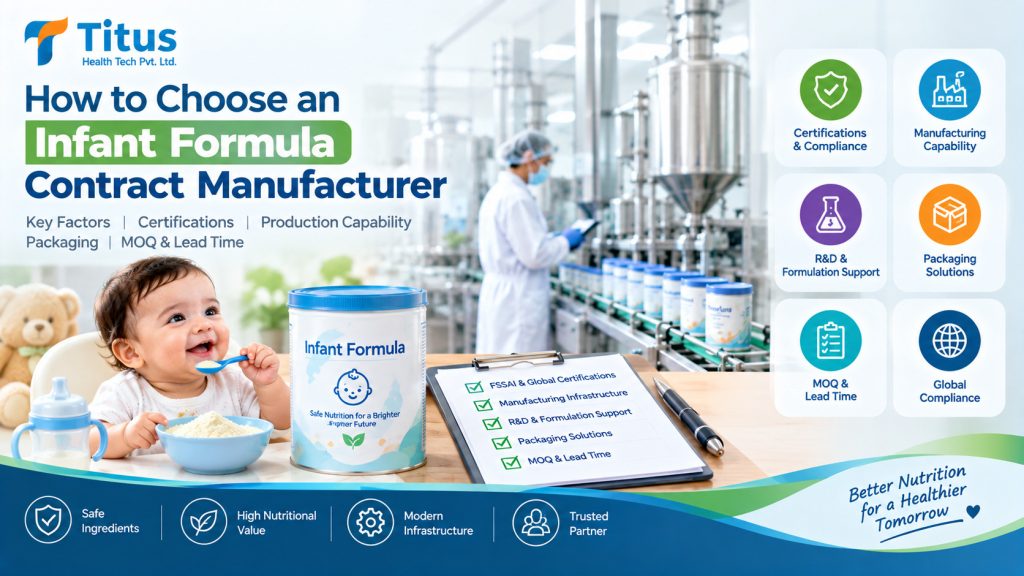
Choosing an infant formula contract manufacturer is not a routine procurement decision. The product is consumed by newborns, it is regulated more tightly than almost any other food category in India, and a single deviation in a spray-drying batch can turn into a recall, a licence suspension, or worse. This guide explains what genuinely separates a capable partner from an average one: the certifications that matter, the manufacturing capability you should verify on site, the depth of formulation support you should expect, and the commercial terms — packaging, minimum order quantity and lead time — that decide whether your launch is viable. By the end, you will have a practical checklist you can take into supplier meetings.
Infant nutrition sits squarely in what search engines and regulators alike treat as a “Your Money or Your Life” category. The consumer cannot judge the product by taste or appearance. They rely entirely on the brand, and the brand relies entirely on the factory.
That dependency has three practical consequences for anyone appointing an infant formula contract manufacturer. First, liability follows the label. If a batch fails a micronutrient assay, the regulator and the retailer come to you, not to the plant. Second, recovery from a quality failure in infant nutrition is far slower than in general FMCG, because trust is the entire value proposition. Third, the technical gap between manufacturers is wider here than in most categories. Blending a protein powder is a straightforward operation; producing a compliant, stable, correctly fortified infant milk formula is not.
A serious infant formula contract manufacturer therefore behaves less like a job-work vendor and more like a technical partner. They will question your formulation, flag a nutrient that will not survive shelf life, and refuse claims they cannot substantiate. When choosing baby formula manufacturer partners, treat that friction as a positive signal — a supplier who agrees to everything in the first meeting is usually the one who has not read the standard.
Infant formula contract manufacturing in India is also concentrated: relatively few plants hold the combination of licence category, equipment and analytical capability required. Shortlisting realistically, rather than casting a wide net, saves months when you are searching for a long-term infant formula manufacturing partner.
Certification is the first filter when screening any infant formula contract manufacturer, but read the certificates rather than the logo wall. Check scope, issuing body, validity dates and whether the certified site is the same site that will run your batches.
For any manufacturer operating in India, the baseline set is: a valid FSSAI manufacturing licence with infant nutrition products explicitly listed in the product category endorsement; compliance with the Food Safety and Standards (Foods for Infant Nutrition) Regulations; and adherence to the applicable Bureau of Indian Standards specifications, such as IS 14433 for infant milk substitutes and IS 1547 for infant milk food. You can verify the current regulatory framework directly on the Food Safety and Standards Authority of India website before your audit.
On top of the statutory layer, look for ISO 22000:2018 or an equivalent food safety management system, documented HACCP plans specific to powdered infant formula, and GMP certification. Titus Health Tech, for example, operates a facility certified to GMP, ISO 22000:2018 and HACCP, with its quality policy published rather than described only on request — a small but useful indicator when you are choosing baby formula manufacturer options and comparing transparency.
If you intend to export, ask about country-specific registration support early. An experienced third party infant formula manufacturer will have compiled such dossiers before and will know what a destination market asks for: composition certificates, free sale certificates, stability data, allergen declarations and manufacturing process descriptions.
Ask your shortlisted infant formula contract manufacturer how the powder is actually made. There are two broad routes, and the difference matters.
In a wet-mix and spray-dry process, ingredients are blended in liquid form, standardised, heat treated and then spray dried. Nutrient distribution is highly uniform and the thermal step adds microbiological control. In a dry-blend process, pre-dried ingredients are mixed mechanically. It is faster and more flexible for small runs, but homogeneity depends entirely on blender validation and micronutrient premix quality. Many plants combine both. Neither is inherently wrong — but the manufacturer should be able to justify the choice for your specific formulation.
Then look at the plant as an operating system rather than a set of machines.
A genuine infant formula manufacturing partner will let you see these systems without hesitation. If a plant visit is discouraged, treat it as a finding. Titus Health Tech publishes details of its manufacturing infrastructure so buyers can assess fit before travelling.
This is where one infant formula contract manufacturer separates most visibly from another. Three levels exist in practice, and you should know which one you are buying.
At the first level, the manufacturer offers a fixed catalogue formulation with your label on it. At the second, they will adjust a base formulation — sweetener system, flavour, selected nutrient levels — within validated limits. At the third, they will co-develop a formulation against your target specification, run bench trials, conduct accelerated and real-time stability studies, and take responsibility for the technical dossier.
Most private label infant formula manufacturers operate at the first or second level, and a third party infant formula manufacturer with true development capability is comparatively rare. If your positioning depends on differentiation — a lactose-free variant, a partially hydrolysed protein base, a specific prebiotic blend, or a stage-wise range from birth through toddlerhood — you need the third.
Practical questions that reveal the real level of capability:
Commercial terms decide whether a technically strong infant formula contract manufacturer is also a workable business partner. Clarify all three together, because they interact.
| Factor | Tin / metal can | Mono-carton with inner liner | Sachet / stick pack |
| Barrier and shelf life | Highest barrier, longest stated shelf life | Good, dependent on liner specification | Good per unit, single use |
| Typical use | Premium and export ranges | Mainstream retail, value ranges | Trials, sampling, travel packs |
| Tooling and setup | Higher setup cost | Moderate | Moderate to high for stick lines |
| Effect on MOQ | Usually raises MOQ | Moderate | Depends on line changeover time |
| Best suited for | Brands prioritising premium shelf presence | Brands optimising landed cost | Sampling and market-entry testing |
Minimum order quantity is driven by blender and dryer batch size, premix procurement lots and packaging material minimums — often the packaging, not the powder, sets the floor. Ask for MOQ per SKU and per variant, since a four-stage range at a single-SKU MOQ multiplies your first order.
On timelines, a realistic first-order cycle for a customised product runs across formulation sign-off, premix and raw material procurement, artwork approval and printing, trial and production batches, and analytical release. Repeat orders are substantially shorter because development and artwork are already closed. Any contract baby formula manufacturer India buyers shortlist should be able to give you a phased schedule with named dependencies rather than a single number. Ask for that schedule in writing before artwork is approved, because a contract baby formula manufacturer India brands rely on for seasonal peaks must be able to commit to dates, not ranges.
Get answers in writing from every infant formula contract manufacturer on your shortlist and fold them into the manufacturing agreement. Verbal assurances from a sales contact rarely survive a change of personnel, and a serious infant formula manufacturing partner will expect the request.
Titus Health Tech Pvt. Ltd. manufactures infant milk formula, baby cereals, family nutrition and sports nutrition powders from its facility in Gandhinagar, Gujarat, and works with private label and contract clients in India and overseas. The company is founded and run by professionals with research backgrounds, which shows up in practice as willingness to engage on formulation detail rather than only on price.
For brands evaluating infant formula contract manufacturing options, and for those comparing private label infant formula manufacturers specifically, three things tend to matter in the assessment: a certified facility, an existing multi-stage infant formula range that demonstrates the category is core rather than incidental, and structured private labelling support covering formulation, packaging and documentation. Reviewing an existing range is often the fastest way to judge technical depth when choosing baby formula manufacturer candidates — the products already made tell you more than a capability presentation.
An infant formula contract manufacturer produces finished infant formula under your brand name, covering formulation, raw material sourcing, production, quality testing, packaging and regulatory documentation. You retain brand ownership, marketing and distribution while the manufacturer carries the technical and production responsibility.
At minimum, a valid FSSAI manufacturing licence covering infant nutrition, compliance with the Foods for Infant Nutrition regulations and relevant BIS standards, plus GMP. ISO 22000:2018 and documented HACCP plans specific to powdered infant formula indicate a more mature food safety system.
In private label, you take an existing formulation and apply your branding. In third-party or contract manufacturing, the product can be developed to your specification. Many private label infant formula manufacturers offer both routes, and the difference affects cost, timeline and formulation ownership.
MOQ is set by blender and dryer batch sizes, premix procurement lots and packaging material minimums, and is quoted per SKU rather than per order. Packaging format frequently sets the floor, so confirm MOQ separately for each variant and pack size.
Expect a phased schedule covering formulation approval, raw material and premix procurement, artwork and packaging production, trial batch, production batch and analytical release. Repeat orders are considerably faster because development, artwork and supplier qualification are already complete.
An experienced third party infant formula manufacturer will supply composition certificates, free sale certificates, stability data and process descriptions for product registration abroad. Confirm which destination markets they have already registered products in before you commit.
Ownership depends entirely on your agreement, so address it before development starts. Specify whether the formulation, technical dossier and any exclusivity period sit with you, with the manufacturer, or are jointly held if the relationship ends.
The decision comes down to evidence rather than assurance. Verify licence scope and certification against the actual production site, understand the process route and why it suits your formulation, test the depth of R&D support with specific technical questions, and settle packaging, MOQ and lead time before you commit to artwork. A well-chosen infant formula contract manufacturer removes risk from your business; a poorly chosen one transfers it to you, usually at the worst possible moment.
If you are shortlisting suppliers, start by reviewing the existing infant formula range and facility details of each candidate, then take the questions above into your first technical meeting with each contract baby formula manufacturer India offers. You can explore Titus Health Tech’s infant formula portfolio or contact the team to discuss formulation, packaging and quantity requirements for your brand.
WhatsApp us