
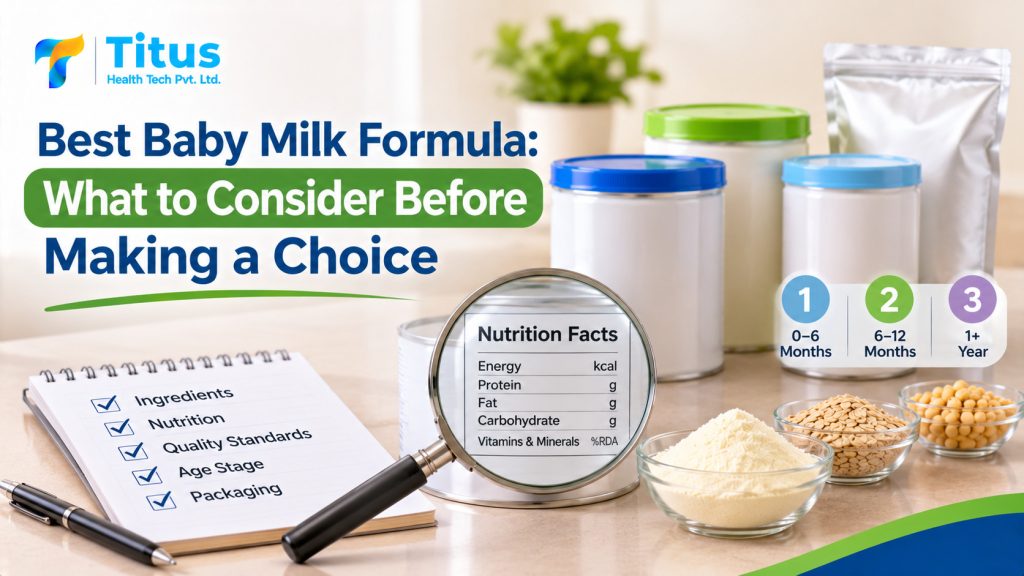
Choosing a baby milk formula is one of the first product decisions that families, distributors and institutional buyers face, and it is rarely as simple as comparing price or packaging. Behind every tin or pouch lies a chain of formulation decisions, ingredient sourcing, regulatory compliance and manufacturing controls that determine whether the product is consistent, safe and suitable for its intended age group. Understanding what to look for allows buyers to judge options on evidence rather than on marketing language.
This guide explains the factors that matter when assessing infant formula, from regulation and product categories to composition, quality systems and manufacturing. It is general educational information and not medical advice. Which formula suits an individual infant is a decision for a pediatrician or qualified healthcare professional, and regulatory standards describe formula as a substitute for human milk where one is necessary.
Infant formula is a manufactured food, in powder or liquid form, designed to meet the nutritional needs of infants when human milk is not available or is not used. Because it can be an infant’s sole source of nutrition, it is among the most tightly regulated food categories. In India, the Food Safety and Standards Authority of India (FSSAI) notified the Food Safety and Standards (Foods for Infant Nutrition) Regulations, 2020. According to the FSSAI compendium of these regulations, foods for infant nutrition must meet the microbiological requirements in Appendix B of the food product standards regulations, comply with the regulations on contaminants, toxins and residues, and follow specific labelling rules. These FSSAI regulations for infant formula form the legal baseline that every compliant product must meet.
Regulation addresses composition, safety, packaging and labelling together. For buyers, the practical implication is that a pack should carry clear, regulation-aligned information and that the manufacturer should be able to explain how each batch is checked. A working knowledge of FSSAI regulations for infant formula helps buyers ask better questions, although interpreting them for a specific product remains a task for regulatory specialists.
Product ranges are usually organised by age stage and by purpose. Understanding the main infant milk formula types makes labels easier to read and helps prevent mismatches between a product and an age group. The table below summarises common categories in general terms.
Table 1: Common Infant Milk Formula Types at a Glance
| Formula Type | General Purpose | What to Check |
| Standard infant formula | Milk-based substitute for human milk for healthy infants in the early months | Age stage on the pack, declared nutrient values, regulatory compliance |
| Follow-up formula | Intended for older infants, as defined by regulation, alongside other foods | Suitability for the stated age and the label instructions |
| Lactose-free formula | Formulated with reduced lactose for infants whose healthcare professional advises it | Whether use is clinically advised; label declarations |
| Formula for special medical purposes | Used only under medical supervision for specific conditions | Professional guidance; not intended for general selection |
Categories and definitions differ by regulation. Product selection for an individual infant should follow professional advice.
Manufacturers commonly structure ranges by stage. For example, the Titus Health Tech website lists its Triomil infant formula range in standard and premium variants across stages, together with a lactose-free option. This illustrates how formula ranges are typically organised, although the right choice for any infant should come from a healthcare professional.
Infants grow quickly, and their nutritional needs change over the first year of life. For this reason, regulations treat products for younger infants and products for older infants as separate categories, each with its own compositional and labelling provisions. Using a product outside its stated stage means departing from the design intent of the formula. Buyers should therefore treat the stage printed on the pack as a primary selection criterion and confirm any change of stage with a healthcare professional.
Ingredient lists reveal the foundation of a formula. Most infant formulas are based on milk-derived components, with carbohydrates, vegetable oils and added vitamins and minerals. When reviewing baby milk formula ingredients, readers can check the following points:
A longer ingredient list is not inherently better or worse. What matters is that every component is permitted, declared accurately and sourced from qualified suppliers. Ingredient quality sets the ceiling for finished product quality, which is why supplier approval, specifications and certificates of analysis sit at the centre of responsible manufacturing. Allergen management matters as well: because infant formula is milk-based, labels should declare milk clearly, and plants that handle other allergens need documented controls to prevent cross-contact.
Nutrition panels show energy, protein, fat, carbohydrate, vitamin and mineral content per 100 g and per prepared serving. A useful review of baby milk formula nutritional composition compares the declared values with the stage stated on the pack and confirms that the product is intended for that age group. Infant formula nutritional requirements are defined in regulation, which is why values should not be compared across different stages as if they were interchangeable.
For wider nutrient-requirement context, the ICMR-NIN Nutrient Requirements for Indians (RDA and EAR, 2020) is published by the institute that serves as India’s nodal agency for recommending dietary allowances. It describes requirements across age and physiological groups, whereas formula composition is prescribed by FSSAI rules. Appreciating both documents helps readers see why infant formula nutritional requirements differ from general dietary guidance.
Compliance on paper is not enough; quality has to be demonstrated through working systems. Baby milk formula quality standards combine regulatory requirements with management systems such as GMP, HACCP and ISO 22000, which structure hygiene, hazard control and documentation. Baby milk formula safety standards focus on microbiological limits, contaminant limits, packaging integrity and traceability, and they are verified through laboratory testing of raw materials, in-process samples and finished batches.
Buyers cannot audit every plant, but they can look for practical signals of quality:
These signals do not replace laboratory testing, but they show that a company operates a traceable and accountable system.
GMP establishes hygienic, disciplined operations. HACCP identifies hazards and defines the critical control points that manage them. ISO 22000 adds a management system around those controls, including internal audit and continual improvement. A certificate is most meaningful when buyers confirm its scope, its validity dates and the body that issued it, and when they ask how the certified system is applied to the specific product category being purchased.
The baby milk formula manufacturing process typically includes ingredient receipt and testing, blending or wet-mix processing, heat treatment, drying, dry-blending of heat-sensitive nutrients, filling, sealing and packing. Each stage has critical limits that are monitored and recorded. Powdered formula is low in moisture, yet it can still be vulnerable to contamination during handling, so hygienic zoning, environmental monitoring and finished product testing are integral to meeting baby milk formula safety standards.
Process capability also determines consistency. Accurate dosing of micronutrients, uniform blending and protective packaging help every pack deliver the same composition. Reviewing how a manufacturer controls this sequence reveals more about quality than any single claim printed on a label. Plants may use wet-mix and spray-drying, dry-blending or a combination of both, and each route has its own control points. Buyers can ask which route is used, how blend uniformity is verified and how finished batches are sampled.
Packaging protects powdered formula from moisture, oxygen, light and contamination, and it carries the information that caregivers rely on. Sealed, clean and sound packs, legible batch coding and clear preparation and storage instructions are therefore part of product quality. Shelf-life declarations should be supported by stability data, and caregivers should follow the label instructions for preparation, storage after opening and use of prepared feeds. Where doubts arise about a pack that appears damaged or a product that seems unusual, the sensible step is to stop using it and contact the manufacturer or a healthcare professional.
Titus Health Tech Pvt. Ltd., based in Gandhinagar, Gujarat, is a nutrition products manufacturer with divisions for infant milk formula (DUGDHA), baby cereals (SATVA), protein supplements (SFURTI) and sports nutrition (SHAKTI). According to the company’s website, its manufacturing facility is certified for GMP, ISO 22000:2018 and HACCP, and its team includes scientists experienced in product development, quality assurance and production. The company also states that it manufactures for more than 40 private label companies in India and 10 international partners, and that it offers contract manufacturing, bulk supply and custom formulation. Businesses that want to develop their own brand can learn more about private-label manufacturing on the company’s website, alongside its quality policy and infrastructure pages. As with any supplier, these statements should be confirmed through documentation and audit.
Brands entering the infant nutrition market are making a quality decision as much as a commercial one. Technical depth matters as much as capacity, because formulation changes, new age stages and product registrations all call for scientific and regulatory support, and documentation that is complete from the first batch avoids delays later. Useful questions include:
Businesses exploring formulation, contract manufacturing or private-label requirements can contact Titus Health Tech to discuss scope, documentation and quality expectations with its team.
A well-informed choice of baby milk formula rests on regulatory compliance, transparent composition, verified quality systems and disciplined manufacturing, not on packaging or claims. Reading labels carefully, understanding age-stage categories, checking packaging and storage instructions and asking manufacturers for evidence are practical steps that any buyer can take, and none of them requires specialist training. Titus Health Tech welcomes brands, distributors and institutions that want to understand its infant nutrition capabilities, review its quality approach and discuss their manufacturing requirements.
No single formula is best for every infant. Suitability depends on the infant’s age and health, so parents should rely on stage information on the label and on a pediatrician’s advice rather than on marketing claims.
Common categories include standard infant formula, follow-up formula, lactose-free formula and formula for special medical purposes. Each is designed for a different purpose and age stage.
Check the protein, carbohydrate and fat sources, the added vitamins and minerals, and any allergen declaration. All components should be clearly listed and regulation-compliant.
Composition is prescribed by regulation and verified through laboratory analysis of batch samples. Infant formula nutritional requirements are specific to each stage, so values are not interchangeable.
The Food Safety and Standards (Foods for Infant Nutrition) Regulations, 2020 apply, together with related rules on labelling, packaging and contaminants.
They are the microbiological, contaminant, packaging and traceability requirements that a formula must meet. Baby milk formula quality standards such as GMP, HACCP and ISO 22000 support them.
Each stage, from ingredient receipt to packing, has defined limits, hygiene controls and records. Together with batch testing, these controls keep composition and safety consistent.
No. This content is general and educational. Decisions about feeding an individual infant should be made with a pediatrician or qualified healthcare professional.
WhatsApp us