
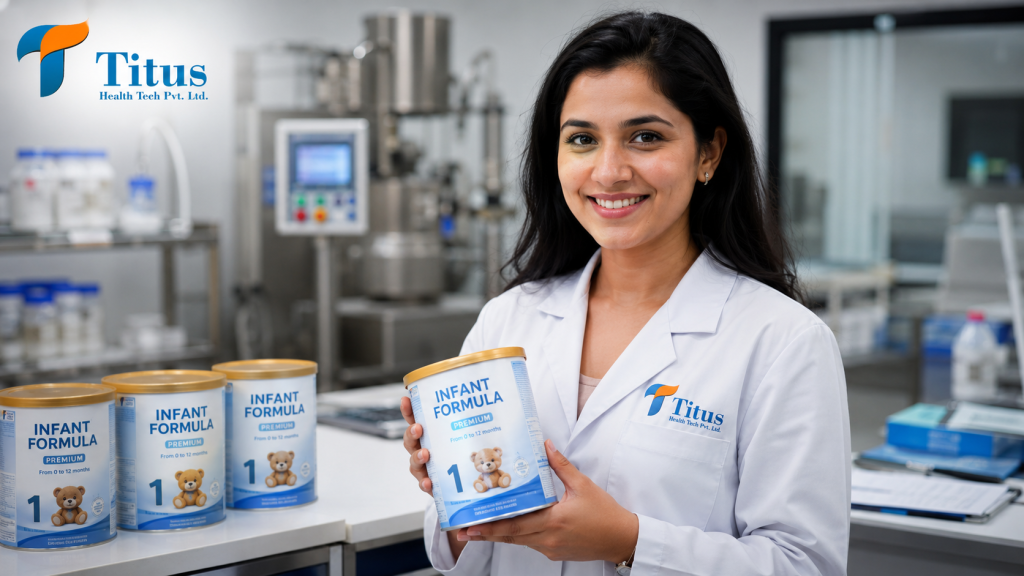
Launching your own baby food brand sounds huge, yet a Baby Milk Formula Private Label model makes it surprisingly doable. Instead of building a factory, you partner with one that already exists. You own the brand, the recipe choices, and the label. They own the plant, the process, and the certifications. This article maps the full path from first idea to the moment your product sits on a shelf, so you know exactly what to expect at every stage and where the real work lies.
| Quick answer A Baby Milk Formula Private Label lets you sell infant formula under your own brand while a certified manufacturer produces it for you. You pick the formula and packaging; they handle sourcing, blending, testing, and compliance. Typical projects run from a few weeks to a few months, depending on whether you use an existing recipe or a custom one. |
The idea is simple at heart. A baby milk formula private label, also called an infant milk formula private label, is a product made by an established manufacturer and sold under your name. The factory has already invested in equipment, safety systems, and regulatory approvals. You plug into that, add your brand, and skip years of setup.
This model now powers a large share of India’s baby-nutrition market. Many shelf brands you recognise do not own a single mixing tank. Instead, they rely on a trusted infant milk formula private label partner and focus their energy on branding, distribution, and customer trust.
A private label route fits more people than you might think. Still, it is not for everyone.
For the vast majority of founders, though, a Baby Milk Formula Private Label is the fastest sensible way in.
Here is where the Baby Milk Formula Private Label process gets real. Most projects follow these eight steps, roughly in order:
| Want a clear plan for your own launch? See our private labeling services , then send us your concept and we will map the timeline and costs for you. |
A Baby Milk Formula Private Label works because each side does what it does best. The table below shows the split, and you can see the production side in detail on our infrastructure page.
| You bring | The manufacturer brings |
| Brand name and identity | Certified, GMP-grade facility |
| Target market and pricing | Raw-material sourcing and blending |
| Recipe direction and preferences | Formulation science and R&D |
| Label artwork and copy | Batch testing and lab analysis |
| Distribution and marketing | Regulatory and export paperwork |
Numbers vary by plant and product, but the shape of a deal is fairly predictable. Plan for these:
A clear quote should break all of this down. If a partner cannot, that is a sign to keep looking.
Numbers feel abstract until you see them on a calendar. Here is how a typical custom project unfolds, though a stock recipe moves a good deal faster:
Most delays come from artwork changes and approvals, not from the factory floor. So lock your label early, and the rest tends to stay on schedule.
Baby food is one of the most tightly regulated categories in India, and rightly so. Every Baby Milk Formula Private Label must follow FSSAI rules on composition, claims, and labelling. Your label needs accurate nutrition data, clear feeding instructions, and the mandatory notice on the superiority of breast milk. A good partner handles most of this, but you stay responsible too. Review our quality and compliance approach to see the standard you should expect.
Not all partners are equal. When you compare options for an infant milk formula private label, weigh these points carefully:
Scale matters more than people expect. Working with the largest private label infant formula manufacturer in India, or one close to that size, usually means steadier supply, better pricing, and deeper expertise. For a closer look at why this matters, read our blog on how quality, safety, and scale define a top infant formula maker.
A short, honest conversation early on saves months of friction later. Before you commit to any partner, sit down and ask the questions that really decide whether a project succeeds. Here are the ones that matter most:
The answers tell you a lot. A confident partner replies plainly and backs each point with documents. A vague one leaves gaps you will pay for later, so trust the clarity of the response as much as the content.
Even careful founders trip over the same few errors. First, many order far too much stock before testing real demand, which ties up cash in a warehouse. Second, some rush the label and miss a required notice, then face costly reprints. Third, a few pick a partner on price alone and regret it when quality slips. Learn from these, and your launch stays lean, legal, and on track.
Plenty of founders hesitate because of myths that simply do not hold up. Let me clear the common ones:
Once these myths fall away, a Baby Milk Formula Private Label looks far less risky and a lot more practical.
Trust is your real product, so guard it from the very first conversation. A few simple safeguards go a long way:
A reputable partner welcomes these steps, because clear rules protect both sides. If a manufacturer dodges the topic, treat that as a quiet warning.
Production is only half the story. A finished tin still needs buyers, so plan your route to market while the factory runs. First, decide your channels. You might sell online, through pharmacies, via distributors, or across all three. Next, build messaging around safety and trust, since parents buy on confidence above all. Then invest in honest photography and accurate claims, because nothing erodes a baby brand faster than a promise it cannot keep.
Finally, start small and learn fast. Launch a tight range, gather real feedback, and scale the products that actually sell. That patience keeps your cash safe and your brand credible while you grow.
Titus Health Tech runs a full Baby Milk Formula Private Label service under one roof. We make standard, premium, lactose-free, and specialty infant formula, backed by FSSAI, ISO 22000, and HACCP certification. As one of the largest private label infant formula manufacturer in India by reach, we already serve more than 40 private brands and 10 international partners, so your project lands in experienced hands.
A Baby Milk Formula Private Label turns a daunting dream into a clear, staged project. You focus on the brand and the buyer, while a certified partner handles the science and the safety. Choose carefully, respect the compliance rules, and the path from concept to shelf is smoother than it looks. When you are ready, reach out to the Titus team for a timeline and a quote built around your idea.
It is a product made by a certified manufacturer and sold under your own brand. A Baby Milk Formula Private Label lets you launch without building a factory, since the partner handles sourcing, blending, testing, and compliance.
White label means a ready-made product you simply rebrand. Private label usually allows more customisation of the recipe, packaging, and specs. Most baby-food projects sit somewhere on this spectrum.
With a stock recipe, a few weeks is realistic. A custom infant milk formula private label usually takes two to four months, because development, testing, and approvals all add time.
It depends on the plant and the product. Ask for the smallest viable batch early, so you can test demand before committing to large volumes.
Often yes, alongside the manufacturer’s. A strong partner will guide you through the paperwork and tell you exactly which approvals sit on your side.
Scale brings stability. The largest private label infant formula manufacturer in India, or one near that size, typically offers reliable supply, sharper pricing, and stronger R&D than a small workshop can.
Yes, if your partner has export experience. Each country has its own rules, so confirm that the manufacturer can prepare the right documentation before you plan an overseas launch.
Usually yes. Most partners let you adjust the recipe between batches, within regulatory limits. Just expect fresh testing, and possibly new samples, whenever the composition changes. Plan those tweaks between production runs rather than mid-batch.
WhatsApp us