
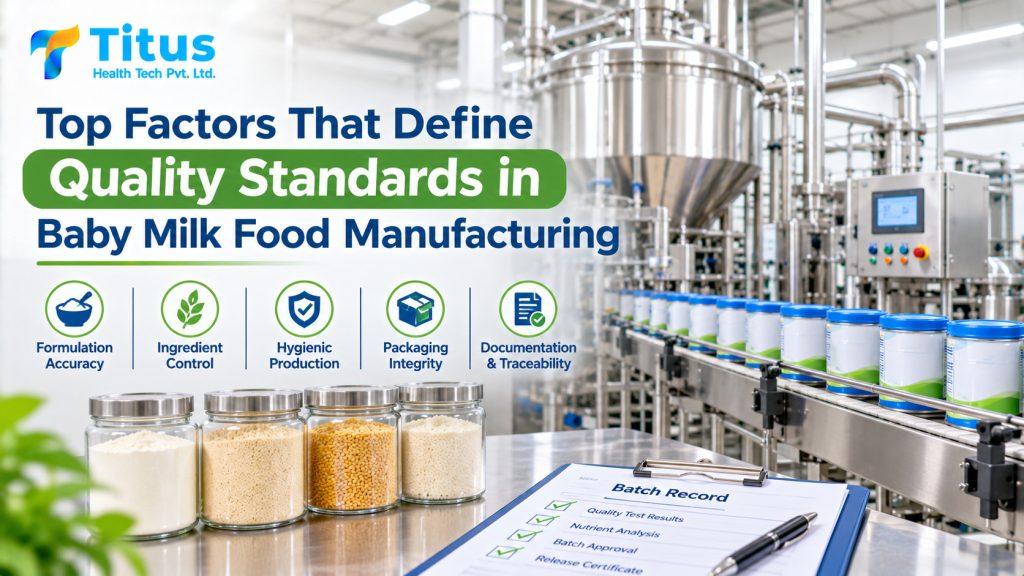
The baby milk food manufacturing standards that govern production in India are among the most demanding in the food sector, because the end consumer is an infant whose nutrition and development depend heavily on product quality.
For brand owners, procurement teams and regulatory managers, quality in this category is not a single certificate or test result. It is the combined outcome of formulation discipline, ingredient control, hygienic production, laboratory verification, compliant labelling and transparent documentation.
This article explains the top factors that define quality in infant milk manufacturing, how Indian regulations frame them and what buyers can verify when evaluating a production partner. It is general educational information for industry readers and is not medical or individual feeding advice. Parents should consult a pediatrician for decisions about their own child, and readers who want a wider view of infant nutrition manufacturing standards will find the factors below a useful starting point.
Infant milk products fall under the Food Safety and Standards Authority of India (FSSAI), which notifies regulations under the Food Safety and Standards Act, 2006. FSSAI publishes the complete list of these regulations on its website, including the Food Safety and Standards (Foods for Infant Nutrition) Regulations, 2020, which sit alongside separate regulations on labelling, packaging and contaminants. Taken together, these rules represent the core FSSAI standards for baby food and define the legal baseline for baby milk food safety requirements. Because the regulations address composition, safety and presentation together, compliance has to be demonstrated across the whole product lifecycle, from formulation and sourcing to labelling and distribution.
Statutory rules are the minimum, not the ceiling. Responsible manufacturers also operate recognised management systems such as GMP, HACCP and ISO 22000, which add structure, hazard analysis and auditability. Infant nutrition manufacturing standards in practice are therefore a layered framework, summarised below.
Table 1: Frameworks That Shape Infant Milk Manufacturing Quality
| Framework | Primary Focus | Role in Quality |
| FSSAI Foods for Infant Nutrition Regulations, 2020 | Composition, safety, packaging and labelling of infant foods | Mandatory legal baseline for products sold in India |
| Good Manufacturing Practice (GMP) | Hygienic premises, equipment, personnel and process discipline | Foundation for consistent and clean production |
| HACCP | Hazard analysis and critical control points | Prevention-based control of biological, chemical and physical hazards |
| ISO 22000:2018 | Food safety management system | Structured management, internal audit and continual improvement |
Frameworks differ in scope. GMP, HACCP and ISO 22000 are management and hygiene systems; the FSSAI regulations are legal requirements.
Quality starts with the formula itself. Composition must follow the nutrient requirements prescribed by regulation and must be declared accurately on the label. For general nutrient-requirement context in India, the ICMR-NIN brief note on Nutrient Requirements for Indians explains how requirements are defined for individuals of all age groups and physiological groups. Formulation scientists use such references together with the product-specific regulatory limits when they design a product for a given age stage, and they document the rationale for every nutrient level. Stage-specific design is equally important: the needs of a young infant differ from those of an older infant, so each product should have its own documented formulation file, stability evidence and label review.
Ingredient quality sets the ceiling for finished product quality. A formula may rely on milk-derived components, carbohydrates, vegetable oils and vitamin and mineral premixes, and each of these needs defined specifications. When reviewing baby milk food ingredients, quality teams typically look at:
Powdered infant products are produced in controlled conditions, with hygienic zoning, equipment sanitation programmes, trained personnel and environmental monitoring. The baby milk food production process usually includes receiving, storage, blending, heat treatment, drying, filling and packing, and each step has defined critical limits. Process records show that limits were met for every batch, which is why documentation is treated as part of production rather than a separate administrative task. Equipment design also matters: smooth, cleanable surfaces, validated cleaning procedures and controlled air handling reduce the chance of cross-contamination between batches.
Testing confirms that controls worked. Effective baby milk food quality control includes raw material testing, in-process checks and finished product analysis covering nutrients, microbiology, contaminants and physical attributes. FSSAI requires infant nutrition foods to meet specified microbiological and contaminant standards, so release decisions are linked to documented results. Laboratory competence is part of this factor: validated methods, calibrated instruments, trained analysts and regular proficiency checks give confidence that results are reliable, whether testing is done in-house or at an external accredited laboratory. A manufacturer’s quality policy should make clear who approves release and on what evidence.
Packaging protects the product from moisture, oxygen, light and contamination, and labelling informs caregivers and trade partners. FSSAI standards for baby food require infant foods to be packed in sealed, clean and sound packaging that follows the packaging regulations, with labels that follow the Labelling and Display Regulations, 2020 and the specific infant food provisions. Shelf-life declarations should be supported by stability data rather than assumption.
Complete documentation is the visible proof of quality. It includes specifications, batch records, certificates of analysis, deviation reports, change control and complaint handling. Manufacturers that also support labelling review and product registration documents help brand owners reduce regulatory risk, particularly when products are exported to markets with their own rules. Clear communication between the manufacturer and the brand owner on specification changes, complaints and audit findings is a further sign of a mature quality culture.
Safety is designed into the process rather than inspected at the end. A powdered product is low in moisture, but it can still be exposed to contamination during handling, so manufacturers combine HACCP-based preventive controls with hygiene verification and routine testing. Cronobacter species and Salmonella are among the microorganisms commonly monitored in infant foods. In practice, baby milk food safety requirements are met when the plant can show that critical limits were controlled, tested and recorded for each batch. Water, compressed air and packaging materials that touch the product are controlled as well, because each can introduce contaminants if left unmanaged.
Process capability also affects consistency. Uniform blending, accurate dosing of micronutrients and controlled drying help each pack deliver the same composition. Where a plant operates its own production lines, buyers can inspect this directly during audits.
Documented evidence is what turns good practice into verifiable quality. Auditors typically sample records across the chain, from supplier approval through to dispatch, and ask how deviations were handled. Strong quality control is visible in the way out-of-specification results are investigated, root causes are recorded and corrective actions are verified. Brand owners should request the following before awarding a contract:
Consistency is the quiet test of every infant product. A caregiver who buys the same product twice expects the same composition, the same behaviour on reconstitution and the same shelf life. Meeting infant nutrition manufacturing standards therefore means controlling variation through standard operating procedures, calibrated equipment, trained operators and clear acceptance criteria for each batch. Traceability completes the picture. If a query arises, the manufacturer should be able to trace a finished lot back to ingredient lots, process records and test results, and identify where that lot was distributed. This capability protects families and brand owners alike, and it is a routine expectation within GMP and ISO 22000 systems.
Certain weaknesses recur across food manufacturing, and they are worth checking during supplier evaluation. Useful questions to ask include whether the manufacturer has:
Closing these gaps before launch is far less costly than correcting them afterwards, and a transparent manufacturer will welcome such questions.
Choosing a production partner is both a commercial and a quality decision. A credible baby milk food manufacturer in India should be able to explain its regulatory approach, show its quality system in operation and provide documents on request. Technical depth matters as much as capacity, because formulation changes, new age stages and export registrations all require scientific support. Buyers should also ask how complaints are investigated, how often internal audits are performed and how regulatory updates are tracked and applied to existing products.
Titus Health Tech Pvt. Ltd., based in Gandhinagar, Gujarat, is a nutrition products manufacturer with divisions for infant milk formula (DUGDHA), baby cereals (SATVA), protein supplements (SFURTI) and sports nutrition (SHAKTI). According to its website, its manufacturing facility is certified for GMP, ISO 22000:2018 and HACCP, and its team includes scientists experienced in product development, quality assurance and production. The company states that it manufactures for more than 40 private label companies in India and 10 international partners, and that it offers contract manufacturing, bulk supply and custom formulation. Readers can explore the company’s infant formula range on its website to see how its portfolio is presented.
These statements are drawn from the company’s own website and should be verified through audit, as with any supplier. Brands that want to discuss private-label manufacturing requirements or request documentation can contact Titus Health Tech to start a technical conversation about scope, formulation, documentation and quality expectations for their own product range.
Quality in infant milk manufacturing is the sum of many controlled factors: sound formulation, verified ingredients, hygienic production, laboratory evidence, compliant packaging and complete documentation. Applying baby milk food manufacturing standards consistently, and proving it with records, is what separates a dependable partner from a merely capable one. Titus Health Tech invites brand owners and institutions to review its quality systems, discuss their requirements and explore how its infant nutrition capabilities can support their plans. Together with careful supplier evaluation, such transparency helps families, distributors and brands place well-founded trust in the products that reach the market.
They are set mainly through FSSAI’s Foods for Infant Nutrition Regulations, 2020, supported by rules on labelling, packaging, contaminants and microbiological limits. Many manufacturers also adopt GMP, HACCP and ISO 22000 systems.
Baby milk food quality control combines ingredient testing, in-process monitoring, finished product analysis and documented batch release. Records show that every critical limit was checked before product leaves the plant.
Formulations commonly use milk-derived components, carbohydrates, vegetable oils, vitamins and minerals. The exact composition must follow FSSAI regulations and varies by product and age stage.
Safety is built in through hygienic zoning, HACCP-based controls, environmental monitoring and routine laboratory testing at each production stage, supported by batch-level records.
Key requirements include microbiological limits, contaminant limits, compliant packaging and accurate labelling. These are defined in FSSAI regulations and verified through testing and documentation.
Labels must follow the Labelling and Display Regulations, 2020, together with the specific labelling provisions in the Foods for Infant Nutrition Regulations, 2020.
Verify FSSAI licensing, food safety certifications, laboratory capability, sample certificates of analysis and traceability procedures. An audit of the facility remains the most reliable check.
No. This content is general and educational. Choices about feeding an individual infant should be discussed with a pediatrician or qualified healthcare professional.
WhatsApp us