
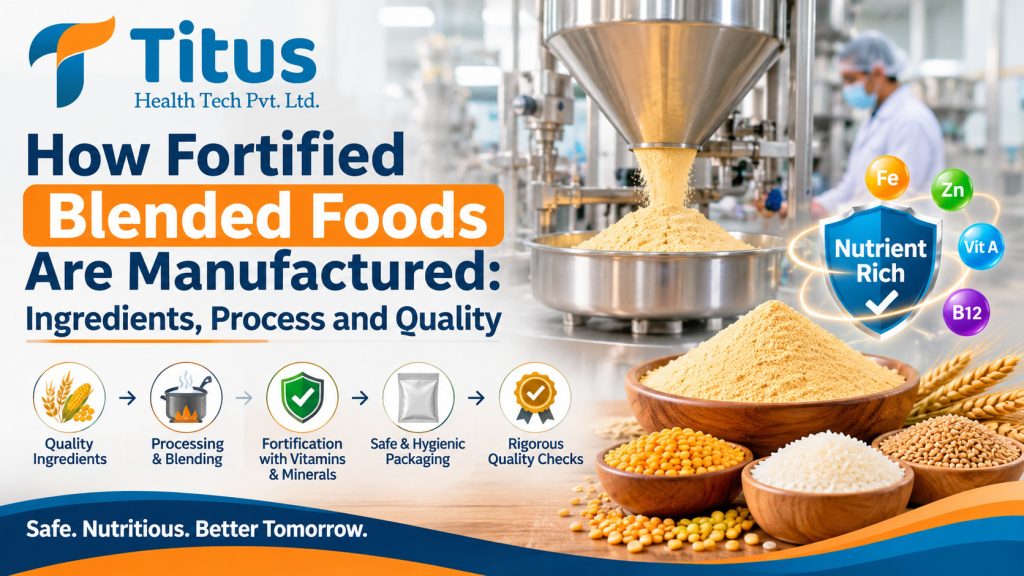
Quick answer: Fortified blended foods are made by cleaning, heat-treating and milling cereals and pulses, blending them with a vitamin and mineral premix, packing the powder under controlled conditions and testing each batch. A qualified fortified blended food manufacturer controls ingredients, premix accuracy, hygiene and documentation so that every batch matches its specification.
Fortified blended foods combine staple cereals, pulses and sometimes milk or oilseed ingredients with added vitamins and minerals to deliver a more nutrient-dense powder than the base ingredients alone. Because the finished product is often consumed by children, mothers and other nutritionally vulnerable groups, the choice of a fortified blended food manufacturer has direct consequences for safety and nutrient accuracy.
This guide explains the ingredients, the process and the quality controls involved, so that brands, buyers and students of food technology can understand what good practice looks like. It is general educational information and not individual dietary or medical advice.
Fortified blended foods are powdered or granular products made by blending processed cereals and pulses and fortifying the mixture with a micronutrient premix. They are used in commercial weaning cereals, nutrition powders and, more widely, in nutrition programs that need an affordable, shelf-stable and easy-to-prepare product. The concept is straightforward, but achieving consistent nutrient levels, safety and taste at scale requires disciplined production, which is why a fortified blended food manufacturer must combine food technology with strict quality control.
Fortified blended food ingredients fall into a few functional groups, each chosen for nutrition, processing behavior and cost:
The quality and cleanliness of fortified blended food ingredients matter as much as their nutrient content, because contaminants such as mycotoxins, foreign matter or microbial load carry through to the finished product. A responsible fortified blended food manufacturer therefore approves suppliers and tests raw materials on receipt.
Fortified blended food formulation begins with a target consumer and a nutrient specification. Technicians choose the ratio of cereals, pulses and other ingredients to meet energy and protein targets, then calculate the vitamin and mineral levels required in the premix. Fortified blended food formulation must account for processing and storage losses, since some vitamins degrade with heat, light and time, and must stay within regulatory limits for composition and labeling. Trial batches are evaluated for taste, texture, solubility and stability before the recipe is approved. A fortified blended food manufacturer that documents each formulation decision can reproduce the product reliably and explain changes when they are needed.
Micronutrient fortification in food means adding vitamins and minerals to a food to improve its nutrient content. In blended foods, common targets include iron, zinc, vitamin A, folic acid and other B vitamins, although the exact selection depends on the product and its regulatory category. It must be accurate: too little fails to deliver the declared nutrition, and too much can exceed permitted levels. According to the Food Safety and Standards Authority of India (FSSAI), the fortification of foods and the composition and labeling of foods for special dietary use are governed by standards notified under the Food Safety and Standards Act, 2006. Choosing compatible forms of each nutrient, handling the premix carefully and verifying results by analysis are the foundations of effective micronutrient fortification in food.
The fortified blended food manufacturing process follows a defined sequence, although each fortified blended food manufacturer adapts the details to its equipment and products.
Raw materials are received, inspected and sampled. Tests commonly cover moisture, foreign matter, microbiological quality and contaminants relevant to the ingredient. Materials that fail are rejected or quarantined before they can enter production.
Cereals and pulses are cleaned and sorted, then heat-treated by roasting, cooking or extrusion. Heat improves digestibility, develops flavor and reduces microbial load and certain anti-nutritional factors in pulses. The fortified blended food manufacturing process must control temperature and time carefully, because excessive heat damages nutrients and too little leaves safety risks.
Heat-treated ingredients are milled to the required particle size and blended in controlled batches. Blend uniformity is critical, since small ingredients must be evenly distributed so that every serving delivers the declared nutrition.
The micronutrient premix is usually added after heat treatment to protect heat-sensitive vitamins and is blended in stages so that it disperses evenly. Because premix quantities are small compared with the batch, accurate weighing, sequencing and verification of homogeneity are essential.
The finished powder is cooled, sieved and packed in moisture-resistant packaging under controlled humidity. Batches are tested against specification and released only when results are acceptable, with records retained for traceability.
The same stages apply to many powdered products, and the nutritional powder manufacturing process depends on control at each one. The table below summarizes the purpose and main control for each.
| Stage | Purpose | Key Control |
| Ingredient receipt | Confirm quality and safety of inputs | Supplier approval and incoming testing |
| Heat treatment | Improve safety and digestibility | Temperature and time monitoring |
| Milling | Achieve required particle size | Sieve checks and particle size control |
| Blending | Distribute ingredients evenly | Validated blend times and sampling |
| Premix addition | Deliver declared micronutrients | Accurate weighing and homogeneity checks |
| Packing | Protect shelf life | Moisture barrier, seal checks and coding |
| Release | Confirm batch meets specification | Analysis and documented approval |
A clear view of the nutritional powder manufacturing process lets brands ask informed questions of any production partner.
Fortified nutrition powder production adds particular challenges compared with simple milling. It must manage dust, humidity and cross-contact, because powders absorb moisture and may carry allergens such as milk, soy or wheat between batches. Equipment cleaning must be validated, and changeovers between products documented. Packaging also needs attention: barrier materials, seal integrity and batch coding protect the product through distribution. Brands evaluating fortified nutrition powder production should ask how humidity is controlled, how allergen declarations are managed and how finished goods are stored before dispatch.
Fortified food quality standards define what a safe and accurately labeled product must achieve. They typically address composition, nutrient content, microbiological safety, contaminant limits, labeling and shelf life. They also require that declared nutrient values reflect what is actually in the product, so analysis and records are central. Brands should ask a fortified blended food manufacturer which fortified food quality standardsapply to the product category and how compliance is demonstrated, and they should take advice from the regulator on current requirements, since standards are updated from time to time.
Quality control in fortified food manufacturing combines testing, monitoring and documentation. A thorough program covers the following:
Quality control in fortified food manufacturing is only credible if results are documented and acted on, so buyers should ask how out-of-specification findings are handled.
Fortified foods are valuable tools, but they complement rather than replace a varied diet. According to the ICMR-National Institute of Nutrition’s Dietary Guidelines for Indians, nutritional needs are best met through a balanced diet drawn from different food groups, and for infants, complementary feeding begins around six months of age alongside continued breastfeeding. Products made by a fortified blended food manufacturer should therefore be presented as supplements to diet and positioned within recognized feeding guidance, without unsupported health claims.
Buyers can learn a great deal from a short list of direct questions. Ask the fortified blended food manufacturer which raw materials are tested on receipt and what limits apply, how the premix is sourced and stored, and how blend uniformity is checked. Ask how long batch records are kept, how complaints are investigated and what happens if a batch fails specification. Finally, ask for written confirmation of minimum order quantities and lead times. A fortified blended food manufacturer that welcomes these questions is usually one that has the systems to answer them, and the answers often reveal more about quality culture than any brochure.
A buyer comparing partners should look for evidence rather than assurances. Ask a fortified blended food manufacturer to explain how premix accuracy is verified, how blend uniformity is tested, how raw materials are approved and how batches are traced. Request licensing and quality system documentation, review sample records and visit the facility or take a structured walkthrough. A fortified blended food manufacturer that answers plainly and in writing is generally more dependable than one that offers only brochures.
Titus Health Tech Pvt. Ltd. is a nutrition products manufacturer based in Gandhinagar, Gujarat, with divisions covering infant nutrition, baby cereals, speciality nutrition and sports nutrition. It manufactures cereal-based and speciality nutrition powders, and the blending, premix handling and quality practices described in this article apply to products of this kind; brands should confirm the fortification specification of any given product with the company. The facility operates under GMP, ISO 22000:2018 and HACCP-aligned practices. Readers can review the baby cereal range and the manufacturing infrastructure, and brands can explore private labeling options across the company’s divisions.
Brands and buyers looking for a fortified blended food manufacturer for a defined product are encouraged to contact Titus Health Tech to discuss formulation, fortification requirements and quality documentation.
Understanding how fortified blended foods are made makes it easier to judge the partner behind them. From approved ingredients and careful formulation to controlled heat treatment, accurate premix addition and documented testing, each stage determines whether a product is safe and nutritionally accurate. A fortified blended food manufacturer that can explain and evidence these steps gives brands and buyers a dependable foundation for supply. Titus Health Techsupports brands across baby cereals and nutrition powders and welcomes enquiries about requirements and next steps.
It is a producer that blends processed cereals, pulses and other ingredients with a vitamin and mineral premix, then packs and tests the powder under controlled conditions.
It includes ingredient testing, cleaning, heat treatment, milling, blending, premix addition, packing and batch release with documented quality checks.
They include cereals, pulses or oilseeds, sometimes milk or fat sources, and a micronutrient premix. Flavors and sweeteners may be used where permitted.
It is the addition of vitamins and minerals to a food to improve its nutrient content, within limits set by food safety regulations.
Through humidity management, validated cleaning, accurate weighing, blend uniformity checks, packaging barriers and batch testing before release.
They cover composition, nutrient content, microbiological safety, contaminants, labeling and shelf life, in line with FSSAI requirements.
It confirms that declared nutrients are present, that the product is safe and that each batch can be traced if a problem arises.
Contact the team through the website with your product type, fortification requirements, packaging preferences and expected volumes.
WhatsApp us