
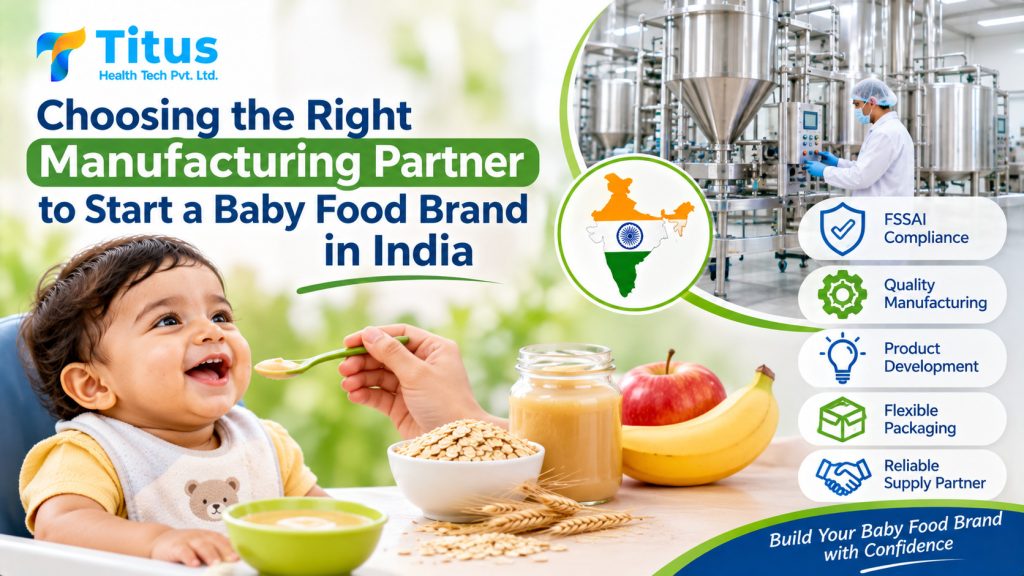
Quick answer: To start a baby food brand in India, choose a manufacturing partner that holds the required FSSAI licensing, produces under hygienic and documented conditions, supports product development and packaging, and offers private label or contract manufacturing. Verify documentation, approve samples and agree responsibilities in writing before the first order.
Founders who want to start a baby food brand in India quickly discover that the product idea is the easy part. Infant and toddler foods are among the most closely regulated food categories, and the manufacturing partner determines whether the product is safe, consistent and compliant.
This guide explains how to approach the decision, covering regulation, production models, product development, packaging and costs, and how Titus Health Tech supports brands entering infant and baby nutrition. It is general educational information for businesses and not medical advice.
Launching in this category requires more than a formula and a label. A brand must secure licensing, commission validated production, design compliant packaging and build trust with parents and healthcare professionals. Two early decisions shape everything that follows.
Brands usually begin with a focused range, such as single-grain cereals, multi-grain cereals or fruit-based weaning products, rather than a broad catalogue. A narrow range lets each product be developed, tested and marketed properly, and it simplifies the discussion with a manufacturer. Anyone planning to start a baby food brand in India should decide the age stage, format and positioning of the first product before approaching partners.
Building a compliant infant food factory demands significant capital, specialist staff and time. Most new brands therefore outsource production to an established facility, which lets them concentrate on branding, distribution and customer relationships while the manufacturer handles processing and quality control, which is why most founders who start a baby food brand in India choose this route.
Understanding the FSSAI requirements for baby food business operations is essential before any commercial launch. According to the Food Safety and Standards Authority of India (FSSAI), food businesses must hold the appropriate license or registration, and infant nutrition products must comply with standards notified under the Food Safety and Standards Act, 2006, covering composition, labeling and safety. These rules also include accurate labeling and restrictions on claims. Separate national legislation restricts the promotion of infant milk substitutes and feeding bottles, so brands should take specialist advice on marketing. A capable manufacturer will explain how the FSSAI requirements for baby food business projects apply to a given product and will not treat compliance as an afterthought. Brands should confirm current rules directly with the authority, because requirements are updated from time to time.
Brands typically enter the category through one of two routes, and the differences affect cost, speed and ownership of the formulation.
| Model | How It Works | Formulation | Typical Fit |
| Private label | Brand sells a manufacturer’s existing product under its own name | Manufacturer’s base | New brands seeking a faster launch |
| Contract manufacturing | Manufacturer produces to the brand’s specification | Brand-defined | Brands with an established recipe |
| Custom development | Product developed around the brand’s brief | Developed for the brand | Differentiated products |
Baby food contract manufacturing suits brands that already hold a defined formulation and need a facility to produce it consistently. Here, recipe confidentiality, change control and batch release responsibilities should be agreed in writing, and the brand should confirm how specifications are documented and revised.
A private label baby food manufacturer offers existing base formulations with customized packaging and branding, which reduces development time and risk for new entrants. Brands comparing a private label baby food manufacturer should ask which formulations are available, how much customization is included and what minimum order quantities apply. The two models are not mutually exclusive, and many facilities offer both.
Selecting a baby food manufacturing company in India calls for evidence rather than assurances. Anyone ready to start a baby food brand in India will find the following checks useful:
A baby food manufacturing company in India that welcomes this scrutiny is generally more reliable than one that offers only brochures. Visiting the facility, or reviewing a structured walkthrough, remains one of the most dependable ways to assess any partner.
Cereal-based weaning foods are a common starting point because the format is well understood and suits staged introduction. A baby cereal manufacturer in India typically cleans, cooks or pre-gelatinizes, mills and blends grains and pulses with fortification premixes before packing under controlled conditions. Brands should ask a baby cereal manufacturer in India how it manages blend uniformity, allergen declarations and moisture control, because these determine texture, safety and shelf life. Titus Health Tech’s baby cereal division, which includes the Triolac range and the SATVA line, illustrates the type of products produced in this category, and cereals are often the format that founders who start a baby food brand in India choose first.
The infant food manufacturing process follows a defined sequence, although each facility adapts it to its products. Raw materials are received and tested, then cleaned, processed and blended under controlled conditions. Fortification premixes are added in measured quantities, and the product is filled and sealed in protective packaging. Finished batches are tested against specification before release, and records are retained for traceability. Brands should ask a prospective partner to explain each stage of the infant food manufacturing process and show how it is monitored, because a clear explanation is usually a sign of genuine control. Readers can review the manufacturing infrastructure at Titus Health Tech to see how production is organized.
Baby food product development begins with a brief covering the target age, nutrient profile, ingredients, taste, texture and price point. Technical staff then run bench trials, evaluate solubility and mixability, and check stability under storage conditions similar to real distribution. Because the consumers are infants, baby food product development should stay within regulatory limits on composition and avoid unsupported claims. Brands should agree who owns the final recipe before development starts, and ask how trial results are documented. Good baby food product development also considers allergens, ingredient sourcing and the practical needs of caregivers, such as easy preparation and clear serving instructions.
Powders absorb moisture readily, so packaging must provide an effective barrier, secure sealing and clear batch coding. When evaluating baby food packaging solutions, brands should consider:
Baby food packaging solutions should be validated with shelf-life data, and draft labels should be reviewed against regulatory requirements before printing, because relabeling after production is costly.
Several errors recur among founders who start a baby food brand in India. The first is choosing a manufacturer on price alone, which can hide gaps in testing, packaging or documentation. The second is launching too many products at once, which stretches budgets and complicates quality control. The third is neglecting regulatory review of labels and claims until after packaging has been printed. Another is assuming that a facility experienced in general foods can handle infant products, when hygiene, ingredient control and traceability requirements are much stricter. Founders who avoid these mistakes and who start a baby food brand in India with a focused range and a transparent partner generally reach the market faster and with fewer corrections.
A simple sequence keeps the project on track. Begin with a written product brief and a shortlist of manufacturers, then request documentation and samples from each. Approve a formulation and packaging format, review draft labels against regulatory requirements and agree responsibilities for testing and release. Plan the first production run to match realistic sales, and confirm replenishment lead times before launch. Founders who treat the roadmap as a checklist, and who document each decision, find it much easier to resolve questions later and to demonstrate diligence to retailers and distributors.
The cost of launching depends on formulation, ingredient grade, packaging, testing and order volume. Smaller runs usually cost more per unit because fixed activities such as changeovers and documentation are spread over fewer units. Minimum order quantities vary by facility, so brands should confirm them in writing instead of assuming a figure. Founders who want to start a baby food brand in India should budget for development, testing and packaging as well as production, and requesting an itemized quotation from each shortlisted partner allows like-for-like comparison, and brands should also agree timelines for sampling, first production and replenishment so that launch plans remain realistic.
Founders should understand the feeding framework in which their products are used. According to the ICMR-National Institute of Nutrition’s Dietary Guidelines for Indians, complementary feeding should begin around six months of age alongside continued breastfeeding, with variety and quantity increasing gradually. A brand that wants to start a baby food brand in India responsibly should design products around this staged approach and avoid presenting any product as a replacement for breast milk or for individual medical advice.
Titus Health Tech Pvt. Ltd. is a nutrition products manufacturer based in Gandhinagar, Gujarat, with divisions covering infant nutrition, baby cereals, speciality nutrition and sports nutrition. The facility operates under GMP, ISO 22000:2018 and HACCP-aligned practices. Brands can review the baby cereal range and explore private labeling options across the company’s divisions.
Founders and brands planning to start a baby food brand in India are encouraged to contact Titus Health Tech to discuss formulation, packaging, minimum order quantities and timelines for their project.
Choosing a manufacturing partner is the most important step for anyone who wants to start a baby food brand in India. Understanding FSSAI licensing and labeling rules, comparing contract and private label models, and assessing a manufacturer on documentation, hygiene and transparency will protect both the brand and the end consumer. Titus Health Tech supports brands across infant and baby nutrition and welcomes enquiries about requirements and next steps.
To start a baby food brand in India, define your product range, understand FSSAI licensing and labeling rules, choose a qualified manufacturer, approve samples and validate packaging before launch.
Businesses need the appropriate FSSAI license or registration, and products must meet notified composition, labeling and safety standards. Confirm current rules with FSSAI.
It is production of a brand’s own specification at another company’s facility, with agreed terms on testing, release and recipe confidentiality.
It provides existing base formulations with branded packaging, shortening development time and reducing risk for a first launch.
Check licensing, hygiene design, ingredient control, batch traceability and willingness to share documentation and a facility walkthrough.
Cereals are a well-understood weaning format suited to staged introduction, so many brands begin there.
Packaging should provide moisture and oxygen barriers, secure sealing, clear batch coding and space for mandatory label information.
No. It is general information for businesses. Parents should consult a pediatrician about infant feeding decisions.
WhatsApp us