
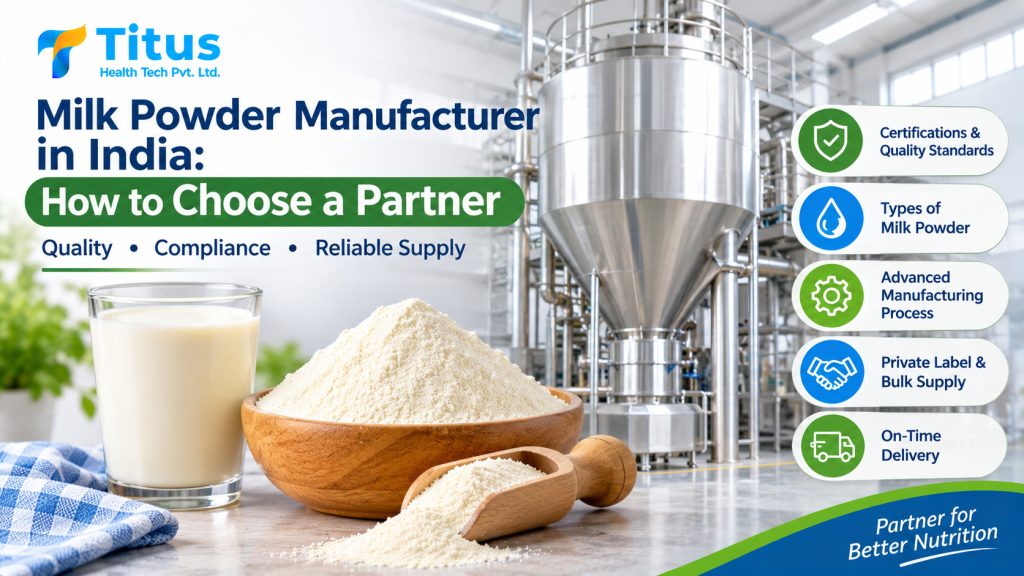
Brands in dairy, nutrition and food service often reach a stage where sourcing powdered milk products reliably becomes a strategic priority, and the choice of a milk powder manufacturer in India then shapes product quality, regulatory standing and supply continuity. A capable milk powder manufacturer in India combines controlled processing, documented testing and technical support, so that every batch meets its specification and label. This guide explains the types of milk powder available, how the production process works, which quality standards matter, and how to evaluate a manufacturing partner, including where Titus Health Tech fits.
This article is general educational information for brands. Products intended for infants require particular care, and feeding decisions for an individual baby should be made with a pediatrician.
A milk powder manufacturer in India converts liquid milk or milk-based formulations into shelf-stable powders through controlled heat treatment, concentration and drying, followed by packing under hygienic conditions. Some facilities focus on commodity powders such as whole or skimmed milk powder, while others produce formulated milk-based nutrition powders that combine milk ingredients with added proteins, carbohydrates, vitamins and minerals. Because these two categories differ in equipment, documentation and regulation, brands should define precisely what they need before approaching any milk powder manufacturer in India.
Milk and milk products are an established food group in Indian dietary guidance. According to the ICMR-National Institute of Nutrition’s Dietary Guidelines for Indians, milk and milk products contribute protein and calcium within a varied, balanced diet. Powdered forms extend shelf life and simplify transport and storage, which is why they are used in beverages, nutrition products, bakery and confectionery, and infant and adult formulations. Choosing a reliable milk powder manufacturer in India therefore supports both product consistency and the practicalities of distribution.
Requirements differ widely by application. Brands commonly source one or more of the following:
Each type has its own specification, packaging and regulatory considerations, so a supplier suited to one may not suit another. Writing a short technical brief covering product type, composition, pack size and expected volume helps any manufacturer respond with an accurate proposal rather than a generic estimate, and it makes quotations from different partners easier to compare.
The milk powder production process follows a defined sequence, although each facility adapts it to its products. Raw milk or milk ingredients are first received and tested for quality and safety. The milk is then standardized to the required fat and solids content and heat-treated to ensure microbiological safety. Next, water is removed in evaporators to concentrate the milk, and the concentrate is spray dried into a fine powder. The powder is cooled, sifted and packed in moisture-resistant packaging under controlled humidity. For formulated nutrition powders, the milk powder production process may also include dry blending of added ingredients, which requires accurate weighing and verification of blend uniformity. Brands should ask a prospective partner to explain each step and show how it is monitored, because understanding the milk powder production process is the quickest way to judge whether a facility is suited to a given product.
Milk powder quality standards cover composition, hygiene and safety, and a manufacturer should be able to show how each is verified. Key parameters typically include:
According to the Food Safety and Standards Authority of India (FSSAI), food products including milk and milk products must comply with standards and labeling requirements notified under the Food Safety and Standards Act, 2006. Brands should ask any milk powder manufacturer in India which milk powder quality standards apply to their product category, and request documentation that shows how compliance is maintained.
The phrase milk powder suppliers in India covers a wide range of businesses, from producers to traders and distributors. A manufacturer controls processing and testing directly, while a trader sources from others and may have limited visibility of production conditions. Brands comparing milk powder suppliers in India should therefore ask whether the business manufactures the product, which facility produces it and what documentation can be shared. When traceability matters, as it does in nutrition and infant products, dealing directly with a milk powder manufacturer in India is generally more transparent than relying on layers of intermediaries.
Brands usually source through one of the following routes.
| Model | How It Works | Formulation | Typical Fit |
| Private label | Brand sells a manufacturer’s existing product under its own name | Manufacturer’s base | New brands seeking a faster launch |
| Contract manufacturing | Manufacturer produces to the brand’s specification | Brand-defined | Brands with an established recipe |
| Bulk supply | Large volumes for repacking, blending or further processing | Agreed specification | Food manufacturers and distributors |
A private label milk powder manufacturer offers existing formulations with customized packaging and branding, which shortens development time, and brands should ask which base formulations are available and how much customization is included. Contract milk powder manufacturing suits brands that hold a defined specification and need a facility to produce it consistently, and it calls for clear terms on recipe confidentiality and change control. In contract milk powder manufacturing, the specification, testing plan and release criteria should be documented before the first batch is produced. A bulk milk powder manufacturer supplies larger quantities for repacking or use as an ingredient, so brands should confirm batch sizes, packaging formats, lead times and storage requirements before ordering. Whichever model is chosen, responsibilities for testing, release and complaint handling should be agreed in writing.
Milk powders are hygroscopic, meaning they absorb moisture from the air, which can cause caking, flavor changes and shorter shelf life. Packaging therefore needs an effective moisture and oxygen barrier, secure seals and clear batch coding, and the packing area should be humidity controlled. Brands should ask a milk powder manufacturer in India which pack formats have been validated, what shelf-life data supports the stated expiry and how finished goods are stored and dispatched. Storage conditions in the warehouse and during transport matter as much as production, so agreements should state temperature and handling expectations clearly.
Several errors recur when brands choose a manufacturer. The first is selecting on price alone, which can hide gaps in testing, packaging or documentation. The second is assuming that any milk powder manufacturer in India can produce every type of powder, when infant, adult and commodity products need different equipment and controls. The third is failing to agree the commercial model clearly: a private label milk powder manufacturer, a contract milk powder manufacturing partner and a bulk supplier carry different responsibilities for formulation, testing and release. Finally, many brands skip sampling and documentation review, although these steps are the best protection against later quality disputes.
A milk powder manufacturing company should be assessed on evidence rather than assurances. Brands will find the following checks useful:
Visiting the facility, or reviewing a structured walkthrough, remains one of the most reliable ways to assess a milk powder manufacturing company, and responsiveness during sampling is usually a good indicator of the support available afterwards.
The price of milk powder depends on raw material costs, the type of powder, specification, packaging and order volume. Formulated powders usually cost more than commodity powders because of added ingredients and tighter controls. Minimum order quantities vary by facility and product, so brands should confirm them in writing rather than assume a figure. Comparing itemized quotations from each milk powder manufacturer in India like for like, including testing and packaging, gives a clearer picture than comparing headline prices, and a bulk milk powder manufacturer should be willing to explain how volume affects the final cost.
Titus Health Tech Pvt. Ltd. is a nutrition products manufacturer based in Gandhinagar, Gujarat, with divisions covering infant nutrition, baby cereals, speciality nutrition and sports nutrition. Its published range centers on formulated nutrition products, including infant formula and other milk-based nutrition powders, so brands that need commodity dairy powder should confirm scope before proceeding. The facility operates under GMP, ISO 22000:2018 and HACCP-aligned practices. Readers can review the infant formula range and the manufacturing infrastructure to understand how production is organized, or explore private labeling options across the company’s divisions.
Brands looking for a milk powder manufacturer in India for milk-based nutrition powders, with defined specifications, packaging and volumes, are encouraged to contact Titus Health Tech to discuss specifications, packaging and volumes.
Choosing a milk powder manufacturer in India requires clarity about the type of powder needed, an understanding of the production process and quality standards, and a careful review of documentation, hygiene and traceability. Whether a brand is comparing milk powder suppliers in India or assessing a milk powder manufacturing company for a long-term partnership, evidence of process discipline should carry more weight than price alone. Titus Health Tech supports brands in formulated nutrition powders and welcomes enquiries about requirements and next steps, whether the project is a private label milk powder manufacturer arrangement or a custom specification.
A milk powder manufacturer in India processes milk or milk-based formulations into shelf-stable powders through heat treatment, concentration and drying, with testing and packaging.
It involves receiving and testing milk, standardizing and heat-treating it, evaporating to concentrate it, spray drying, cooling, sifting and packing under controlled humidity.
They cover composition, microbiological safety, physical quality, contaminant control and shelf-life stability, in line with FSSAI requirements.
A manufacturer controls processing and testing directly, while some suppliers are traders who source from others and have less visibility of production.
It is production to a brand’s own specification at another company’s facility, with agreed terms on testing, release and recipe confidentiality.
When it needs larger quantities for repacking or use as an ingredient and can manage packaging and labeling itself.
Many do, offering branded packaging and pack sizes on existing formulations. Brands should confirm options and minimums in writing.
Titus Health Tech manufactures formulated nutrition products, including infant formula. Brands should contact the team to confirm scope for their requirement.
WhatsApp us