
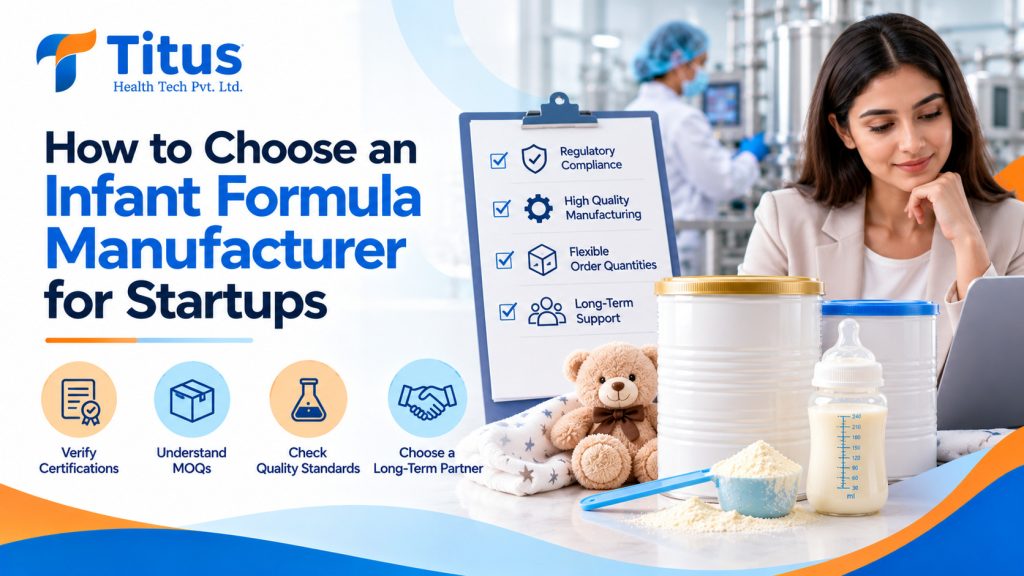
Launching an infant nutrition brand is unlike launching almost any other food business. The product is fed to babies, the rules are strict, and parents notice every change in taste, texture or tin design. For most founders, the real question is not whether to outsource production but how to pick the right infant formula manufacturer for startups. A partner with a proven infant formula range and private label experience can save you months of trial and error.
This guide walks through how contract manufacturing works, what to check before signing, how order quantities and trial batches usually work, and the mistakes that sink new brands. It reflects requirements as they stand in 2026 under India’s infant food regulations.
An infant formula manufacturer for startups is a licensed contract or private label producer that formulates, manufactures, tests and packs infant formula under a young brand’s name, while accepting the smaller volumes, guidance needs and flexibility that new businesses require.
Large contract manufacturers often prioritise established clients with predictable, high-volume orders. A startup-focused partner works differently. It helps with product selection, explains regulatory requirements, supports label compliance and accepts more modest first orders. In short, a startup friendly nutrition manufacturer treats your first production run as the start of a long relationship rather than a small job to squeeze in.
Put simply, the best infant formula manufacturer for startups combines regulatory discipline with patience. It knows a founder’s first order is small, and it knows the brand’s reputation will rest on that order anyway.
Infant formula is one of the most tightly regulated foods in India. The Food Safety and Standards (Foods for Infant Nutrition) Regulations, 2020 define infant formula as a breast milk substitute intended to meet the nutritional requirements of infants during the first six months of life. The same regulations set nutrient composition limits, contaminant and microbiological requirements, and specific packaging and labelling rules.
They also require compliance with the Infant Milk Substitutes, Feeding Bottles and Infant Foods (Regulation of Production, Supply and Distribution) Act, which restricts how infant formula can be promoted. That has a direct impact on your marketing plan, and a good infant formula manufacturer for startups will raise it early.
Internationally, the World Health Organization’s guideline on complementary feeding and its long-standing support for breastfeeding shape how regulators view this category. Responsible brands position formula as a carefully made option for families who need it, not as a replacement for breastfeeding advice.
The practical upshot: one weak link in manufacturing, testing or labelling can block your launch or trigger a recall. Choosing an infant formula manufacturer for startups is therefore the most important decision you will make in your first year.
This is also why founders should judge an infant formula manufacturer for startups on its documentation habits as much as on its machinery.
Most startups use one of two models:
For a first launch, private label is usually the sensible route. A new baby food brand manufacturer india partner with ready formulations, such as standard, premium and lactose-free variants, lets you reach market sooner and invest in distribution instead of R&D. Titus Health Tech, for example, produces standard, premium and lactose-free infant formula grades under its Triomil range and offers private labeling services built on these formulations.
Whichever model you pick, confirm early that the infant formula manufacturer for startups you favour holds the supporting data for the formulation and can share it with your distributors.
Use this process to evaluate any infant formula manufacturer for startups before you commit money.
Each step reflects what an experienced infant formula manufacturer for startups should be able to demonstrate, not just promise.
Ask for the manufacturer’s FSSAI licence and confirm it covers infant nutrition products. Then check site certifications such as GMP, HACCP and ISO 22000. Titus Health Tech’s facility, for instance, is certified for GMP, ISO 22000:2018 and HACCP. Certificates should be current and issued to the actual production site, not a head office.
Minimum order quantity (MOQ) is often the biggest hurdle for founders. Ask every candidate for its minimum order quantity infant formula india terms in writing, broken down by formulation, pack size and packaging material. MOQs are driven by blending batch sizes and printed packaging runs, so the packaging MOQ is sometimes higher than the product MOQ.
A low moq infant formula manufacturer is valuable in year one because it protects your cash flow and limits the stock you could be left holding if demand is slower than expected. However, low MOQ should never mean relaxed testing.
Ask, too, whether the infant formula manufacturer for startups can hold printed packaging in stock for repeat orders, which can soften the impact of high packaging MOQs.
Not every factory can run small lots efficiently. Ask whether the plant offers small batch baby formula manufacturing india brands can use for a market test, and what the per-unit cost difference is. A trial batch infant formula manufacturer will typically let you run one smaller production lot to test packaging, shelf appearance and early market response before you scale.
Trial runs also reveal how a manufacturer communicates under pressure: whether dates are met, whether COAs arrive on time, and how problems are handled.
Treat the trial as an audition for the infant formula manufacturer for startups as much as for your product.
Always request sample infant formula manufacturing samples of the exact formulation you plan to sell. Check reconstitution, smell, dissolution and taste, and ask for the matching specification sheet and certificate of analysis. Sampling is also the moment to compare two or three manufacturers side by side on product quality, not just price.
Ask what is tested on raw materials, in process and on finished goods. Infant formula must meet microbiological requirements and contaminant limits under FSSAI rules, so in-house lab capability and the use of accredited external laboratories both matter. Request a sample COA and walk through it with someone qualified.
An infant formula manufacturer for startups that welcomes these questions is usually confident in its systems.
Your label must follow the Food Safety and Standards (Labelling and Display) Regulations, 2020, plus the infant-specific labelling rules. The right infant formula manufacturer for startups will review your artwork for mandatory statements, nutrition tables and prohibited claims. This is where baby formula brand launch support india becomes very real: label errors are one of the most common reasons launches slip.
Ask the infant formula manufacturer for startups how it handles artwork review and who signs off the final label before printing.
You may start small, but you need a partner who can scale. Ask about production capacity, how many brands they serve, and lead times at higher volumes. Titus Health Tech states it manufactures for more than 40 private label companies in India and 10 international partners, which indicates experience managing many brands at once.
Switching suppliers later means new samples, new artwork checks and possibly new registrations, so pick an infant formula manufacturer for startups you can stay with for years.
If possible, visit the plant. Look at hygiene zoning, raw material storage, packing lines and documentation practices. A visit tells you more than any brochure. You can review a manufacturer’s published infrastructure details before you go to prepare better questions.
Good manufacturing partners do more than fill tins. Useful baby formula brand launch support India startups should ask about includes:
A startup friendly nutrition manufacturer will explain what it can and cannot do, so you know where you still need a regulatory consultant or distributor.
Before signing, ask the infant formula manufacturer for startups to list which launch services are included in the quote and which are charged separately.
After working with founders, a few patterns appear again and again:
Avoiding these mistakes is far easier with the right infant formula manufacturer for startups beside you from day one.
When you have two or three shortlisted options, compare them on the same criteria:
A new baby food brand manufacturer India founders rate highly will usually score well on transparency, even if it is not the lowest-cost option. And a low MOQ infant formula manufacturer is only a bargain if quality, documents and timelines hold up.
Score each infant formula manufacturer for startups on every criterion, then give compliance and quality the heaviest weighting.
Consider a founder planning a stage 1 and stage 2 formula for online sale. A realistic sequence looks like this: shortlist manufacturers, request samples, compare COAs and MOQs, select a private label formulation, finalise compliant artwork, run a trial batch, gather early customer feedback, then place a full production order. Working with a trial batch infant formula manufacturer at the test stage keeps the financial risk contained while you learn what your market wants.
The founders who launch smoothly are rarely the ones with the biggest budgets. They are the ones who picked an infant formula manufacturer for startups that asked the hard questions early.
If you are building a new infant nutrition brand, start a conversation with a manufacturer that understands startups. Contact Titus Health Tech to discuss private label formulations, order quantities, samples and launch support for your brand.
The right infant formula manufacturer for startups will answer your questions plainly and help you plan a launch that fits your budget.
What makes an infant formula manufacturer for startups different from a regular contract manufacturer?
An infant formula manufacturer for startups accepts smaller first orders, offers ready formulations and helps with labels and documents. Regular contract plants often focus on high-volume clients with established brands.
How do I find a low MOQ infant formula manufacturer in India?
Shortlist licensed private label manufacturers, ask each for written MOQs by product and packaging, and compare flexibility. A low MOQ infant formula manufacturer should still share full testing records and certifications.
What affects minimum order quantity infant formula India manufacturers set?
Minimum order quantity infant formula India plants set depends on blending batch size, packaging print runs, formulation type and pack size. Custom formulas usually carry higher MOQs than existing private label options.
Is small batch baby formula manufacturing India brands can use worth the cost?
Usually, yes. Small batch baby formula manufacturing India startups use costs more per unit, but it limits stock risk and lets you test packaging, pricing and demand before scaling.
Does Titus Health Tech work with new infant formula brands?
Yes. Titus Health Tech offers private label infant formula manufacturing and can discuss formulations, samples and launch support. As a startup friendly nutrition manufacturer, it supports brands at different stages.
How do I request sample infant formula manufacturing quotes?
Share your target formulation, age stage, pack size and expected volumes, then request sample infant formula manufacturing packs alongside the specification sheet and COA so you can judge quality, not just price.
What baby formula brand launch support India manufacturers usually provide?
Typical baby formula brand launch support India manufacturers offer includes formulation guidance, label compliance checks, COAs, specification sheets, shelf-life data and documents needed by distributors or online marketplaces.
WhatsApp us