
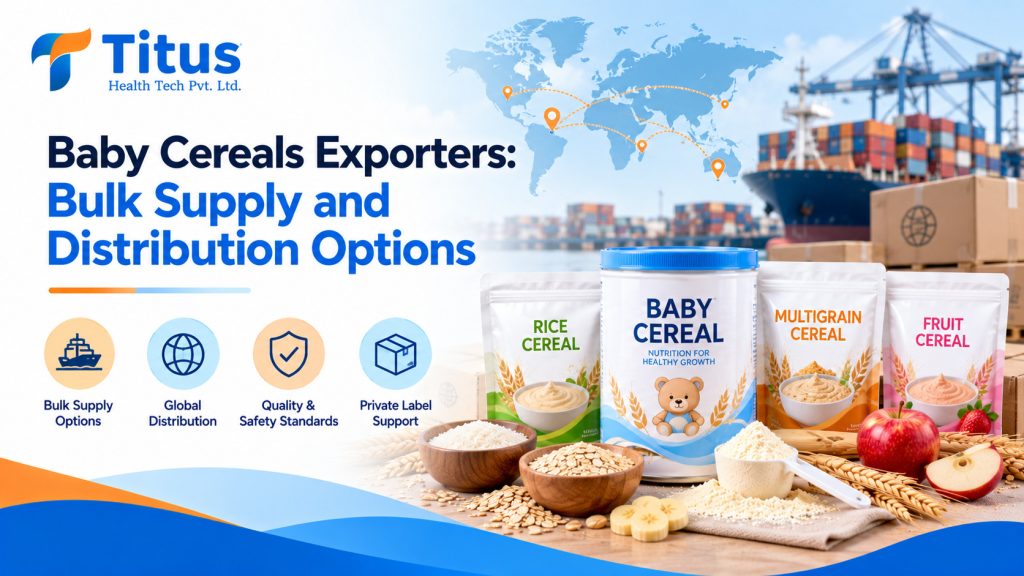
Importing infant cereal is a high-trust purchase. A distributor in Nairobi or a pharmacy chain in the Gulf is not just buying powder in a bag. They are buying batch consistency, test reports that hold up at the port, and packaging that survives weeks at sea. That is why experienced buyers shortlist baby cereals exporters by reviewing their baby cereal product range and manufacturing credentials first, and only then talk about price.
This article explains how baby cereals exporters structure bulk supply in 2026, which distribution models suit different markets, what documents you should expect, and how to compare quotes fairly. It is written for importers, distributors, institutional buyers and brand owners looking for an infant cereal exporter india can offer with dependable quality.
Baby cereals exporters supply processed, cereal-based complementary foods for infants from around six months of age. Products usually leave the factory in one of three forms: finished retail packs under the manufacturer’s brand, private label packs under the buyer’s brand, or bulk powder for local repacking where the destination allows it.
The global reference point for this category is the Codex Alimentarius Standard for Processed Cereal-Based Foods for Infants and Young Children (CXS 74-1981). It covers products intended for infants generally from 6 months onward and sets a minimum energy density of 0.8 kcal per gram (3.3 kJ/g). Many importing countries build their own rules on top of Codex, so baby cereals exporters that already formulate to it remove a lot of friction from registration.
Common product types include:
Because these products are fed during the weaning stage, buyers also search for them as weaning or complementary foods. Anyone looking for a weaning food exporter india has available is generally sourcing from the same category and the same pool of manufacturers.
India has a deep base of cereal, pulse and dairy raw materials, and its infant food manufacturers operate under the Food Safety and Standards Authority of India (FSSAI). The Food Safety and Standards (Foods for Infant Nutrition) Regulations, 2020, gazette-notified in December 2020, set compositional, contaminant, microbiological, packaging and labelling requirements for infant foods.
For an importer, that domestic framework matters. An infant cereal exporter India-based that already meets FSSAI infant food rules and runs GMP, HACCP and ISO 22000 systems usually has the documentation discipline that export markets demand. Ports on India’s west coast also serve East Africa, the Middle East and South-East Asia on established shipping routes, which is one reason an indian baby cereal exporter for africa can often compete on lead time as well as cost.
The same logic applies to weaning foods more broadly. A weaning food exporter India buyers trust is one that treats export compliance as part of production, not as paperwork added at the end.
Indian baby cereals exporters that apply the same controls to every market also make life easier for importers who sell into several countries at once.
Most baby cereals exporters offer three supply models. The right one depends on whether you own a brand, how developed your local distribution is, and how your country regulates imported infant food.
You import ready-to-sell packs, such as the Triolac cereal range from Titus Health Tech, and distribute them locally. This is usually the fastest route to market because labels, specifications and supporting data already exist. It suits distributors who want to add a proven baby food line without investing in brand building.
The manufacturer produces under your brand name, with your artwork and, within regulatory limits, your formulation preferences. Titus offers private label manufacturing for infant nutrition and baby cereals. This model takes longer because of artwork approval, label compliance for your market and sometimes product registration, but it builds an asset you own.
Some importers buy larger packs and repack locally to cut freight volume or meet local-content rules. An export baby cereal bulk supplier should first confirm that your destination permits repacking of infant food, because many regulators restrict it. Where it is allowed, expect strict scrutiny of the repacking site’s hygiene and traceability. A good export baby cereal bulk supplier will also ask about your packing environment before agreeing to ship bulk.
Supply model and distribution model go hand in hand. These are the routes most often used:
A practical path for importers working with an Indian baby cereal exporter for Africa is to start with a master distributor arrangement in one country, prove sell-through, then extend into neighbouring markets. Baby cereals exporters generally prefer this too, because it keeps registration costs focused while demand is being tested.
Packaging is where many first shipments go wrong. Infant cereal is a dry powder that readily absorbs moisture, so humidity and oxygen are the main threats during long transit.
Experienced baby cereals exporters plan packaging around the destination’s climate and transit time, not just the factory’s standard pack.
Good baby cereal export packing india practice usually includes:
FSSAI’s infant nutrition regulations require infant foods to be packed in hermetically sealed, clean and sound containers or in flexible packs made from paper, polymer or metallic film. Ask each supplier how its baby cereal export packing India operations meet that rule and also your destination’s labelling language requirements. Proper baby cereal export packing India suppliers follow should be documented in a written packaging specification you can review.
A certificate of analysis (COA) is the batch-level proof that what you received matches the agreed specification. A reliable baby cereal exporter with coa support provides one for every batch, typically covering moisture, protein, key vitamins and minerals, and microbiological results.
A typical export document set includes:
Some regulators also ask for manufacturing site certificates. Titus Health Tech’s facility is certified for GMP, ISO 22000:2018 and HACCP, which helps when importers register products abroad. Before signing, ask any baby cereal exporter with COA documentation to share a sample COA so your quality team can check test methods and limits. Baby cereals exporters that hesitate here are a warning sign.
Buyers naturally want a baby cereal export price per tonne figure early. Credible baby cereals exporters will rarely quote a fixed number without details, because price depends on:
When comparing baby cereal export price per tonne across suppliers, normalise every quote to the same Incoterm, pack size and shelf life. A lower price paired with a shorter shelf life can cost more in write-offs than a slightly higher price with longer stability.
Choose baby cereals exporters on evidence, not brochures. Work through these steps:
From experience, the suppliers who answer documentation questions quickly are usually the ones who resolve customs holds quickly too. That responsiveness is worth more than a small price difference.
Baby cereals exporters that welcome audits, sample checks and reference calls usually have the systems to back up their claims.
Titus Health Tech states it manufactures for more than 40 private label companies in India and 10 international partners. One client from Ghana has noted the company’s help with product registration and documentation, which is the kind of support importers entering African markets should look for.
To get baby cereal export quote figures you can genuinely compare, share the same brief with every supplier: target country, products, pack sizes, monthly or annual volumes, preferred Incoterm, labelling language and whether you need private label. Clear inputs produce comparable outputs.
If you are evaluating baby cereals exporters for your market, contact Titus Health Tech to discuss your requirements, request samples, or get baby cereal export quote options for retail, private label or bulk supply.
What do baby cereals exporters need from an importer to start?
Most baby cereals exporters need your target country, product list, pack sizes, expected volumes, Incoterm and labelling requirements. Import licences and registration rules in your market also shape timelines and the documents prepared.
Can an infant cereal exporter India supplies help with product registration abroad?
Many can. A capable infant cereal exporter India importers rely on provides specifications, COAs, site certificates and label artwork, which most regulators request when you register imported infant food in a new market.
What should an export baby cereal bulk supplier confirm before shipping bulk?
An export baby cereal bulk supplier should confirm your country allows local repacking of infant food, check your packing site’s hygiene and traceability, and agree specifications before shipping any bulk product.
Does Titus Health Tech supply baby cereal to African markets?
Titus Health Tech works with international partners and has a Ghana-based client using its products. As an Indian baby cereal exporter for Africa, it can discuss registration documents, packing and supply options for your market.
Why is a COA important when buying infant cereal?
A COA proves each batch meets its specification. Working with a baby cereal exporter with COA reports for every lot lets your quality team verify moisture, nutrients and microbiology before goods reach shelves.
Why don’t suppliers publish a fixed baby cereal export price per tonne?
Price depends on formulation, fortification, pack format, volume, Incoterm and private label work. Comparing baby cereal export price per tonne only makes sense when every quote uses the same specification.
How long does it take to get baby cereal export quote details?
It depends on how complete your brief is. Share products, volumes, pack sizes and destination upfront, and most baby cereals exporters can respond faster with a quote that reflects your real landed cost.
WhatsApp us