
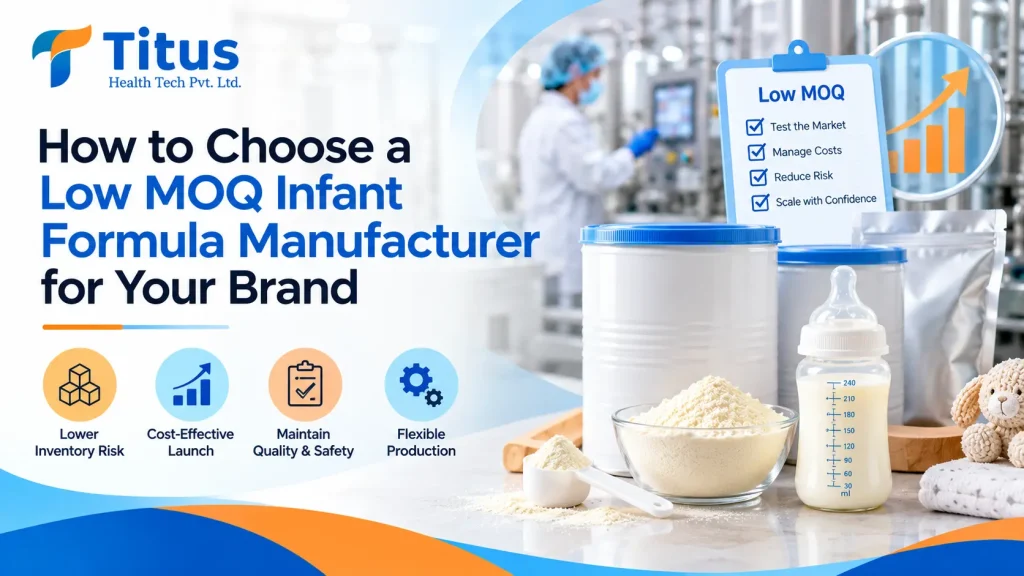
Launching an infant nutrition brand without committing to oversized production runs is a priority for many new entrants, which is why a low MOQ infant formula manufacturer is often the first type of partner they search for. Minimum order quantity (MOQ) shapes cash flow, inventory risk and the speed at which a brand can test the market, and in a category where shelf life and compliance are tightly managed.
This article is general educational information for brands. It is not medical advice, and decisions about feeding an individual infant should be made with a pediatrician.
A low MOQ infant formula manufacturer agrees to produce batches that are smaller than the volumes typically required by high-capacity facilities. For a new brand, this reduces the amount of capital tied up in a first production run and limits the risk of holding unsold stock. MOQ policies differ from one facility to another and often depend on the formulation, packaging format and production line, so brands should confirm the applicable quantity in writing rather than assume a figure. Choosing a low MOQ infant formula manufacturer does not mean accepting lower standards; the same hygiene, testing and documentation expectations apply to every batch, whatever its size.
Infant formula has a defined shelf life, and stock that moves slowly can approach expiry before it reaches consumers. A large first order therefore carries more than financial risk. Brands evaluating any low MOQ infant formula manufacturer should consider the following, since each point affects both risk and speed to market:
India has a growing base of nutrition manufacturers, and many brands now prefer a low MOQ infant formula manufacturer in India because proximity simplifies sampling, audits and logistics. Working domestically also makes it easier to visit the facility, review documentation and resolve queries quickly. Brands should compare each low MOQ infant formula manufacturer on quality systems and regulatory knowledge first, and treat MOQ as one criterion among several.
Brands use several terms for outsourced production, and the differences affect both MOQ and ownership of the formulation.
| Model | How It Works | Formulation | Typical Fit |
| Private label | Brand sells a manufacturer-developed formula under its own name | Manufacturer’s existing base | Faster launch for new brands |
| Contract manufacturing | Manufacturer produces to the brand’s specification | Brand-defined | Brands with an established recipe |
| Custom development | Formula developed around the brand’s brief | Developed for the brand | Differentiated products |
A private label infant formula manufacturer typically starts from an existing base formula, which shortens development time, and a low MOQ infant formula manufacturer offering this route can make an initial launch considerably more manageable. Brands comparing a private label infant formula manufacturer should confirm what packaging and labeling support is included. Infant formula contract manufacturing suits brands that already hold a defined specification and need production capacity. In infant formula contract manufacturing, the brand usually retains ownership of the specification, so documentation and confidentiality terms should be agreed in writing. Third party infant formula manufacturing is the broader term for outsourcing the full production cycle, including sourcing, blending, filling and testing. Brands considering third party infant formula manufacturing should clarify who is responsible for ingredient sourcing, testing and release of each batch. Brands that need a differentiated product may prefer custom infant formula manufacturing, where the recipe is built around their brief, although development effort and timelines are usually longer.
Small batch infant formula manufacturing places specific demands on a facility, because changeovers, cleaning validation and documentation must be as rigorous for a small run as for a large one. When assessing a partner for small batch infant formula manufacturing, ask the following:
A startup choosing an infant formula manufacturer for startups should plan beyond the first batch. Regulatory labeling, packaging artwork, distribution channels and shelf-life management all influence how quickly stock can be sold. An infant formula manufacturer for startups will usually be most helpful when it explains these dependencies early, shares sample documentation and is open about what is, and is not, included in a quotation. Startups are also advised to sequence their launch carefully, beginning with a limited range so that each product can be supported properly.
Infant formula manufacturing cost in India depends on ingredient grade, formulation complexity, pack format, order volume and the testing scope required. Smaller runs can carry a higher cost per unit because fixed activities such as changeovers and documentation are spread over fewer units. Brands should request an itemized quotation so that infant formula manufacturing cost in India can be compared across partners on a like-for-like basis. Comparing only headline figures can hide differences in testing, packaging and documentation. When reviewing quotations, brands should also ask what is included in the quoted price.
Infant nutrition is among the most regulated food categories, so any low MOQ infant formula manufacturer should treat compliance as non-negotiable. According to the Food Safety and Standards Authority of India (FSSAI), foods for infant nutrition must comply with standards notified under the Food Safety and Standards Act, 2006, covering composition, labeling and safety. Separate national legislation also restricts the promotion of infant milk substitutes. A responsible manufacturer will explain how these requirements apply to a brand’s product and will not treat compliance as an afterthought. Brands should request current licensing and quality documentation and confirm its scope before committing to production.
Before signing an agreement, brands should ask a prospective partner to share evidence rather than assurances. Useful documents include current licensing details, quality system documentation, sample batch records and a written statement of the minimum order quantity for each product. Brands should also confirm how deviations are reported, how complaints are handled and how long batch records are retained. A low MOQ infant formula manufacturer that welcomes these questions is usually one that is comfortable with scrutiny, which is an encouraging sign for a long-term relationship.
Titus Health Tech Pvt. Ltd. is a nutrition products manufacturer based in Gandhinagar, Gujarat, with divisions covering infant nutrition, baby cereals, speciality nutrition and sports nutrition. The facility operates under GMP, ISO 22000:2018 and HACCP-aligned practices. Brands exploring a private label infant formula manufacturer can review how private labeling is organized across the company’s divisions, and can also examine the infant formula range and the manufacturing infrastructure to understand how production is set up.
Brands with specific volume or packaging requirements are encouraged to contact Titus Health Tech to discuss minimum order quantities, formulation options and timelines for their project.
Choosing a low MOQ infant formula manufacturer requires balancing order flexibility against quality systems, regulatory knowledge and transparent documentation. Whether a brand is comparing a low MOQ infant formula manufacturer for a first launch or planning infant formula contract manufacturing for a wider range, MOQ should be evaluated alongside cost clarity, batch traceability and compliance support. Titus Health Tech supports brands across infant nutrition and related categories, and its team welcomes enquiries about requirements and next steps.
It is a manufacturer willing to produce smaller batches than typical high-volume facilities, helping new brands limit inventory and cash-flow risk. MOQ policies vary, so confirm them in writing.
A domestic partner simplifies sampling, audits and logistics, while lower volumes reduce stock risk during the launch period.
It means outsourcing sourcing, blending, filling and testing to a specialist manufacturer while the brand focuses on marketing and distribution.
Private label uses a manufacturer’s existing base formula, while custom infant formula manufacturing develops a recipe around the brand’s brief.
Yes. Composition, labeling and safety requirements apply regardless of batch size, so quality controls should be equally rigorous.
Ingredient grade, formulation complexity, packaging, order volume and testing scope all influence cost. An itemized quote allows fair comparison.
It should explain regulatory labeling, sampling steps, documentation and what the quotation includes, so the brand can plan realistically.
You should not choose an infant formula manufacturer based only on price. Check the manufacturer’s quality standards, licenses, and testing procedures before making a decision.
WhatsApp us