
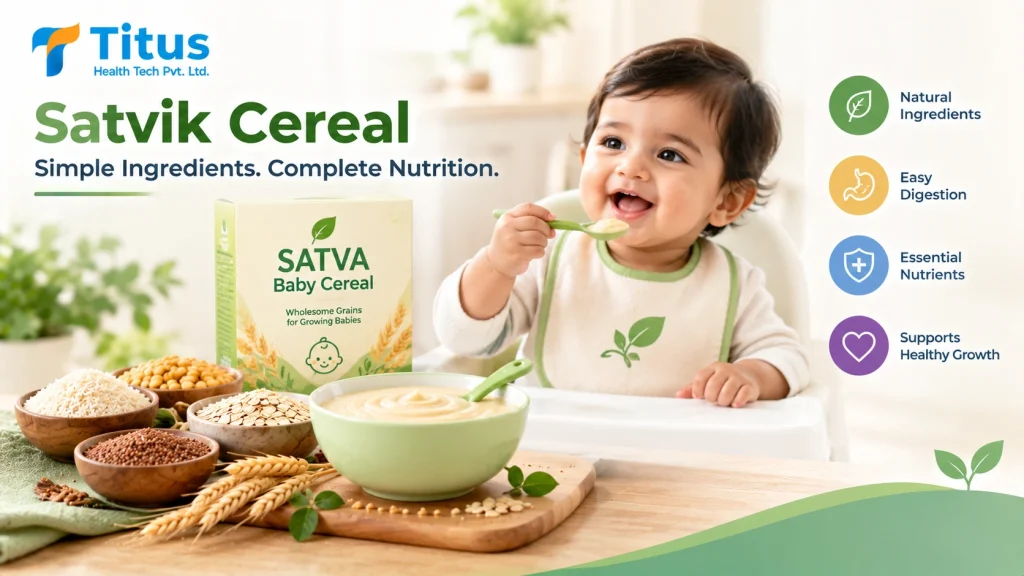
Parents introducing solid foods for the first time often look for a Satvik Cereal that feels close to home-cooked nutrition rather than a heavily processed product. It refers to weaning foods formulated around simple, wholesome grains and minimal processing, while still meeting the fortification and safety standards expected of infant nutrition products.
This article is educational and general in nature. It does not replace individual medical advice, and parents should consult a pediatrician about feeding decisions specific to their child.
It is a category of baby cereal built around the “satvik” philosophy — a preference for pure, natural ingredients prepared with minimal processing and without unnecessary additives. In practice, it typically uses whole grains, pulses, and naturally derived micronutrients, formulated specifically for infants transitioning from milk to solid foods. Titus Health Tech’s SATVA range reflects this approach within its baby cereal division, offering options designed around this wholesome formulation philosophy.
Unlike some conventional baby food products that rely heavily on refined ingredients, a well-formulated product aims to retain more of the grain’s natural nutrient profile while still delivering the fortification levels infants need at this stage of development.
Manufacturing a wholesome weaning product involves more than selecting good ingredients. Grains are usually cleaned, roasted or pre-cooked, and milled to a fine, easily digestible consistency suited to an infant’s stage of development. Pulses used for added protein typically go through similar cleaning and cooking steps before being blended into the final mix. Fortification premixes, containing measured amounts of iron, vitamins, and other micronutrients, are added in carefully controlled proportions so that each serving delivers a consistent nutrient profile. Because this process avoids heavy refining or artificial processing aids, batch consistency becomes especially important, and manufacturers rely on documented standard operating procedures to maintain it across production runs.
Understanding what goes into this type of product helps parents evaluate quality beyond marketing claims. Common Satvik cereal ingredients include:
Brands formulating a Satvik baby cereal should source these Satvik cereal ingredients from tested suppliers and verify purity before each production batch, since ingredient quality directly affects both nutrition and shelf stability.
Satvik cereal nutrition is typically built around three components: easily digestible carbohydrates from grains, moderate plant-based protein from pulses, and fortified micronutrients such as iron and vitamins. This combination is designed to support the nutritional needs of infants during the complementary feeding period, when breast milk or formula alone may no longer meet all requirements.
A transparent brand will display detailed nutrition information per serving on the pack, including energy, protein, fat, carbohydrate, and key micronutrient values. Parents comparing products should check this label rather than relying on packaging claims alone, since actual values can vary between brands even within the same category.
Choosing a well-formulated product can offer several practical advantages during the weaning period:
These Satvik cereal benefits make the category appealing to parents who want nutrition that feels closer to home-style cooking, without compromising on the safety and fortification standards required for infant food.
The broader idea of Satvik baby food extends beyond a single product category. It reflects a preference among many Indian households for food that is pure, minimally processed, and prepared with care — values traditionally associated with “satvik” eating. When applied to infant nutrition, this philosophy translates into formulations that avoid unnecessary additives while still meeting the technical requirements of a safe, fortified weaning food.
Brands offering Satvik baby food should be transparent about how this philosophy is implemented in their formulation and manufacturing process, rather than using the term only as a marketing label.
Introducing Satvik Cereal for babies should follow a gradual approach, consistent with standard complementary feeding guidance. The stages below describe a general pattern; actual timing should always be discussed with a pediatrician.
Most infants are introduced to complementary foods, including cereals, around six months of age, alongside continued breastfeeding. A single-grain cereal option is often used early because it limits potential allergen exposure and is easy to digest.
As the infant tolerates single-grain cereals well, parents may introduce multi-grain Satvik Cereal for babies, combining different grains and pulses for broader nutrient intake and texture variety.
By this stage, cereals are typically combined with other complementary foods such as mashed vegetables and fruits, with cereal continuing to serve as a convenient, nutrient-dense base.
According to the ICMR-National Institute of Nutrition’s Dietary Guidelines for Indians, complementary feeding should begin around six months of age alongside continued breastfeeding, with food variety and quantity increasing gradually as the infant grows. This infant cereal feeding guide approach aligns with that general recommendation, though individual feeding plans should be confirmed with a pediatrician.
When using baby cereal for weaning, a few general principles apply regardless of brand:
Any such product should be prepared fresh for each feeding session rather than stored for extended periods, to maintain both safety and nutrient quality.
The comparison below highlights typical differences between this category and a conventional, heavily processed baby cereal.
| Factor | Satvik Cereal | Regular Processed Cereal |
| Ingredient List | Whole grains, pulses, minimal additives | Refined grains, more additives |
| Processing Level | Minimal | Higher |
| Flavor Additives | Limited or none | Often includes artificial flavors |
| Nutrient Source | Primarily natural, with fortification | Primarily fortified, less natural base |
| Positioning | Wholesome, home-style nutrition | Convenience-focused |
This comparison is general in nature; parents should always verify actual ingredients and nutrition information on the specific product label rather than relying on category assumptions.
Proper storage preserves both safety and nutrient quality once a pack is opened. The product should be kept in a cool, dry place away from direct sunlight and moisture, with the pack resealed tightly after each use to limit humidity exposure. A dry spoon should always be used when scooping powder, since any moisture introduced into the pack can encourage clumping or spoilage. Parents should also check the manufacturing and expiry dates before each use and discard the product once it has been open longer than the period recommended on the label. Following these simple habits helps preserve nutrient integrity through the normal course of use.
When introducing Satvik cereal during complementary feeding, parents should follow the preparation and storage instructions carefully and avoid practices that may affect food safety or the infant’s feeding routine.
Not every product labeled “satvik” meets the same formulation standard. Parents and brands evaluating one should look for clear ingredient labeling without vague or generic terms, transparent Satvik cereal nutrition information per serving, manufacturing under documented food safety practices, and age-appropriate formulation guidance printed on the pack. These checks take only a few minutes but help separate genuinely wholesome formulations from products that use the term loosely for marketing purposes.
Titus Health Tech Pvt. Ltd. is a nutrition products manufacturer based in Gandhinagar, Gujarat, with a dedicated baby cereal division under its SATVA brand, formulated around whole grains and minimal processing. The company’s facility operates under GMP, ISO 22000:2018, and HACCP-aligned practices, supporting its infant nutrition, baby cereal, speciality nutrition, and sports nutrition divisions. Readers can review the baby cereal product range to see the current product formulations, or explore the manufacturing infrastructure behind production.
Parents or brands with questions about a specific formulation are encouraged to contact Titus Health Tech directly for product-specific information.
This category offers a wholesome, minimally processed approach to infant weaning nutrition, combining whole grains, pulses, and essential fortification within a simple ingredient profile. Understanding Satvik cereal ingredients, nutrition, and feeding guidance helps parents make informed choices during this important stage of a child’s development. Titus Health Tech’s SATVA range continues to offer this formulation, built around a wholesome philosophy, giving parents and brands a transparent option within India’s growing infant nutrition category.
It is a category of baby cereal formulated with whole grains, pulses, and minimal processing, following the “satvik” philosophy of pure, natural nutrition while still meeting infant food safety and fortification standards.
Common Satvik cereal ingredients include whole grains such as rice, wheat, or ragi, combined with pulses like moong dal, along with natural fortification sources such as iron and vitamin premixes.
Satvik cereal nutrition generally includes digestible carbohydrates, plant-based protein, and fortified micronutrients, with exact values varying by brand and printed on the product label.
Satvik cereal benefits include easier digestion, fewer artificial additives, a familiar ingredient profile, and continued support for key micronutrients like iron during infant growth.
General guidance suggests complementary feeding, including cereals, begins around six months of age alongside continued breastfeeding, though parents should consult a pediatrician for individual advice.
Baby cereal for weaning should be prepared fresh, with consistency gradually thickened as the infant adapts, following the dilution and serving instructions on the pack.
Yes, Titus Health Tech’s SATVA range includes such formulations, built around whole grains and minimal processing within its baby cereal division.
Yes, manufacturers offering private labeling, including Titus Health Tech, can support brands wanting to launch their own Satvik baby food line under existing or customized formulations.
WhatsApp us