
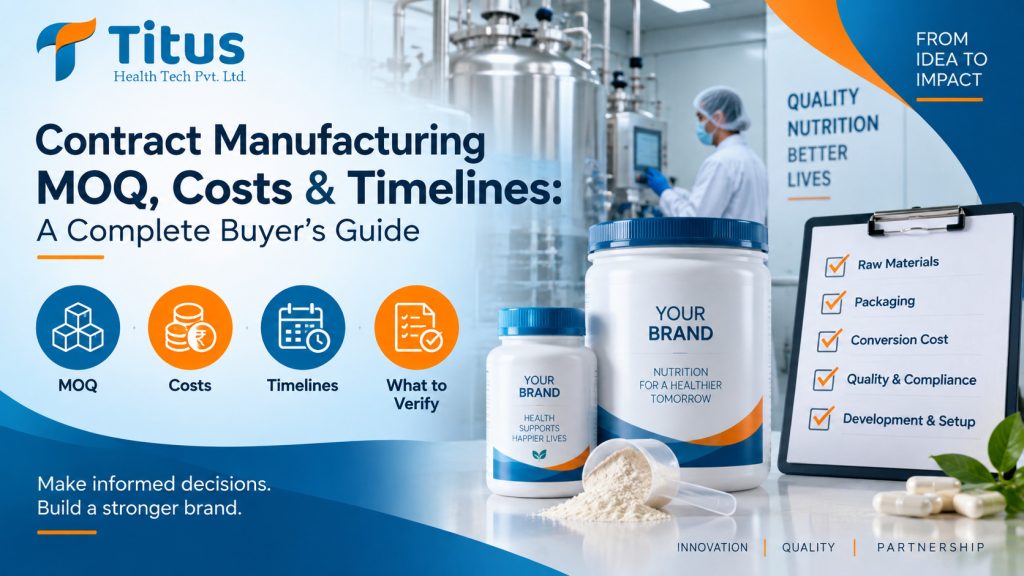
Most quotation disputes in nutrition manufacturing trace back to one gap: the buyer compares headline per-unit prices while the real variables sit elsewhere. Understanding contract manufacturing MOQ costs — how pricing is built up, what actually sets minimum order quantity, and how long each phase takes — lets you compare quotations on equal terms and plan working capital properly. This guide breaks down each cost component, explains the constraints that drive MOQ, sets out a realistic project timeline, and lists what to verify before you place a first order.
Contract manufacturing MOQ costs begin with the quotation itself, and a quotation is rarely a single number with a margin on top. It is built from several layers, and knowing which layer a quotation emphasises tells you where the risk sits.
Raw materials and ingredients normally form the largest share. For nutrition powders this includes dairy solids or protein concentrates, carbohydrate sources, oils, and the vitamin and mineral premix. Premix cost varies enormously with specification: a basic fortification blend and a premium blend with specialised nutrients are not comparable inputs, which is why two quotations for “the same” product can differ sharply.
Packaging is the second major component and is frequently underestimated. Tins, lids, induction seals, scoops, labels, mono-cartons, inner liners and shippers each carry their own cost and their own supplier minimum. Printed material is order-specific and cannot be reused across brands.
Conversion cost covers the manufacturing operation itself: batching, thermal processing, drying, blending, filling, sealing and coding, along with utilities, labour and depreciation. It is usually expressed per unit but is really a function of batch size, which is why small runs cost more per pack.
Quality and compliance costs are real and should be visible: incoming material testing, in-process checks, finished-goods analysis, stability studies, retained samples and documentation. Licensing and product-specific compliance obligations, published by the Food Safety and Standards Authority of India, also carry a cost that has to sit somewhere in the price.
Development and setup covers formulation work, trial batches, artwork coordination and line changeover. Some manufacturers amortise this into unit price; others quote it separately. Neither is wrong, but you cannot compare quotations until you know which approach each supplier has taken.
Within contract manufacturing MOQ costs, the quantity side is the part buyers most often misread. MOQ is not an arbitrary sales target. It is the point below which a batch stops being technically or economically viable, and it is set by physical constraints.
Equipment batch size is the primary driver. A blender, mixing tank or spray dryer has a minimum working volume below which mixing is not homogeneous. You cannot run a quarter batch and expect uniform micronutrient distribution.
Ingredient procurement lots matter just as much. Micronutrient premixes are custom-manufactured to a formulation and supplied in defined lot sizes. If the smallest available premix lot supports a given volume of finished product, that volume becomes your effective floor regardless of the blender.
Packaging minimums are the constraint buyers most often overlook when estimating nutrition manufacturing MOQ. Printed tins, labels and cartons are produced in economic print runs. In practice, packaging frequently sets nutrition manufacturing MOQ rather than the powder itself.
Changeover economics complete the picture. Cleaning and line changeover between products takes hours of capacity. Below a certain run length, that lost time makes the batch uneconomic at any sensible price.
This is why the minimum order quantity supplements buyers encounter varies between manufacturers and between SKUs at the same manufacturer. A brand launching a powder range and a brand launching a single tub will be quoted a different minimum order quantity supplements manufacturers consider viable, even on the same line. It also explains a common trap: quoting an attractive MOQ for one variant while a four-variant launch multiplies the commitment. Always request MOQ per SKU, per pack size and per packaging format. When you assess contract manufacturing MOQ costs across suppliers, compare the total first-order commitment for your full range, not the lowest single-SKU figure.
| Constraint | What sets it | Practical effect on your order |
| Equipment batch size | Minimum working volume of blender, tank or dryer | Fixes the smallest technically valid production batch |
| Premix procurement lot | Supplier’s minimum custom premix quantity | Can raise MOQ above the equipment minimum |
| Printed packaging | Economic print run for tins, cartons and labels | Often the true floor for a new brand launch |
| Line changeover | Cleaning and setup time between products | Makes very short runs uneconomic per unit |
| Testing and release | Fixed analytical cost per batch | Spread across fewer units in a small run |
Timelines are best understood as sequential phases with dependencies, not as one figure, and they interact directly with contract manufacturing MOQ costs because schedule pressure removes cheaper options. A supplement manufacturing timeline usually moves through the following stages.
Each stage below contributes to the overall supplement manufacturing timeline.
Two phases dominate in practice: sample approval and printed packaging. Both are largely within your control. Repeat orders are far quicker because formulation, artwork and supplier qualification are already complete, which is another reason first-order contract manufacturing MOQ costs look higher than steady-state costs.
There are legitimate levers for reducing contract manufacturing MOQ costs, and there are false economies. Use the first and avoid the second.
What not to cut: micronutrient overages needed for shelf-life compliance, stability testing, batch analysis and traceability documentation. These protect you from the cost that matters most — a failed batch or a withdrawn product — and cutting them rarely improves contract manufacturing cost India buyers actually pay over a full year. When comparing contract manufacturing cost India-wide, a quotation that is materially cheaper usually reflects a different specification or a thinner testing regime, not a better deal.
Before you sign, confirm the commercial and technical terms in writing, because contract manufacturing MOQ costs are defined by the agreement rather than by the quotation email.
Ask for a breakdown of contract manufacturing MOQ costs rather than a single figure. A supplier confident in their contract manufacturing pricing will explain how it was built; one that resists is usually protecting an assumption you would have questioned.
Quotation accuracy for contract manufacturing MOQ costs depends almost entirely on the quality of the brief. Manufacturers estimate conservatively when information is incomplete, so a vague enquiry produces a cautious, higher number.
Provide the following when you enquire:
Titus Health Tech Pvt. Ltd. manufactures infant formula, baby cereals, family nutrition and sports nutrition powders from a facility certified to GMP, ISO 22000:2018 and HACCP, and works with private label and contract clients in India and overseas. Reviewing the existing product range before enquiring usually sharpens the brief and clarifies nutrition manufacturing MOQ expectations, because it clarifies which formats and formulations are already validated — and validated formats generally carry lower private label cost India brands would otherwise pay for new development.
Pricing is built from raw materials and premix, packaging, conversion cost, quality testing and development or setup charges. MOQ is set separately by equipment batch size, premix lot size, printed packaging minimums and changeover economics, so the two must be quoted together.
Each plant has different equipment working volumes, premix suppliers and packaging arrangements. A larger facility may have a higher minimum batch size, while a smaller one may offer lower volumes at a higher per-unit price. Compare total commitment, not just the MOQ figure.
Printed packaging. It carries its own supplier minimums, cannot be reused if artwork changes, and frequently sets the real order floor. Artwork revisions after printing are one of the most common avoidable costs in a launch.
It runs through feasibility, formulation, sampling and approval, artwork and regulatory review, packaging printing, raw material procurement, production, and testing and release. Sample approval rounds and packaging printing are typically the longest phases in any supplement manufacturing timeline.
Sometimes, by reducing the number of variants, choosing a packaging format with lower print minimums, or starting with a validated existing formulation rather than a custom one. Reducing scope is more effective than negotiating the minimum order quantity supplements manufacturers quote.
Not necessarily. A materially lower price usually reflects a different specification, a simpler premix or a reduced testing regime. Compare contract manufacturing MOQ costs line by line against an identical specification before drawing conclusions about the contract manufacturing cost India suppliers offer.
Provide the product category, target specification or benchmark product, packaging format and pack size, number of variants, first-order and annual volumes, target market and any on-pack claims. Incomplete briefs produce conservative estimates that are revised later.
Cost, MOQ and timeline are one decision, not three. Batch size drives unit cost, packaging minimums drive MOQ, and approval cycles drive the schedule — so changing any one of them moves the others. Buyers who brief precisely, freeze specifications early and compare quotations on identical specifications consistently get better outcomes than those who negotiate on headline price alone. Approach contract manufacturing MOQ costs as a planning exercise rather than a bargaining exercise and the numbers become predictable, particularly from the second order onwards where nutrition manufacturing MOQ and repeat pricing both improve.
If you are preparing to source a nutrition product, define your specification, packaging format, variant count and volume expectations before requesting quotations. You can review the Titus Health Tech product range or contact the team with your brief for a costing based on your actual requirements.
WhatsApp us