
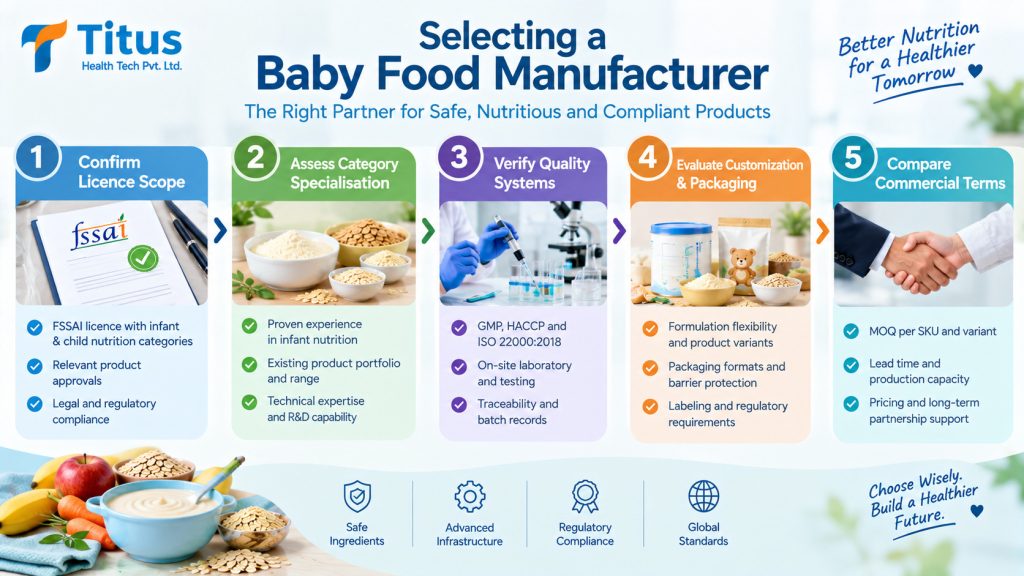
Finding a top baby food manufacturer is the single decision that determines whether an infant nutrition brand can scale, pass audits and hold shelf space. Baby cereals, milk-based complementary foods and toddler nutrition are governed by dedicated Indian regulations, and the technical gap between a competent plant and an average one is wide. This guide walks through the evaluation in the order a buyer should actually run it: understanding what is at stake, checking capability, verifying compliance, assessing customization and packaging, and finally comparing shortlisted suppliers using criteria that hold up under scrutiny.
Baby food is a trust category. Parents cannot evaluate nutrient content, contamination risk or ingredient provenance themselves, so they buy the brand and, indirectly, the factory behind it. That places unusual weight on a sourcing decision that some brands still make on price alone, and it is why the search for a top baby food manufacturer deserves a structured process.
Three factors make this category different from general food manufacturing. The consumer group is physiologically vulnerable, with immature gut and immune systems. The regulatory framework is prescriptive rather than advisory — composition, labelling and claims are all defined in law. And the ingredient set is demanding: cereals must be processed to be digestible, milk solids and micronutrient premixes must remain stable for the full shelf life, and moisture control is critical because these are low-moisture powders with high nutritional density.
A top baby food manufacturer understands all three and builds process controls around them. A weaker supplier treats baby cereal as a milling-and-blending job. The difference rarely shows up in the first sample; it shows up in batch-to-batch consistency, in stability at month twelve, and during a regulatory inspection.
Start with category fit when screening any top baby food manufacturer. A plant that produces snacks, spices or general nutraceuticals and has added baby food as a sideline is structurally different from one built around infant nutrition. Ask what share of output is infant and child nutrition, and how long the plant has produced it.
Then assess these areas in sequence.
Among top baby food manufacturers in India, the strongest signal of technical depth is usually the existing product range. A company already producing multiple infant cereal and formula variants has solved the formulation, stability and packaging problems at least once, which is why buyers comparing top baby food manufacturers in India should begin with the catalogue rather than the credentials page. Most established top baby food manufacturers in India will also share batch documentation from existing lines on request.
Compliance in this category is specific, and generic food safety certification alone is not sufficient evidence that a top baby food manufacturer is operating correctly.
Products for infant nutrition in India fall under the Food Safety and Standards (Foods for Infant Nutrition) Regulations, which define compositional requirements, permitted additives and labelling rules for infant milk substitutes, infant foods and processed cereal-based complementary foods. Applicable Bureau of Indian Standards specifications — including IS 11536 for processed cereal-based complementary foods and IS 1547 for infant milk food — set the technical baseline. The Infant Milk Substitutes, Feeding Bottles and Infant Foods Act also restricts how these products can be promoted, which affects packaging and marketing claims directly. The current framework is published by the Food Safety and Standards Authority of India.
Beyond statutory requirements, a credible baby food manufacturer India buyers can rely on will hold and be able to evidence the following:
Ask any baby food manufacturer India based to show certificates with scope and validity, a recent internal audit report, and the batch release procedure. Titus Health Tech publishes its quality policy and operates a facility certified to GMP, ISO 22000:2018 and HACCP — the kind of documentation that should be available before an audit, not only during one.
Once a supplier clears compliance, evaluate what they can actually build for you. This is where a top baby food manufacturer demonstrates range rather than simply capacity.
Formulation flexibility varies widely. Some manufacturers offer catalogue products only. Others adjust an existing base — cereal blend, sweetener system, flavour, protein source or micronutrient levels. A smaller group will co-develop against your specification with bench trials and stability studies. Establish which level you are buying before discussing price, because the three are not comparable.
Process capability determines what formats are possible. Roller drying and extrusion produce different textures and reconstitution behaviour in cereals; spray drying is standard for milk-based powders. A manufacturer running both wet-mix and dry-blend routes can offer more formulation options than one limited to blending.
Packaging affects shelf life, cost and minimum order quantity simultaneously. Metal tins give the highest barrier and premium presentation; mono-cartons with a printed inner liner balance cost and protection for mainstream retail; sachets and stick packs suit sampling and market entry. Packaging material minimums, not powder batch size, often set the real MOQ, and any baby food manufacturer India based should quote them separately.
Commercial model is the last variable. A private label baby food manufacturer supplies an existing formulation under your brand, which is the fastest and lowest-cost route to market. A third party baby food manufacturer can instead develop to your specification, which costs more and takes longer but produces genuine differentiation. Many suppliers, including Titus Health Tech’s private labelling division, operate as both a private label baby food manufacturer and a third party baby food manufacturer, so ask which route a quotation refers to.
Compare shortlisted suppliers against consistent criteria rather than against their own sales narratives. No single top baby food manufacturer wins on every dimension, so weight the criteria to your own business model. The table below sets out what to weigh, and what a strong answer looks like.
| Evaluation criterion | What to verify | Why it matters |
| Licence and certification scope | Infant nutrition categories named on the FSSAI licence; GMP, HACCP, ISO 22000 with the site in scope | Generic food certification does not cover this category’s specific obligations |
| Category specialisation | Share of output that is infant and child nutrition; years in the category | Specialised plants have already solved the category’s technical problems |
| R&D capability | In-house technologists, bench trials, stability study protocol | Determines whether you get differentiation or a relabelled catalogue product |
| Laboratory and testing | On-site chemistry and microbiology; outsourced tests identified | Affects batch release speed and problem diagnosis |
| Capacity and headroom | Current utilisation and ability to absorb peaks | Prevents your supplier becoming your growth ceiling |
| Documentation support | CoA, composition certificates, stability data, export dossiers | Required for retail listings, tenders and overseas registration |
| Commercial terms | MOQ per SKU, lead time by phase, pricing revision mechanism | Decides whether the technical fit is commercially workable |
Run this as a scored comparison. The best baby food manufacturer for a premium export brand is not necessarily the best baby food manufacturer for a regional value range, and the criteria should be weighted accordingly. Visit the site before signing if at all possible — an hour in the plant reveals more about a baby food manufacturing company India based than any amount of correspondence.
Titus Health Tech Pvt. Ltd. is a nutrition products manufacturer based in Gandhinagar, Gujarat, producing infant milk formula, baby cereals, family nutrition and sports nutrition powders. The company was founded by professionals with research backgrounds and organises its portfolio into four divisions, including SATVA for baby cereals and DUGDHA for infant milk formula.
For brands assessing a baby food manufacturing company India wide, several attributes are worth weighing carefully: a facility certified to GMP, ISO 22000:2018 and HACCP; an existing multi-variant infant nutrition range rather than an occasional category; established private label and contract manufacturing programmes; and experience supporting partners in export markets, which brings documentation discipline into everyday production. As a baby food manufacturing company India brands and overseas partners both work with, details of the manufacturing infrastructure are published so buyers can assess technical fit early in the process.
Check that the FSSAI license explicitly covers the infant and child nutrition categories you plan to sell. license scope is the one item that cannot be worked around, and confirming it early prevents wasted evaluation of otherwise capable plants.
A private label baby food manufacturer supplies an existing formulation under your brand, which is faster and cheaper. A third party baby food manufacturer develops a product to your specification, giving differentiation at higher cost and longer timelines. Choose based on how much your positioning depends on formulation.
A category-specific FSSAI license is mandatory. GMP, HACCP and ISO 22000:2018 demonstrate systematic control, and BIS standard compliance applies to the product itself. Verify that certificates name the exact production site that will run your batches.
MOQ is driven by blending and drying batch sizes, micronutrient premix procurement lots, and packaging material minimums. Printed packaging frequently sets the floor, so request MOQ separately for every SKU, variant and pack size rather than a single figure.
Timelines run in phases: formulation approval, raw material and premix procurement, artwork and packaging production, trial batch, production batch and laboratory release. Repeat orders are much faster since development, artwork and supplier qualification are already complete.
Experienced manufacturers provide composition certificates, free sale certificates, stability data and process descriptions needed for overseas product registration. Ask which destination markets they have already registered products in, as prior experience substantially shortens the process.
Ownership depends entirely on the manufacturing agreement, so settle it before development begins. Define who holds the formulation and technical dossier, whether any exclusivity applies, and what happens to both if the relationship ends.
Choosing well in this category is a matter of sequence and evidence. Confirm license scope and certification against the actual production site, judge category specialisation by the existing portfolio rather than the pitch, establish how much formulation support you are really buying, and settle packaging, MOQ and lead time before artwork is approved. A top baby food manufacturer will welcome that scrutiny; a supplier who resists it has told you something useful.
If you are shortlisting suppliers, review each candidate’s existing infant nutrition range, certification scope and customization options side by side before requesting quotations. To discuss formulation, packaging or quantity requirements for your brand, explore the Titus Health Tech baby cereal and infant formula range or contact the team directly.
WhatsApp us