
Table of Contents
FSSAI Rules for Infant Formula Regulations in India…………………………………………………………………… 1
Why the FSSAI Infant Formula Regulations Exist…………………………………………………………………………… 3
The Legal Framework: IMS Act India and FSSAI Regulations Together……………………………….. 3
FSSAI Infant Milk Substitute Rules Manufacturers Must Follow………………………………………………. 3
Infant Formula Labelling Rules India: What Must Appear on the Pack………………………………… 4
FSSAI Baby Food Regulations for Complementary and Follow-Up Products…………………….. 4
Infant Formula Compliance India: Manufacturing and Quality Considerations…………………. 5
Infant Milk Food FSSAI Standards: Nutritional Benchmarks…………………………………………………….. 5
The Role of Experienced Manufacturers in Sustaining Compliance……………………………………….. 5
Conclusion………………………………………………………………………………………………………………………………………………………. 5
Frequently Asked Questions……………………………………………………………………………………………………………………. 6
1. What are the FSSAI infant formula regulations based on?………………………………………………. 6
2. Is prior approval required before selling a new infant formula product in India?.. 6
3. What does the IMS Act restrict for infant formula manufacturers?…………………………….. 6
4. Are follow-up formula and baby cereals covered under the same rules?………………… 6
5. What warning statement is mandatory on infant formula packaging?……………………….. 6
6. How often are FSSAI’s infant nutrition standards updated?…………………………………………… 6
7. Can a contract manufacturer help a brand stay compliant with these regulations? 6
8. Where can manufacturers find the official infant nutrition regulations?…………………… 6
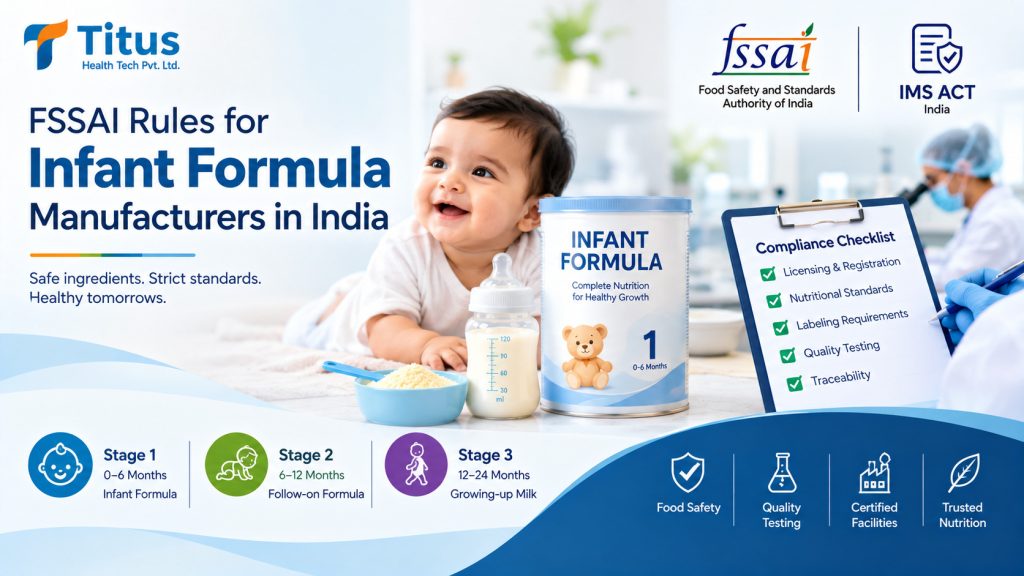
India’s infant nutrition category is closely supervised, and every manufacturer entering this space must build production, labelling and marketing practices around the FSSAI infant formula regulations that govern the sector. These FSSAI infant formula regulations protect newborns, support breastfeeding, and ensure that any infant milk substitute reaching the market meets defined nutritional and safety benchmarks. For companies such as Titus Health Tech, which manufactures infant milk formula under its Dugdha division, working within the FSSAI infant formula regulations is a foundational part of everyday manufacturing, not a one-time formality.
This article outlines the FSSAI infant formula regulations shaping infant formula manufacturing in India, the key statutes involved, and how manufacturers stay compliant.
Infant formula is consumed by a population that cannot evaluate food safety independently, so the FSSAI infant formula regulations are stricter than standards for general packaged foods. The intent is threefold: guarantee nutritional adequacy for infants who are not exclusively breastfed, prevent marketing that could discourage breastfeeding, and hold manufacturers accountable for consistent quality across every batch. Any company manufacturing or marketing infant milk substitutes in India must operate within the FSSAI infant formula regulations from ingredient sourcing through to final packaging.
Two connected legal instruments define how infant nutrition products are produced, labelled and sold. Understanding both matters when researching ims act india requirements alongside FSSAI’s food safety standards.
Together, these frameworks form the backbone of the FSSAI infant formula regulations that every manufacturer, including private label partners, must build compliance systems around. The official text published by the Food Safety and Standards Authority of India defines infant formula as a breast milk substitute product based on milk of cow, buffalo or other milch animals, formulated to meet infant nutritional needs during the first six months, as set out in the FSSAI compendium on foods for infant nutrition. Any company navigating ims act india obligations needs documented internal processes rather than informal checks, since the ims act india provisions carry penalties for non-compliance.
The fssai infant milk substitute rules cover far more than nutrient composition. Manufacturers must control raw material quality, processing hygiene, packaging integrity and finished-product testing. The table below summarises how these FSSAI infant formula regulations map across the product lifecycle.
| Compliance Area | What It Covers | Manufacturer Responsibility |
| Raw Material Sourcing | Milk solids, vegetable oils, vitamins, minerals | Verified supplier documentation, incoming checks |
| Formulation Standards | Energy, protein, fat, DHA/ARA ratios | Adherence to 2020 nutrient limits |
| Processing Hygiene | Spray drying, blending, packing environment | GMP and HACCP-aligned practices |
| Labelling & Packaging | Warnings, composition, batch details | Compliance with IMS Act and labelling rules |
| Post-Market Surveillance | Batch traceability, complaint handling | Documented recall systems |
Manufacturers that treat the fssai infant milk substitute rules as an ongoing discipline, rather than a one-time approval exercise, sustain compliance more reliably across product lines.
Among the most visible aspects of the FSSAI infant formula regulations are the infant formula labelling rules india enforced through the IMS Act, designed to ensure caregivers receive clear, non-misleading information.
Following the infant formula labelling rules india protects both consumers and manufacturers, since violations can trigger recalls or licence suspension.
Beyond infant formula, the fssai baby food regulations extend to follow-up formula, milk-cereal-based complementary foods and foods for special medical purposes intended for infants. Each category carries its own compositional standards under the 2020 regulations. Manufacturers producing baby cereals alongside infant milk formula, as Titus Health Tech does through its Satva division, must align practices across categories to stay consistent with the wider FSSAI infant formula regulations, since the fssai baby food regulations and formula-specific rules work together rather than in isolation.
Achieving infant formula compliance india requires infrastructure purpose-built for infant nutrition rather than adapted from general food lines. Facilities need controlled environments for spray drying and blending, validated cleaning-in-place systems, and laboratory capability for nutritional and microbiological testing. Titus Health Tech’s facility, certified under GMP, ISO 22000:2018 and HACCP, reflects the infrastructure that supports consistent adherence to the FSSAI infant formula regulations across every production run, whether for its own Triomil range or for partners pursuing infant formula compliance india at scale.
Manufacturers building infant formula compliance india into their FSSAI infant formula regulations checklist typically maintain:
The infant milk food fssai standards prescribe nutrient ranges so infant formula can safely substitute for or supplement breast milk when required. Ready-to-consume infant formula must supply a defined energy range per 100 ml, along with regulated protein, essential fatty acid, vitamin and mineral levels. These parameters are periodically reviewed, so manufacturers must continuously track updates to the FSSAI infant formula regulations rather than rely on one-time approval. Broader nutrition benchmarks published by the ICMR-National Institute of Nutrition inform the scientific context around infant feeding generally, even though the infant milk food fssai standards remain the binding legal reference for formula composition specifically.
Consistent compliance with the FSSAI infant formula regulations depends on manufacturing experience and scientific capability. Titus Health Tech Pvt. Ltd., based in Gandhinagar, Gujarat, has built its infant nutrition manufacturing around dedicated quality processes, GMP and HACCP-certified production, and a formulation team focused on infant and family nutrition. As a private label and contract manufacturer, Titus Health Tech works with businesses needing a partner capable of sustaining the FSSAI regulations across formulations, packaging formats and export markets.
Brands evaluating a manufacturing partner for infant nutrition products are welcome to connect with Titus Health Tech to discuss formulation support, private label manufacturing and regulatory documentation before finalising a production partnership.
Navigating the FSSAI infant formula regulations requires more than a single certification; it demands sustained attention to formulation science, labelling accuracy, manufacturing hygiene and post-market accountability. Manufacturers who embed the FSSAI infant formula regulations into daily operations, rather than treating them as periodic audits, are better placed to deliver safe, compliant products consistently. Titus Health Tech continues operating its infant formula manufacturing within this regulatory framework, supporting private label partners who need dependable compliance alongside consistent quality.
They rest primarily on the Food Safety and Standards (Foods for Infant Nutrition) Regulations, 2020, along with the IMS Act, 1992, which together govern composition, safety and marketing of infant formula in India.
Yes. Any infant milk substitute whose standards are not already specified under FSSAI regulations requires prior approval from the Food Authority before manufacture or sale.
It restricts advertising of infant milk substitutes to the general public, bans inducements to healthcare workers, and mandates specific warning statements on every pack.
Yes, under the same FSSAI infant formula regulations umbrella. Follow-up formula, milk-cereal-based complementary foods and special medical purpose foods for infants fall under the 2020 regulations, though each has distinct compositional standards.
Every pack must carry a statement that mother’s milk is best for the baby, along with an advisory that the product be used only on a health worker’s recommendation.
FSSAI periodically reviews and amends nutrient and safety parameters for infant nutrition foods to reflect current science, so manufacturers must track updates continuously.
An experienced contract or private label manufacturer with GMP, ISO 22000 and HACCP-certified facilities can support formulation, documentation and quality processes aligned with FSSAI’s expectations.
The complete regulatory text is published on FSSAI’s official website and should be treated as the authoritative reference for compliance planning.
WhatsApp us