
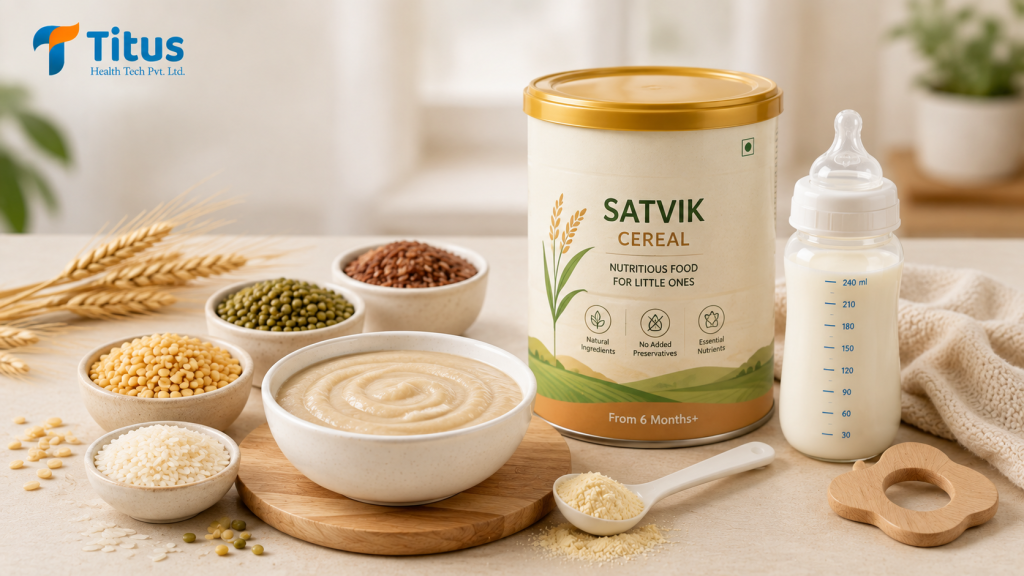
Entering the baby cereal category requires more than a good recipe idea. It demands a dependable infant cereal manufacturer in India who understands nutritional science, regulatory compliance, and the operational discipline needed to produce safe, consistent food for infants. At Titus Health Tech, our SATVA division specialises in exactly this, helping brands launch trusted, wholesome baby cereal lines backed by scientific formulation and certified manufacturing standards.
In this article, we explore what to look for when selecting a manufacturing partner for your baby cereal line, the production process involved, and why the right partner can make all the difference to your brand’s success.
India’s baby food market has seen consistent growth as more parents shift toward fortified, ready-to-cook cereal options for weaning and toddler nutrition. Increasing awareness about balanced early childhood nutrition, combined with busier urban lifestyles, has fuelled demand for convenient, nutritionally complete baby cereals that parents can trust.
This growth has created significant opportunity for new and existing nutrition brands, but it has also raised consumer expectations. Parents today actively compare ingredient quality, fortification levels, and manufacturing transparency before choosing a brand, making the choice of manufacturing partner more important than ever.
E-commerce has also played a meaningful role in this shift, giving smaller and newer baby food brands direct access to consumers without needing extensive retail distribution networks from day one. This has lowered the barrier to entry for entrepreneurs, but it has simultaneously increased competition, making product quality and manufacturing credibility even more critical differentiators for standing out in a crowded digital marketplace.
An infant cereal manufacturer in India handles the complete production journey, from ingredient sourcing and formulation to processing, fortification, packaging, and quality testing. Reputable manufacturers work closely with brand owners to design cereal blends that meet age-specific nutritional requirements while complying with FSSAI regulations governing infant and toddler food products.
Beyond production, a good manufacturing partner also supports brands with documentation, labelling compliance, and shelf-life validation, ensuring the final product is not only nutritious but also fully market-ready and legally compliant for sale across India.
Always confirm that your prospective baby cereal manufacturer holds FSSAI licensing along with GMP, ISO 22000, and HACCP certifications. These standards confirm rigorous hygiene, traceability, and food safety practices throughout the production process, which is non-negotiable when manufacturing food for infants.
Infant cereals require precise fortification with essential vitamins, minerals, and proteins to support healthy growth. A manufacturer with dedicated research and development capabilities can help you design a formulation that balances nutritional completeness with taste and texture that infants actually accept well.
Ask your manufacturing partner about their raw material sourcing practices. Traceable, quality-tested ingredients are essential for building consumer trust, particularly in a category as sensitive as infant nutrition, where parents scrutinise every ingredient on the label closely.
Ensure your chosen partner can accommodate your order volumes, whether you are launching a small test batch or scaling toward nationwide distribution, without significant delays that could disrupt your go-to-market timeline.
The process starts with formulation, balancing grains, pulses, and fortificants to create a nutritionally complete product tailored to specific age groups, from early weaning stages through toddlerhood.
Ingredients undergo careful processing, including roasting, milling, and blending, followed by precise fortification to meet regulatory nutrient benchmarks. Every step is monitored to preserve nutritional integrity while achieving the right texture and solubility for easy preparation.
Before packaging, each batch undergoes microbiological and nutritional testing to confirm safety and compliance. Packaging is then designed to preserve freshness while clearly displaying mandatory nutritional information, preparation instructions, and safety guidelines required under Indian food regulations.
Among the many formulation approaches available today, satvik cereal has gained particular attention for its emphasis on natural, minimally processed ingredients rooted in traditional Indian nutrition philosophy. Brands exploring this positioning often partner with manufacturers experienced in Satvik-style formulations to appeal to parents seeking wholesome, purity-focused baby food options.
This approach resonates strongly with Indian consumers who value traditional nutritional wisdom alongside modern food safety standards, making it a compelling positioning strategy for new baby cereal brands entering a crowded market.
Packaging plays a bigger role in baby cereal manufacturing than many new brand owners initially realise. Moisture-resistant, food-grade packaging is essential to preserve the nutritional integrity and freshness of fortified cereal blends over their intended shelf life, particularly in India’s varied climatic conditions across different regions.
Your manufacturing partner should conduct shelf-life validation testing for every formulation, confirming exactly how long the product retains its nutritional value and safety under real-world storage conditions. This data is not just a regulatory requirement, it directly affects your brand’s credibility if a product underperforms once it reaches store shelves or a parent’s kitchen shelf.
In a category where parents are feeding products directly to infants, transparency is one of the most powerful brand-building tools available. Brands that openly share information about their manufacturing partner’s certifications, testing protocols, and ingredient sourcing tend to build stronger, longer-lasting customer loyalty than those relying purely on marketing claims.
Consider working with your infant cereal manufacturer in India to develop clear, honest packaging communication and supporting digital content that explains your formulation choices. This approach not only builds trust but also differentiates your brand in an increasingly crowded and competitive baby food market.
Brands that partner with inexperienced or under-certified manufacturers often face inconsistent product quality, failed regulatory inspections, or delayed launches due to incomplete documentation. These issues can damage brand credibility significantly, particularly in a trust-sensitive category like infant nutrition where a single quality lapse can affect years of reputation building.
Choosing a manufacturer with a proven track record in infant cereal production specifically, rather than general food manufacturing experience, significantly reduces these risks and ensures a smoother path from concept to shelf.
It is also worth asking prospective partners for case studies or examples of brands they have previously helped launch. A manufacturer confident in their process and track record will typically be happy to share this information, while vague or evasive answers to straightforward questions can be an early warning sign worth taking seriously before committing to a long-term partnership.
Infant nutritional needs change rapidly during the first two years of life, which means a single generic cereal formula rarely serves a brand’s full target audience well. Early weaning cereals typically require finer textures and simpler ingredient profiles, while toddler-stage cereals can incorporate more complex grains, added protein sources, and bolder flavour profiles.
A capable baby cereal manufacturer will guide you through developing a formulation roadmap across these different age stages, rather than offering a one-size-fits-all product. This approach allows your brand to grow with its customers, introducing new products as children progress through different developmental stages, while maintaining consistent brand trust built on your very first product launch.
As your baby cereal brand grows, you may look beyond domestic retail into modern trade, e-commerce, or even export markets. A manufacturer experienced in producing for diverse distribution channels will understand the differing packaging, labelling, and documentation requirements each channel demands, saving your team significant time and reducing compliance risk.
Manufacturers with prior export experience are particularly valuable here, since international markets often impose additional certification and testing requirements beyond what is mandated domestically. Partnering with a manufacturer already familiar with these processes positions your brand for smoother expansion when the time comes.
Our SATVA division brings together scientific formulation expertise, certified manufacturing infrastructure, and a genuine commitment to wholesome infant nutrition. With GMP, ISO 22000, and HACCP-certified facilities, we help brands across India launch baby cereal lines that meet the highest safety and nutritional standards.
We work closely with each brand partner to understand their positioning, whether focused on fortified nutrition, traditional formulation approaches, or specific dietary requirements, and translate that vision into a market-ready product supported by rigorous quality control at every stage.
Ready to launch your baby cereal brand with a manufacturing partner you can trust? Contact our team today to discuss your formulation requirements and take the first step toward building a trusted nutrition brand.
Choosing the right infant cereal manufacturer in India is one of the most important decisions you will make when building a baby food brand. From certifications and formulation expertise to ingredient sourcing transparency and production capacity, every factor plays a role in determining whether your product earns and keeps parents’ trust. A dependable manufacturing partner does more than produce your cereal, it becomes a genuine extension of your brand’s commitment to infant health and safety. With the right partner by your side, you can confidently bring a nutritious, compliant, and market-ready baby cereal line to India’s growing families.
1. What does an infant cereal manufacturer in India typically offer?
They handle formulation, fortification, processing, packaging, and regulatory compliance, allowing brands to launch baby cereal products without building in-house production facilities.
2. What certifications should I look for in a baby cereal manufacturer?
Look for FSSAI licensing along with GMP, ISO 22000, and HACCP certifications, which confirm strict food safety and hygiene standards throughout production.
3. Can I customise the recipe for my baby cereal brand?
Yes, reputable manufacturers offer formulation customisation, including ingredient selection, fortification levels, and flavour profiles tailored to your target age group.
4. What is satvik cereal and why is it popular?
Satvik cereal refers to baby food made with natural, minimally processed ingredients rooted in traditional Indian nutrition philosophy, appealing to purity-focused parents.
5. How long does it take to launch a private label baby cereal product?
Most brands can launch within three to five months, depending on formulation complexity and regulatory documentation requirements.
6. Is there a minimum order quantity for infant cereal manufacturing?
Yes, though minimum order quantities vary by manufacturer, many offer flexible options to support smaller and first-time nutrition brands.
7. Why is ingredient sourcing transparency important for baby cereals?
Transparent sourcing builds consumer trust and ensures traceability, which is essential for a sensitive category like infant nutrition where safety is paramount.
WhatsApp us