
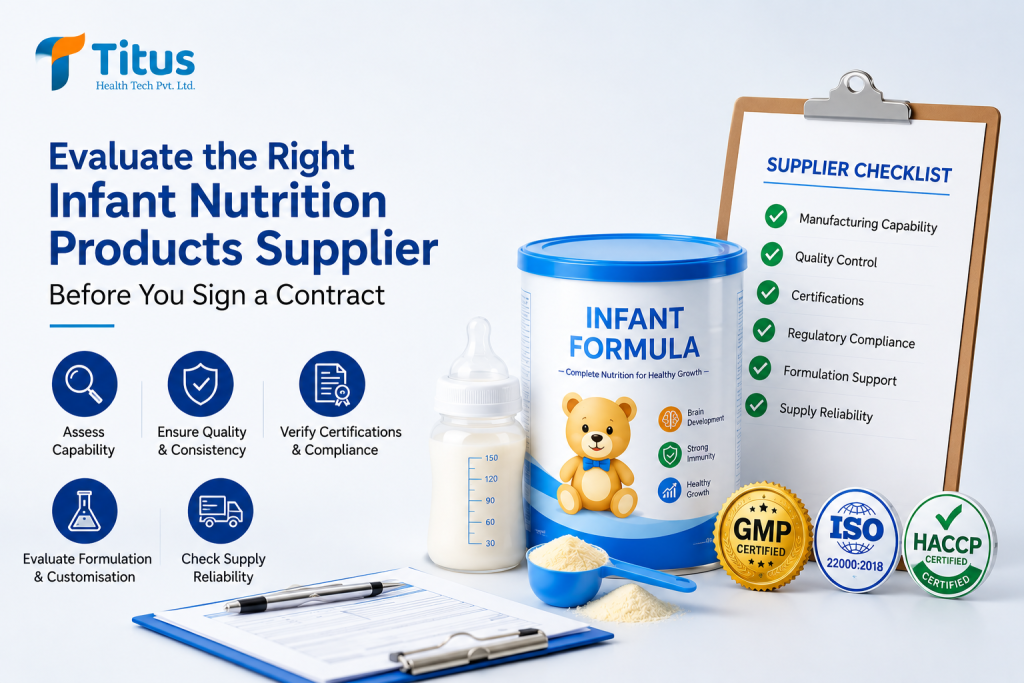
Launching an infant formula brand does not require owning a factory. It requires finding one that can produce to specification, document what it produces, and keep doing both as volumes grow. That is the appeal of infant milk formula private label manufacturing: the brand owns positioning and distribution, while a qualified manufacturer handles formulation, production and compliance. Businesses exploring this route can review the private labeling options available before approaching the market.
The model carries a dependency. Quality, consistency, documentation and supply reliability sit with a third party, so anyone considering infant milk formula private label manufacturing should evaluate systems, compliance, formulation capability and capacity before signing.
In infant milk formula private label manufacturing, a producer makes a finished product sold under your brand name. You define specification and market position; the manufacturer supplies formulation, production, testing and documentation.
The alternative is owning a facility, requiring capital, licensing, technical staffing and ongoing compliance. For most brands entering infant nutrition that commitment is disproportionate to the opportunity.
The division of responsibility is simple in principle. The manufacturer is accountable for what is inside the pack; the brand for how it reaches consumers. Problems arise where that boundary is undefined, which is why documented agreements matter more here than in most sourcing arrangements.
Infant milk formula private label manufacturing follows a predictable sequence, though timelines vary by product and market.
Define what you are asking for: product type and stage, target consumer, nutritional specification, ingredient restrictions, pack size and the regulatory requirements of each market you intend to supply.
Vagueness causes the most rework later. No infant milk formula private label manufacturing programme develops well against an incomplete brief, and specifications added after trial batches usually mean starting again.
The manufacturer translates the brief into a workable formulation, then produces trial batches. Expect iteration on dispersibility, taste, appearance and stability.
Ask how many revisions are included and who owns the formulation. Stability testing determines the shelf life you can legitimately declare, and it takes real time. Any figure offered before testing is an estimate, not a claim.
Production covers raw material qualification, in-process controls at blending and filling, finished-product testing against release criteria, and traceability from ingredient lot to pack.
Batch consistency matters more than peak quality in infant milk formula private label manufacturing. Distributors judge your brand on repeatability, so ask what is measured, how often, and what happens when a result drifts.
Infant formula powder is hygroscopic and oxygen-sensitive, so packaging protects the product rather than presenting it. Clarify pack formats, barrier properties, sealing integrity and tamper evidence.
Labelling carries regulatory weight in infant milk formula private label manufacturing. Confirm who is responsible for artwork accuracy, mandatory declarations and language requirements in each destination market.
Businesses select baby milk formula private label production for several practical reasons:
These advantages are real but conditional. Baby milk formula private label arrangements do not automatically reduce cost or guarantee a rapid launch, since development, stability testing and registration take time regardless of who manufactures. What the model offers is access to capability you would otherwise build.
Several qualities separate capable partners in infant milk formula private label manufacturing from adequate ones.
Equipment determines what can be produced. Spray-drying, dry blending and packing lines each limit format and pack size. Assess hygiene zoning, facility design, equipment condition and category experience. Reviewing the manufacturing infrastructure in person reveals more than a capability document.
Ask about raw material testing, in-process controls, release testing, batch records, traceability and complaint handling. A partner in infant milk formula private label manufacturing that cannot describe its own controls is unlikely to apply them consistently.
Verify current certificates, validity dates and scope, since a logo proves nothing about present status. Titus Health Tech operates a facility certified under GMP, ISO 22000:2018 and HACCP, and its quality policy sets out the framework applied in production. Request market-specific documentation early, since delays in infant milk formula private label manufacturing usually trace to paperwork rather than production.
In-house development shortens cycles in infant milk formula private label manufacturing, because trial and correction happen internally. Ask who performs formulation work and what technical support continues after launch.
Current capacity is only half the question. Ask about installed capacity, utilisation, batch sizes and how production is prioritised at peak demand. A partner comfortable at trial volumes may struggle with a national order, which is where many infant milk formula private label manufacturing relationships fail.
Ask how suppliers are qualified and whether approved alternatives exist for critical ingredients. In infant milk formula private label manufacturing, single-source dependency becomes your stockout when an ingredient runs short.
Technical communication is a genuine differentiator. Assess response times, documentation quality and willingness to explain problems honestly during evaluation, since that behaviour rarely improves later.
Compare on evidence rather than presentation. Quality systems, infrastructure, experience, formulation support, documentation, capacity, lead times and order quantities vary considerably between suppliers that look similar on paper.
Total cost matters more than unit price in infant milk formula private label manufacturing. Development charges, sampling, artwork, testing, minimum quantities and freight all move the real figure, and two quotations rarely cover the same items. The lowest frequently reflects thinner specification or weaker testing.
Experience shows in the problems a manufacturer anticipates rather than those it solves afterwards. A team producing infant nutrition for years knows which formulations behave predictably at scale, which ingredients complicate processing and what documentation regulators request.
That knowledge affects development speed, quality consistency, supply planning and problem resolution across any infant milk formula private label manufacturing programme.
Buyers searching for the largest private label infant formula manufacturer in India usually want something more specific than size: capacity that will not run out, systems that hold up under scrutiny, and a team that responds when something goes wrong. Scale can indicate those attributes without confirming them, so verify capability directly rather than ranking by the largest private label infant formula manufacturer in India label.
Titus Health Tech Pvt. Ltd. is a nutrition products manufacturer in Gandhinagar, Gujarat, operating four divisions covering infant milk formula, baby cereals, family nutrition powders and sports nutrition. Its infant formula range includes standard, premium and lactose-free variants, alongside a separate baby cereal range.
Founded by professionals with research backgrounds, the company provides private label, contract manufacturing and bulk supply with custom formulation support, and its facility is certified under GMP, ISO 22000:2018 and HACCP. Further background appears in the company overview. As with any prospective partner in infant milk formula private label manufacturing, verify current documentation and assess the facility against your own requirements.
Successful infant milk formula private label manufacturing depends on partner selection rather than product concept. Manufacturing capability, quality systems, regulatory understanding, formulation support, sourcing reliability, packaging and scalable production together determine whether a brand delivers consistently over several years.
Each factor is verifiable beforehand and expensive to discover afterwards. Anyone entering infant milk formula private label manufacturing should request documentation, visit the facility, examine line-produced samples and define responsibilities in writing.
If you are evaluating options for infant milk formula private label manufacturing, contact the Titus Health Tech team to discuss product requirements, custom formulation, private-label plans and contract manufacturing needs.
A manufacturer produces finished infant formula sold under your brand name. You define specification and positioning while the manufacturer handles production, testing and documentation.
Infant milk formula private label manufacturing removes the need to build a facility, provides technical expertise and development support, and concentrates resources on branding.
Requirements are defined, a formulation is developed and trialled, stability testing follows, then commercial production begins under agreed quality controls and documentation.
Before committing to infant milk formula private label manufacturing, verify certification validity and scope, quality procedures, capacity, formulation capability and documentation support.
Many can, within applicable standards. Confirm whether development is in-house, how many revisions are included and who owns the formulation once work is complete.
Look for recognised food-safety and manufacturing certifications appropriate to the category and destination market, and confirm current validity rather than relying on displayed logos.
Ingredient specification, pack format, order quantity, development work, testing and packaging complexity all influence the final figure alongside the base unit rate.
Compare quality systems, capacity, formulation support and documentation rather than price alone, then verify those claims through a facility visit and line-produced samples.
WhatsApp us